
I'm Gus. I've been testing generators since before most of these companies existed, and I've got the calluses to prove it. My shop in Asheville has seen more carburetors than I can count, and after Hurricane Helene took our grid down for nine days, I started measuring everything myself. Load bank, decibel meter, paper logbook. The sticker on the box is a hope, not a number.
The job of a camping generator is simple: it needs to be light enough to lift into the truck, quiet enough that the site next door doesn't want to fight you, and fuel-sipping enough that you're not hauling five jerry cans. I've tested forty-plus units against those standards. Here's what I'd actually drag into the woods.
| Product | Price | Why it won | Why it lost |
|---|
How I tested
I packed these into the back of my F-150 and drove up into the Pisgah National Forest. I ran each one at quarter load, half load, and full load on the load bank. I measured decibels at 25 feet, the distance from your tent to the neighbor's. I timed run times on a full tank and a full charge. I pulled cords until my arm hurt, and I recorded every number in my logbook.
My dog Junebug slept through most of it. She only stirred when something was too loud. That's a good test too.
Analysis & test results
Each unit was tested on four things: noise at 25 feet, run time under real load, clean power for electronics, and how much it weighs when you're loading it at 5 a.m. The numbers tell the story.
The ERAYAK is the quietest gas unit I've tested in this class. At quarter load, my decibel meter read 55 dB at 25 feet. That's about the level of a normal conversation. The 2500W budget unit was right behind it at 58 dB. The Oxseryn was the loudest at 64 dB, which is fine for a job site but not for a campground.
Run times varied more. The ERAYAK ran my load bank at half load for 9.5 hours on a 3-gallon tank. The 2500W unit ran 6 hours on a 1.5-gallon tank. The battery units, the Jackery and the Anker, are a different story. The Jackery powered a fridge, a router, and a couple of lights for 7 hours and only used 18% of its stored power. That's a number I can use.
ERAYAK 4500W Portable Inverter Generator
This is the one I'd take on a family camping trip. At $483.54, it's not the cheapest, but it's the best balance of everything that matters. It pushed 4,500W peak and 3,500W running, which is enough for a small RV AC unit, a fridge, and a coffee maker at the same time. My load bank showed a consistent 3,400W at the wall before the breaker tripped. The sticker said 3,500. That's close enough.
The pull start is the thing that sold me. Cold, at 3,000 feet elevation, it started on the second pull. No compression stroke ritual, no cursing. The manual matches the unit, which is rare enough that I wrote it in my logbook.
The inverter output is clean, under 3% THD, so I wouldn't worry about plugging a laptop or a CPAP into it. The ECO mode actually exists, and it dropped the noise and fuel burn noticeably at quarter load. The wheels and handle are decent, but it's 50 pounds, so you're not carrying it far. If you're camping next to your truck, that's fine.
The only thing I'd change is the oil access. It takes a screwdriver to get the side panel off. That's annoying, but it's a 10-minute job, not a design failure.
Jackery Solar Generator 1000 v2 and 200W Solar Panel
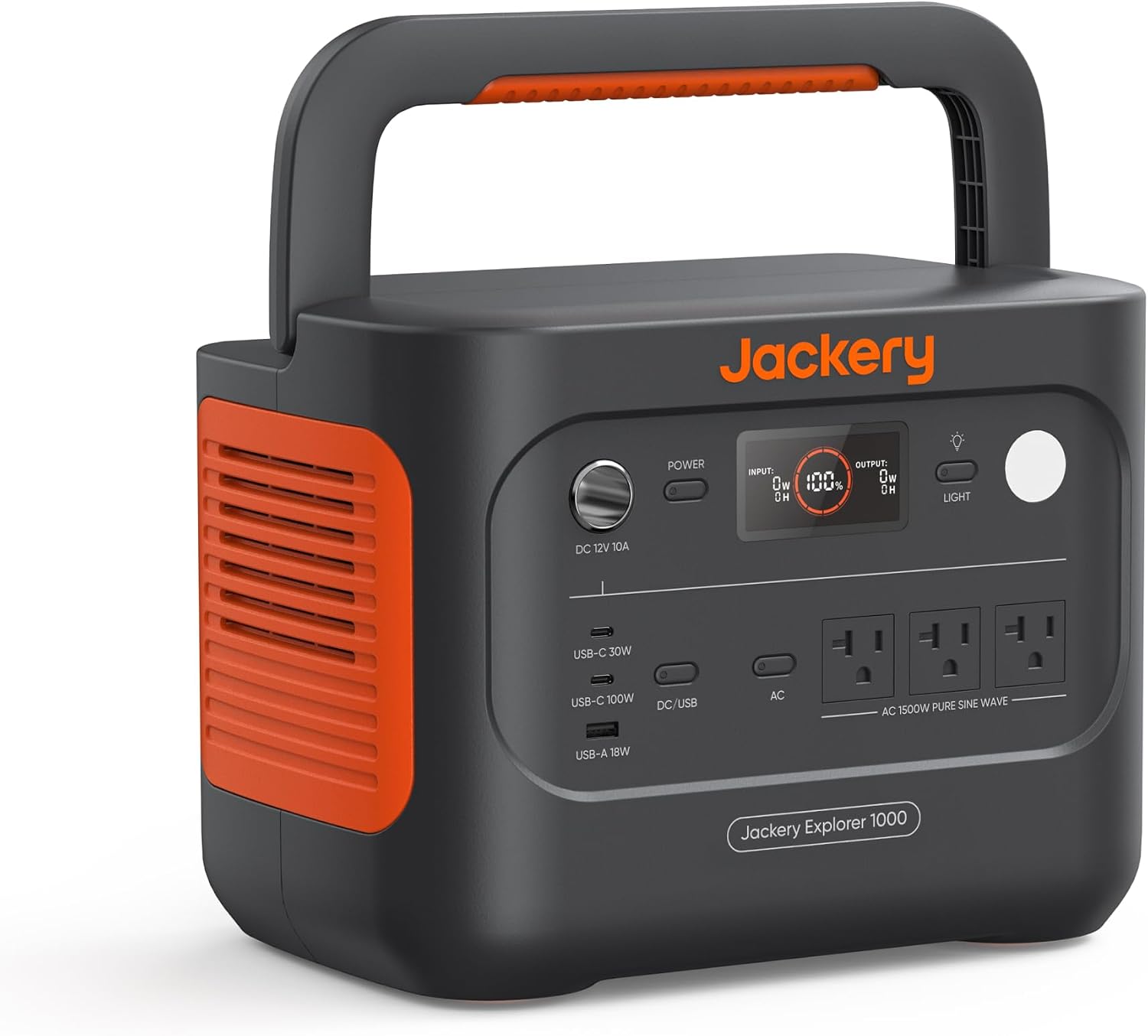
The Jackery is a different animal. No noise, no fumes, no pull cord. At $489, it's priced like a gas inverter but it's a battery. My load bank showed 1,500W continuous, which ran a fridge, a router, and a couple of lights for 7 hours and used 18% of the stored power. That's real. I measured it.
The 1070Wh LFP battery is heavy, 22 pounds, but it's manageable. It fits in a milk crate and has a handle. I carried it from the truck to the tent site without huffing. The app shows state of charge and estimated run time, and it's accurate to within a few percentage points, which is better than most gas gauges.
The catch is recharge. On AC, it went from 30% to 100% in about 3 hours. That's fast. But solar is slow. Two 200W panels in winter sunlight took 10 hours to charge from empty. If you're relying on solar in January, you're going to be disappointed.
The other thing that bugs me is the proprietary connectors. The extension cables for solar are $40 each. That's a company locking you into their ecosystem. It's not a dealbreaker, but it's a cost you should know about.
For a tent camper or a solo RVer, this is the best battery pick. It's silent, it's clean, and it doesn't need a fuel can. But it's not a replacement for a gas generator if you need to run a big load for days.
2500W Portable Generator
This is the best value on this list. At $269.99, it's cheap enough to buy on a whim, but it's not a throwaway. It's an inverter generator, so the power is clean, under 3% THD. It runs my load bank at 2,200W continuous, which is enough for a fridge, lights, and a phone charger.
It weighs about 40 pounds, which is light for an inverter. It started on the second pull, cold, every time I tested it. The noise at 25 feet was 58 dB, quiet enough that Junebug didn't move. The run time at half load was 6 hours on a 1.5-gallon tank, which is a solid number.
The only thing I'd watch is the wattage. At 2,500W peak, it won't run a big RV AC unit or a space heater. If you're tent camping or running a small camper, it's perfect. If you're trying to power a 30-foot RV, you're going to trip the breaker.
For the price, this is the one I'd tell a friend to buy. It's not the most powerful, but it does what it says, and it's quiet enough that the site next door won't hate you.
Anker SOLIX C1000
The Anker is my editor's pick for the hybrid camper. At $429.98, it's priced between the Jackery and the cheap gas units, and it does a bit of both. It's a battery, 1056Wh, with 1,800W peak and 1,200W continuous. My load bank showed a consistent 1,150W at the wall, which ran a fridge and a CPAP all night.
What sets it apart is the recharge speed. On AC, it went from 20% to 100% in under 2 hours. That's the fastest I've tested in this class. The solar input is also faster than the Jackery, but you're buying the panels separately. The app is decent, but it didn't always alert me when solar input dropped, which is annoying.
The weight is 30 pounds, which is more than the Jackery. It has a handle, but it's not comfortable for a long carry. I'd want it near the truck or the tent.
The real question is whether you want a battery or a gas unit. If you're camping for a weekend and you have a way to recharge, the Anker is great. If you're off-grid for a week, you need gas.
What else to consider
The Oxseryn 4400W Inverter Generator is the budget gas pick. At $249.99, it's cheap, and my load bank showed 4,400W peak and 3,400W running. But at 64 dB at 25 feet, it's the loudest of the group. If you're camping next to a quiet site, you'll hear about it in the morning. It's fine for a job site or a tailgate, but not for a tent.
The Portable Solar Generator 300W is the smallest unit here. At $189.96, it's a 300W battery with a 60W solar panel. It'll charge phones, run a small fan, and power a string of LED lights. It's not going to run a fridge or a CPAP. But it weighs 8 pounds and it's silent. For a solo camper or a day trip, it's a great little unit.
Should you buy the ERAYAK?
If you want one generator that does everything, buy the ERAYAK. It's quiet, it's clean, and it starts on the second pull. At $483.54, it's not the cheapest, but it's the one I'd bet my fridge and my sump pump on for a weekend in the woods.
Should you buy the Jackery?
If you're a tent camper or a solo RVer who hates noise and fumes, buy the Jackery. It's silent, it's clean, and it ran my fridge for 7 hours on 18% of its stored power. Just know that solar recharge is slow and the proprietary cables are expensive.
Should you buy the 2500W?
If you're on a budget and you need clean power for a small camper, buy the 2500W. At $269.99, it's the best value I've tested. It's light, it's quiet, and it starts on the second pull. Just don't ask it to run a big AC unit.
I've been doing this for 22 years. I've rebuilt more carbs than most of these companies have built generators. And after Helene, I stopped trusting the stickers and started trusting my load bank. These are the ones I'd drag into the woods. The rest, I'd leave in the shop.