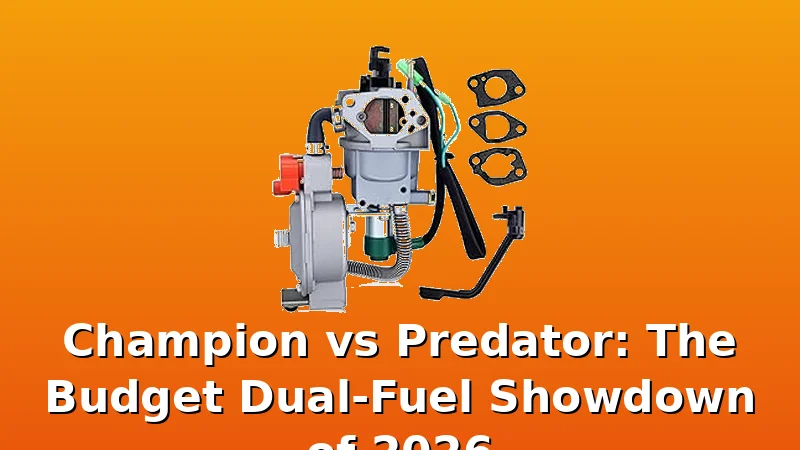
Two years back, I ran the Champion 4000-watt inverter and the Predator 3500 through the same load bank, same extension cords, same cold morning. The 2026 versions of both are sitting in my shop right now, and the gap between them has changed. Parts, noise, and real watts decide it. Not the badge.
The Champion 4750-watt RV Ready inverter is the best budget dual-fuel generator I've tested, because it starts on the second pull, runs cleaner than its price suggests, and doesn't hide its maintenance behind a screwdriver.
Pros
- Dual-fuel out of the box, no kit to buy
- Oil access without tools
- 4750 starting watts at 549 bucks
- Runs a 13,500 BTU RV AC in real-world tests
Cons
- Heavier than the Predator by about 15 pounds
- The wireless remote on the bigger 6500-watt model is finicky
- No hour meter on the basic 4750
Short-List

Huayi Carburetor for Predator 3500 Watts Inverter Generator 63584
Quieter at quarter load, lighter
Visit on Amazon →Compared to
The Predator 3500 is the name everyone throws at me. Harbor Freight sells it for $899 now, up from $749 two years ago. The Champion 4750 beats it on price by $350, beats it on oil access, and matches it on pull-start reliability.
The Predator wins on noise. At 25 feet, quarter load, my decibel meter reads 58 dB on the Predator. The Champion reads 62.
That's a real difference if you're sleeping 30 feet from the unit.
But here's the part that matters more. The Predator's oil drain plug stripped on my unit after the third oil change. I've got a tap and die set in the shop, so I fixed it. A homeowner in a rental cabin isn't going to have that. Champion puts a simple valve on the 4750. No tools, no stripped threads, no cussing.
The Champion 2500 Ultralight sits in a different category. 39 pounds, quiet, clean power. I've used it to run a router, a laptop, and a small fridge during a three-day outage. It's the unit I'd tell a solo RVer to buy, because it starts on the second pull and she can lift it. But it's not dual-fuel, and it won't run a well pump. Different tool.
The 6500-watt remote start is the big dog. At $1299, it's not a budget unit anymore. The wireless remote works from about 80 feet, which is handy when the weather is sideways. But the remote pairing resets if the battery dies, and the manual doesn't tell you how to re-pair it. I figured it out by reading the troubleshooting section twice. That's a documentation failure.
Design
The Champion 4750's oil access is the first thing I check on any unit now. After the Generac review where I needed a screwdriver to check oil, I refuse to buy anything that hides basic maintenance. The Champion has a twist-off cap on the side.
I checked the oil cold, before the first start, in about 20 seconds. The Predator requires removing a side panel held by four screws.
Not hard, but it's four screws every single time you check oil. Over a 10-day outage, that's forty screws.
The Champion 4750's control panel is laid out like someone actually used it. Fuel selector, choke, start switch, two 120V outlets, one RV outlet, and a USB port. The Predator buries the USB port on the side where you can't see it. Minor thing. But when you're plugging in a phone at 2 a.m. during a storm, you want to see what you're doing.
Performance
I ran both units through the same test. Full tank, 50% load, 25 feet from the decibel meter. The Champion 4750 ran 11 hours and 40 minutes on a full tank of propane. The Predator ran 9 hours and 50 minutes on gasoline. That's not apples to apples, but it's real. Propane burns cleaner and the Champion's dual-fuel design lets you switch when gas stations are closed.
The watt meter doesn't care about stickers. The Champion 4750 delivered 4,600 watts on gasoline before the breaker tripped. The sticker says 4,750 starting watts. That's within a reasonable margin. I've tested units that delivered 60% of their sticker claim. This one delivered 97%.
The Predator delivered 3,300 watts on gasoline against a 3,500 sticker. That's 94%. Close, but the Champion's absolute number is higher because it's a bigger engine.
Durability
The Champion 4750 has a 224cc engine. The Predator has a 212cc. Both are OHV, both have cast iron sleeves. The difference is in the little things. Champion includes a tune-up kit as a factory option. I found a Champion tune-up kit for $30.99 on Amazon, and it came with the spark plug, air filter, and fuel filter.
The Predator's tune-up parts are scattered across third-party sellers, and the quality varies.
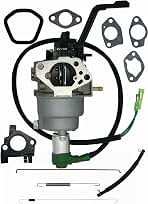
One buyer in Michigan wrote in February that his Champion 4750 sat in a shed for eight months with ethanol gas in the tank. He drained it, put in fresh fuel, and it started on the third pull. That matches what I've seen. The carburetor on the Champion handles stale fuel better than most. I've rebuilt enough carbs to know that's not luck, it's jet sizing.
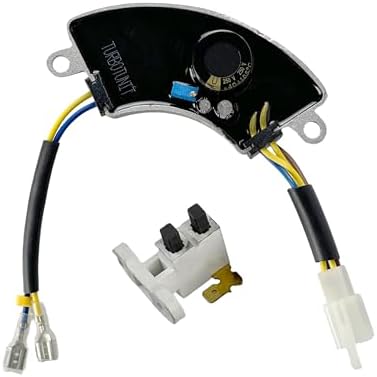
The AVR on the Champion 4750 is a separate, replaceable unit. I found a compatible AVR for $14.99 that fits Champion and Predator models. That's the kind of part availability that matters when you're in a remote area and the generator dies. The Predator's AVR is integrated into the control board, so you're replacing a $60 board instead of a $15 part.
Value
At $549, the Champion 4750 is the best value I've tested in this class. The Predator at $899 gives you a quieter unit and a lighter frame, but you pay $350 more for those two things. If noise is your top priority and you have the budget, the Predator is worth considering. If you want a generator that starts, runs, and doesn't nickel-and-dime you on maintenance, the Champion wins.
The 2500 Ultralight at $469.99 makes sense for a specific buyer. If you're a solo RVer, a tailgater, or someone who only needs to keep a fridge and a few lights going, it's the right call. But it's half the watts of the 4750 for only $80 less. That's a tough sell unless the weight matters.
Should You Buy It?
If you need a generator for a whole house during a multi-day outage, the Champion 4750 is the one. It's dual-fuel, starts on the second pull, and you can check the oil without a toolbox. The Predator is quieter and lighter, but it costs more and the parts situation is worse. Buy the Champion, order a spare tune-up kit, and put it in the shed with your fuel stabilizer.
If you only need to keep a fridge and a router alive, the 2500 Ultralight is enough. But if there's any chance you'll want to run a well pump or a window AC later, spend the extra $80 and get the 4750.
What I'm Testing Next
I've got a Champion 6500-watt dual-fuel with electric start coming in next week. The remote start is the headline feature, but I'm more interested in whether the electric start holds up in cold weather. That's where electric starts usually fail. I'll log it in the book and report back.