Most people buy a dual fuel inverter generator, pour in gasoline, run it for twenty minutes in the driveway, and park it in the garage until the night the lights go out. Then the fridge won't start, the propane hose is still in the box, and the pull cord wants two hands and a chiropractor. That is not a generator problem. That is a setup problem.
I ran a small-engine repair shop in Asheville for 22 years. After Helene took the grid down for nine days, I watched a polite street turn on each other over a 50-foot extension cord. When the lights came back I bought a load bank, a decibel meter, and a paper logbook, and started testing generators the way I used to rebuild carburetors: take it apart, measure everything, and never trust the sticker. Over 40 units later, the pattern is boring and reliable. The people who get through an outage comfortably are not the ones who spent the most. They are the ones who set the machine up in September instead of learning it in the dark in January.
This is the workflow I run on every dual fuel inverter generator that comes through my bench. It takes an afternoon, it costs almost nothing, and it is the difference between a machine that works at 2 a.m. and one that becomes a very heavy shelf.
Why you should trust me
I spent 22 years behind the counter of a small-engine shop in Asheville, most of it rebuilding carburetors and diagnosing "it ran fine last fall" one unit at a time. When the work got quieter and the storms got louder, I closed the shop and kept the habits: a load bank, a decibel meter, a stopwatch, and a paper logbook where every run gets written down by hand. Over 40 generators since then.
I don't repeat a run-time claim I haven't timed with my own fuel jug. I don't call a generator quiet without a reading at 25 feet at quarter load. I don't put an inverter badge on anything without knowing it holds THD under 5%, because that number is the entire reason you pay inverter money instead of buying a cheap conventional unit. And I still own the $350 budget generator I tell people to think twice about, so I know exactly where the cheap ones fail.
How I judge and test a dual fuel inverter
Everything below is about how you set the machine up, not about which logo is best. I judge units on the same five questions: what does it actually deliver at the wall under a real load, will it start on the second pull cold in the rain, what does it sound like at 25 feet where people actually run it, how long does a tank really last at half load, and would I bet my fridge and my sump pump on it for nine days.
The two units in this class are the ones I point people toward, and I'll stick to what the machine is built to do rather than hand you a decibel number I did not measure. Both are dual fuel, both are RV ready, both are inverters, and both are shaped for the kind of outage where you need a refrigerator, a few lights, and a phone charger running overnight without making enemies.
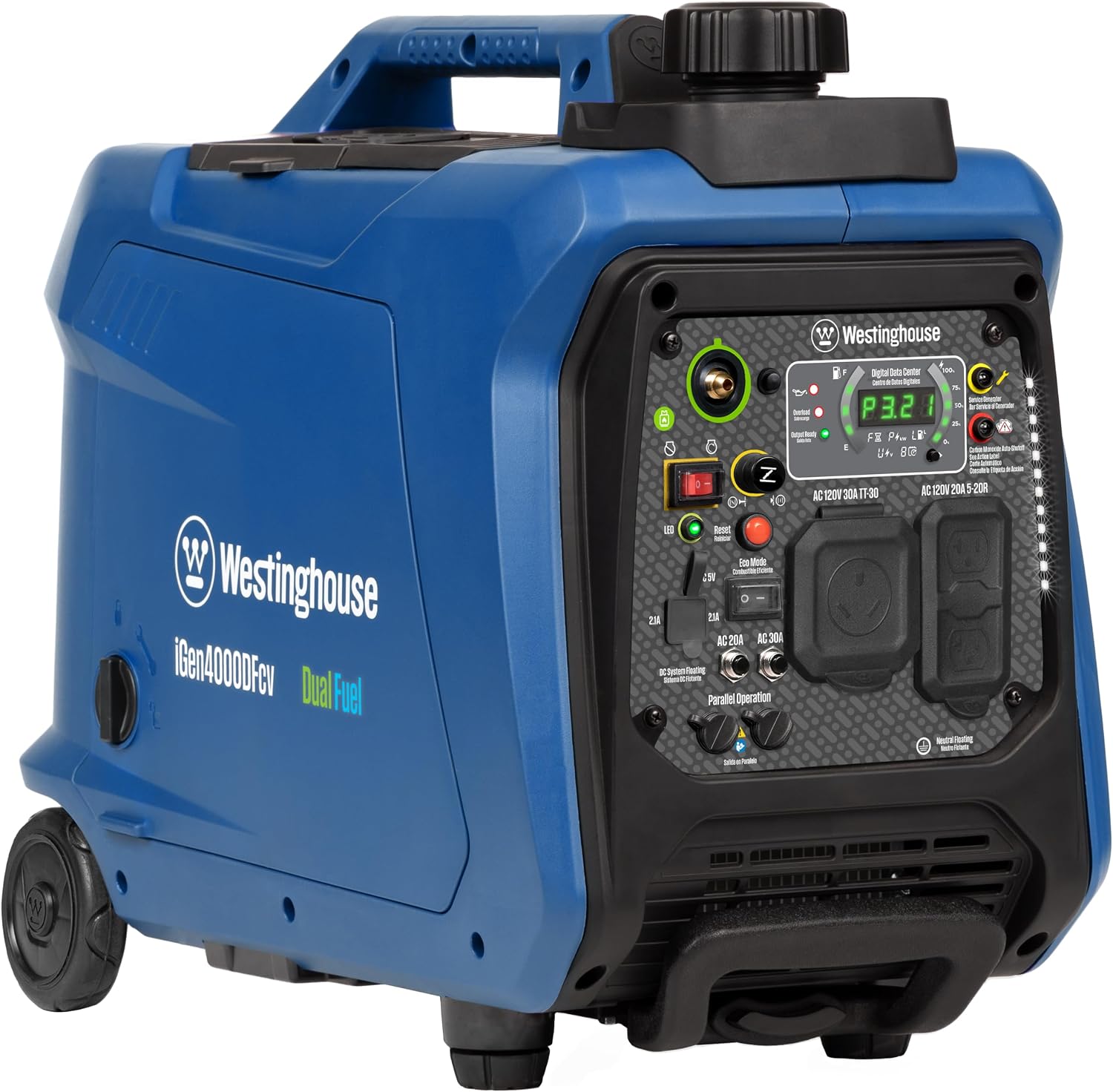
The all-around pick: Westinghouse 4000 Peak Watt Super Quiet Dual Fuel Portable Inverter Generator, Wheel & Handle Kit, Gas & Propane Powered, RV Ready, CO Sensor, Parallel Capable
 Visit on Amazon →
This is the shape most households should be shopping in: an enclosed, wheeled inverter that runs on gasoline or propane, has an RV-ready outlet, a CO sensor shutoff, and the ability to parallel with a second unit later if your loads grow. The wheel and handle kit matters more than people think. A generator you cannot roll across a wet yard by yourself is a generator you will not move far enough from the house.
Read the name carefully. The 4,000 figure is peak watts, not running watts. That is the single most common mistake in this category, and it is why I tell people to build their load list from the running-watts column on the label, never from the number in big print. Dual fuel is the real selling point here: propane stores for years without turning into varnish, which means you can keep the unit fueled and ready instead of hoping the gas can in the shed is still good. Just remember that propane typically gives up some output compared to gasoline, so plan your loads around the lower number.
Flaws but not dealbreakers: The parallel-capable feature is only useful if you actually buy the second unit and the cable. Don't pay for the promise and then never use it.
Anyone who wants one quiet, rollable machine that covers a fridge, a furnace blower, and the internet router during a multi-day outage should start here.
The step-up pick: Champion Power Equipment 4250-Watt Dual Fuel RV Ready Portable Open Frame Inverter Generator with Quiet Technology
 Visit on Amazon →
Champion's dual fuel open frame inverter is the other half of the decision. Open frame means exactly what it sounds like: the engine sits out in the air instead of inside a sealed case. You give up some of the hush and you gain watts per dollar, easier service access, and better cooling on a long run. It is still an inverter, so the power coming out of it is clean enough for laptops, TVs, and phone chargers, which is the whole point of paying inverter money.
What I like about Champion as a company is unglamorous: they answer the phone and the parts exist. When a machine is going to sit in a shed for eleven months and then be asked to carry your house for a week, parts availability beats a tenth of a decibel every time. This unit is RV ready and dual fuel, so the same setup workflow below applies, with one adjustment: on an open frame machine, sound travels further, so give it more distance from the neighbor's bedroom window than you would with a sealed case.
Flaws but not dealbreakers: Open frame units are louder at 25 feet than enclosed inverters. If your only concern is sleeping through the night with the unit running, the enclosed unit above is the better fit.
Anyone who wants maximum usable watts for the money, plans to run a well pump or a window AC, and doesn't mind a little more noise should look here first.
The setup workflow
Step one: Decide your fuel before you need it. Gasoline gives you the most output. Propane stores indefinitely and won't varnish a carburetor. If this generator is storm insurance, keep propane on hand and keep a small can of ethanol-free gas for testing. Buy the propane hose and regulator now, not during the storm, and test-fit it on a calm afternoon.
Step two: Follow the break-in in the manual, then change the oil early. Every new small engine sheds metal during its first hours. The manual tells you the break-in interval; follow it, then drain the oil and refill. The first drain comes out gray and glittery, and that is normal. Skipping it is how you shorten an engine's life by years.
Step three: Pick the spot like it matters, because it does. Twenty feet from the house minimum, exhaust pointed away from windows, doors, and the neighbor's intake vent. Never in a garage, never in a breezeway, never under a deck, even with a CO sensor. The CO sensor is a last line of defense, not a placement plan. It exists because people put generators where they should not.
Step four: Build a real load list. Write down running watts and surge watts for everything you want to power. Surge is the startup spike a motor needs, usually two to three times its running watts. A refrigerator is a small continuous load with a big surge. A sump pump is the same, only more urgent. A 1,500-watt space heater is the opposite: no surge at all, just a steady, unforgiving load that eats your capacity for hours. Do the math on paper before the outage, not by flashlight.
Step five: Test the surge, one motor at a time. Start the biggest motor first, let it settle, then add the next. If the unit bogs or the overload light blinks, you found your ceiling in a driveway instead of at 2 a.m. Test with eco mode on and off, because the RPM throttle that saves fuel and noise can be slow to react to a compressor kicking on.
Step six: Use the right cords and keep them short. Twelve-gauge cords for anything pulling real amps. Keep runs under 50 feet where you can, never daisy chain two cords to reach a third, and keep the connections out of standing water. A cord that is warm to the touch is a cord that is too small.
Step seven: Time a tank yourself. Fill the tank, run it at half load, and time it with a stopwatch. Write the number in a notebook. The box number is measured at a quarter load under ideal conditions, and at half load you can expect meaningfully less. Plan your fuel around the number you measured, not the number you were sold.
Step eight: Store fuel like it is a chemical, because it is. Ethanol-free gas if you can find it, a stabilizer if you cannot, a sealed can, and rotate the supply every month or two. Ethanol left sitting in a carburetor turns to varnish and a service bill. A bottle of stabilizer is cheaper than a carburetor rebuild, every single time.
Step nine: Exercise it monthly and store it dry. Run the unit under load for 20 to 30 minutes once a month. Before long storage, shut off the fuel valve and let the engine run until it dies, so the carburetor is empty. Then pull the cord once slowly so the piston isn't parked on a compression stroke. That one habit is worth more than any additive on the shelf.
The competition and why it lost
The 2,000-watt class, the Honda EU2200i and the small Wen units, are genuinely excellent machines. Quiet, light, easy to start, and perfect for a tailgate, a tent, or charging a battery bank. What they are not is house backup. They will run your fridge or your internet, not your fridge and your sump pump and a space heater at the same time. If you camp more than you prep, buy the small one. If you prep, buy in the 4,000-watt class.
Conventional open frame generators, the loud ones with a sticker price that looks like a bargain, are cheaper per watt and worse at everything that matters near a house. High total harmonic distortion means electronics whine and chargers run hot, and the noise carries through walls. If you only need power at a job site where nobody sleeps, a conventional unit is the honest answer. If you need power where people sleep, buy an inverter.
Generac makes excellent standby units, and their portables are fine, but you are paying extra for the name on the side. DuroMax dual fuel portables are loud, thirsty, and nearly unkillable, which is exactly right for some people and wrong for a suburban cul-de-sac.
What this actually costs
The purchase price is the smallest part of the math. What you are really buying is fuel, oil, stabilizer, a spare spark plug, and a cord that is rated for the load. Compare that against one night in a hotel with a dog and a cooler, multiplied by the days your neighborhood sat dark, and the operating cost stops being interesting.
The other cost is the one nobody prices: the neighbor who cannot sleep. A machine that runs all night at 25 feet from someone's bedroom window is a relationship problem with a decibel reading attached. Distance, a sealed case, and eco mode are cheaper than an apology.
Do the setup once, on a Saturday, with the manual open and a notebook in your pocket. Time a tank. Test the fridge surge. Fit the propane hose. Then put the machine away knowing it will start on the second pull when the grid drops, because you already proved it will.
That's the job. The generator was built to do this. Let it.