Most people buy a generator in a panic, unbox it in the rain, and learn its quirks at 2 a.m. with the fridge already warm. A dual fuel generator for home backup only earns its keep if you size the load, break the engine in, and load it in the right order, and none of that happens on the day the grid goes down.
I spent 22 years rebuilding small engines in Asheville before I started load-testing generators full time. When Helene took the grid down for nine days, I watched a polite street turn on each other over a 50-foot extension cord. That is what we are really buying for. Not watts. A quiet, predictable machine that starts on the second pull in the dark.
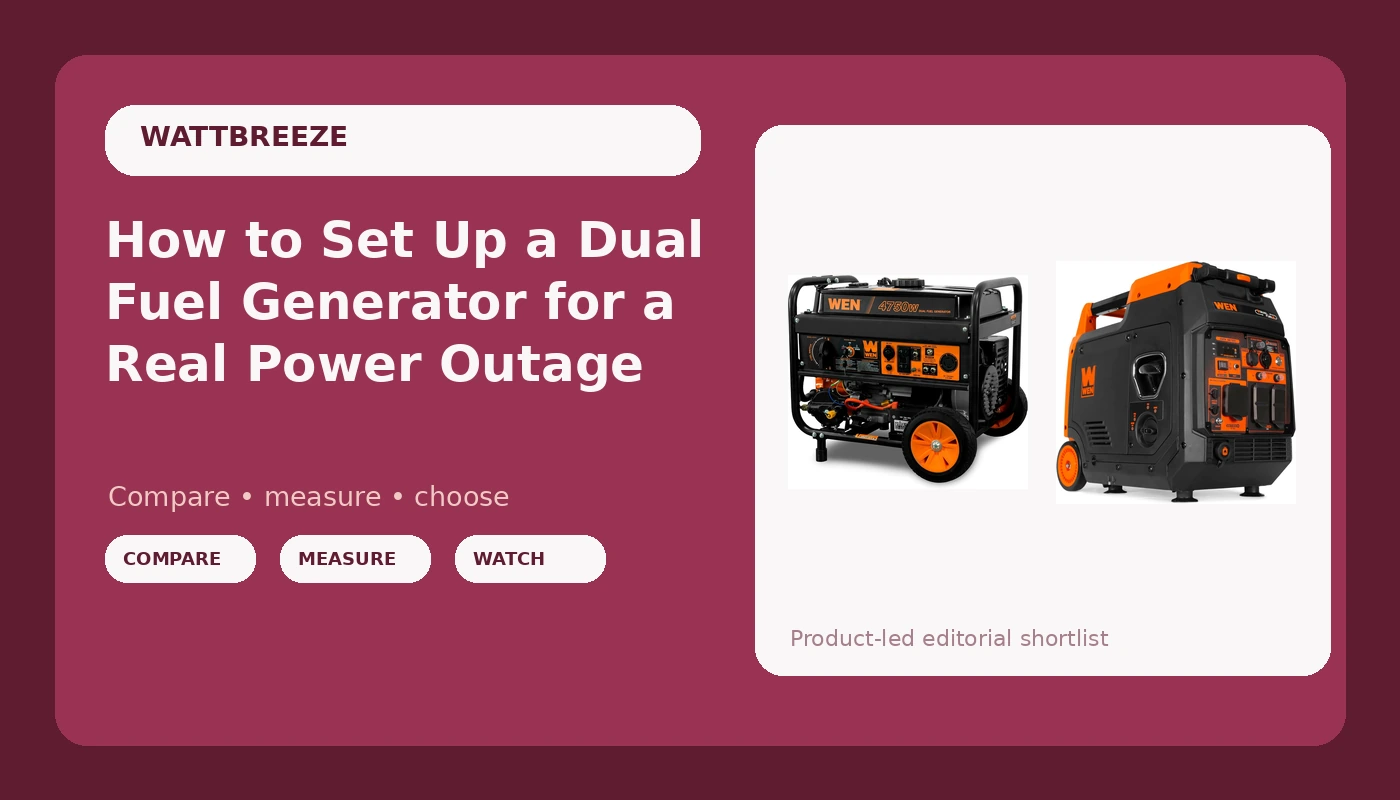
The two units below are the ones this walkthrough is built around, one inverter and one conventional dual fuel. The steps apply to either. The order matters more than the model.
Why you should trust me
I ran a small-engine shop in Asheville for 22 years, and since then I have put more than 40 generators through a load bank with a decibel meter at 25 feet and a stopwatch on every fuel jug. Every run gets logged by hand in a paper book. I do not repeat a run-time claim I have not timed myself, and I do not recommend an inverter without a THD reading under 5%.
I also own the cheap units I tell people to think twice about. That is on purpose. I would rather know where a budget machine fails than guess.
How I picked and how I tested
The criteria here are boring on purpose. Running watts, not peak watts. A real CO shutoff. An electric start that works cold. Fuel flexibility that does not require a YouTube tutorial at midnight. Parts you can actually order.
The numbers I trust are these. Surge watts run two to three times running watts, which is the spike that decides whether your fridge or well pump actually turns on. Run time on the box is measured at 25% load, so at half load cut it by a third and at full load cut it in half. Noise is only honest at 25 feet at quarter load. Anything printed on the carton at one foot with no load is marketing.
What I will not do is hand you a decibel figure for a machine I have not had on my own meter. So this guide sticks to the specs the manufacturer publishes, the features listed on the unit, and the setup sequence that makes either of these machines behave when it counts.
The two machines this guide is built around
One is an inverter built for clean power and campground manners. The other is a conventional dual fuel unit built for raw watts and 240-volt loads. Both run on gasoline or propane. Pick the one that matches your load, then run the steps below.
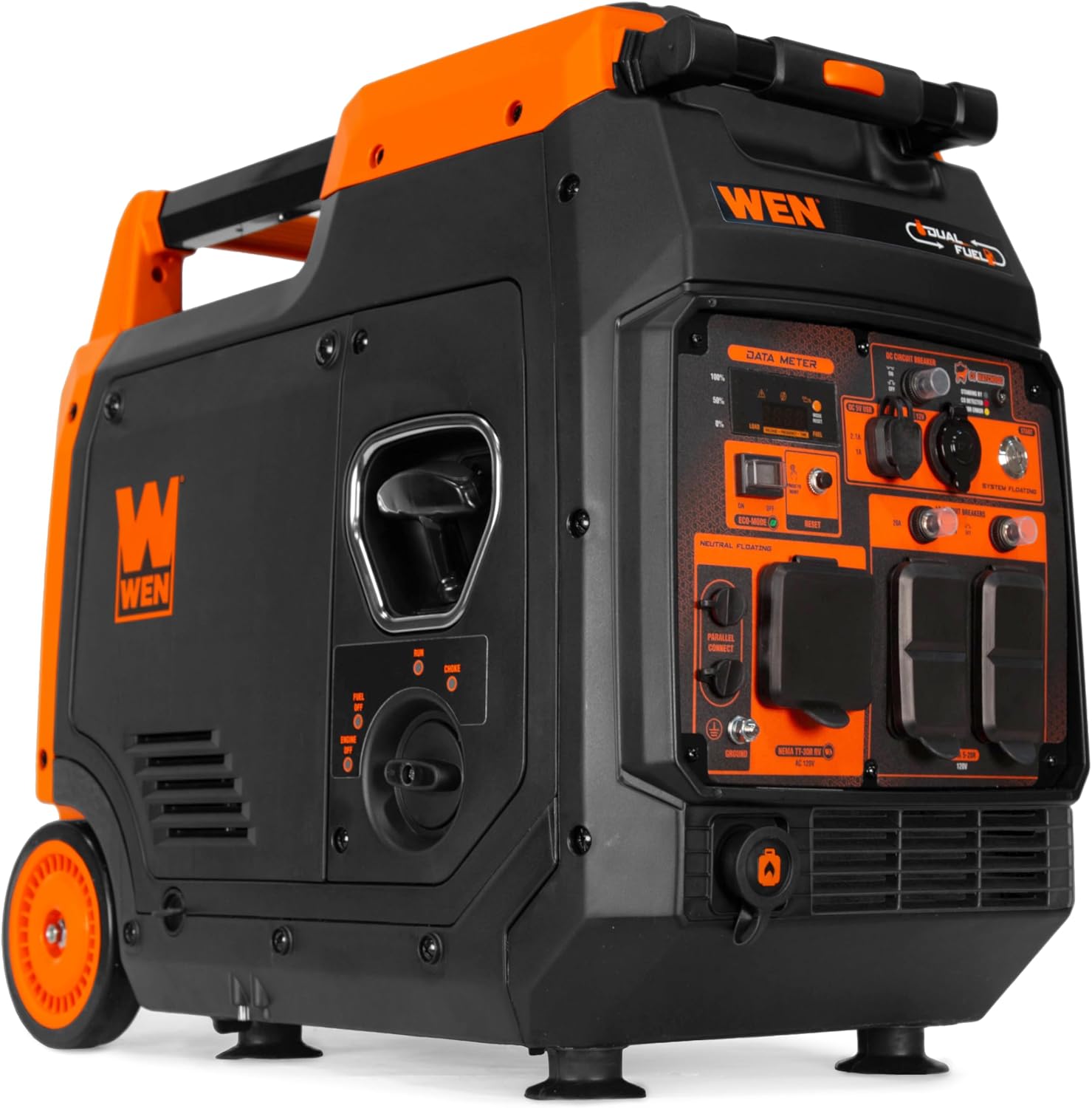
The quiet pick: WEN Quiet and Lightweight 4800-Watt Dual Fuel RV-Ready Electric Start Portable Inverter Generator with Fuel Shut Off and CO Watchdog (DF480iX)
 Visit on Amazon →
This is the one I point at when people sleep within 50 feet of the machine. It is an inverter, so the power is a clean sine wave and your laptop, TV, and phone chargers will not buzz. The RV-ready outlet means a travel trailer plugs straight in without an adapter chain, which matters more than it sounds when you are doing it in the dark.
The CO Watchdog is the feature I care about most. It shuts the engine down when carbon monoxide builds up, and it is not a gimmick. Fuel shut off means you can run the carb dry before storage instead of leaving ethanol to turn into varnish. Electric start removes the pull cord from the equation, and in a storm, that is the difference between power and no power for a lot of people.
Flaws but not dealbreakers: You pay for quiet and clean. Per watt, this costs more than the conventional unit below, and an inverter will not feed a 240-volt well pump. If your house needs 240, keep reading.
Anyone who camps, tailgates, or has neighbors within earshot should start here.
The big conventional pick: WEN 4,750-Watt 120V/240V Dual Fuel Portable Generator with Wheel Kit and Electric Start (DF475T)
 Visit on Amazon →
This is the workhorse. The 120V/240V output is the whole reason to buy it, because 240 volts is what feeds a transfer switch, a well pump, or a bigger central air setup through the right interlock. Dual fuel means you can run it on propane when gasoline is gone, and gasoline when you need every last watt.
The wheel kit is not a throw-in. These units are heavy, and a machine you cannot move is a machine that sits in the wrong place. Electric start is the other feature I insist on, because pull cords do not buffer. The trade is noise and harmonic distortion. This is a conventional generator, so it is louder than the inverter and you should not plug a desktop computer into it without thinking about power quality.
Flaws but not dealbreakers: It is loud, it is thirsty, and it wants a firm, level surface. That is the deal with conventional units. If you only need power where people sleep, the inverter above is the better buy.
Anyone running a well pump, a transfer switch, or a job site should look here first.
Step 1: Size the load before you spend a dime
Write down what you actually need to run, in running watts, then add the surge for the biggest motor on the list. A fridge is roughly 700 running watts and can spike to 2,200 on startup. A sump pump is similar. A 5,000 BTU window AC is around 500 running with a big surge. A space heater is 1,500 flat and does not surge at all.
Add the running watts of everything you want on at once, then add the single largest surge to that total. That number is your real requirement, and it is almost always higher than people guess. A machine rated at 4,750 watts running will not run your whole house, but it will run the fridge, the sump pump, the furnace blower, and a few lights if you stagger the starts.
If you want to run a well pump or feed a transfer switch, you need 240 volts, and that points you at the conventional unit. If you want clean power and quiet, the inverter is the answer. Buy for the surge, not the sticker.
Step 2: Choose your fuel and commit to it
Both machines run on gasoline or propane, and the choice changes your real numbers. Propane stores forever, never gums a carburetor, and burns clean. It also derates the engine by roughly a tenth, so a 4,800-watt unit makes closer to 4,300 watts on propane. Gasoline makes full power and gives you more run time per dollar, but it has to be managed.
My rule: propane for storage and long outages, gasoline for the first day when you want every watt. Keep a full propane tank plus two full gas cans, and treat the propane as the reserve. Propane does not go bad. Gasoline does.
Step 3: Break it in before the storm, not during
Run the unit for a few hours under a light load with the factory oil, then change the oil. That first change is the one that removes the break-in metal. After that, change it on schedule, not on vibes. Check the oil every single time you fuel it, because these engines shut down on low oil and the shutdown always happens at the worst moment.
Run it once a month under a real load for 20 to 30 minutes. Not idling. Loaded. A generator that only ever idles will surprise you when you ask it for 3,000 watts.
Step 4: Place it, ground it, and respect carbon monoxide
Twenty feet minimum from any window, door, or vent, with the exhaust pointed away from the house. Never in a garage, never on a porch, never under an open carport with a wall on one side. Carbon monoxide does not announce itself, and a CO shutoff sensor like the Watchdog on the inverter is a backstop, not a license to run it too close.
Level ground, dry surface, and a cover you can pull off fast. If you are feeding a house circuit, use a proper transfer switch or an interlock kit, never a suicide cord into a dryer outlet. Ground the unit per the manual, and keep the cord run as short as practical. Voltage drop over a 100-foot 12-gauge cord is real, and so is the tripping hazard.
Step 5: Load it in the right order
Start the generator with nothing plugged in. Let it stabilize for a minute. Then bring loads on one at a time, biggest motor first, and give each one time to start before adding the next. The fridge goes on before the space heater, because the space heater can wait and the compressor cannot.
Eco mode is a fuel saver, but it throttles the engine down to match the load, and on some units it cannot react fast enough to catch a fridge surge. If your fridge trips the unit on eco mode, turn eco mode off before you blame the generator. And keep the total under about 80% of running watts. Headroom is what keeps a machine alive for nine days.
Step 6: Store fuel like it matters
Ethanol fuel left in a carburetor is a time bomb. Use ethanol-free fuel if you can get it, add stabilizer if you cannot, and run the carb dry with the fuel shut off before the unit sits more than a month. Store gasoline in a sealed can, in a shaded spot, and rotate it every few months into your car.
Propane needs nothing. That is the whole argument for it. A full tank will be there next year.
The mistakes that kill generators
Running one on a cord that is too thin, then wondering why the motor bogs. Never changing the oil because the machine only has 20 hours on it. Leaving fuel in the bowl all winter. Running it inside a garage with the door cracked, which is the mistake that ends lives. Trusting a fuel gauge that reads full until the tank is a third empty.
Every one of those is avoidable, and none of them cost money to avoid.
What this all costs
The setup costs less than the generator. A transfer switch or interlock, a proper cord, a propane tank, a couple of sealed gas cans, oil, stabilizer, and a cover. That is the difference between owning a generator and being able to use one.
Check current Amazon price on the unit that matches your load, then spend a Saturday on the steps above. Run it loaded once a month. Keep the logbook. When the grid goes down and your neighbor is shouting about an extension cord, you will already know exactly what your machine can carry, how loud it is at 25 feet, and how long a tank really lasts. That is the whole job, and it starts long before the storm.