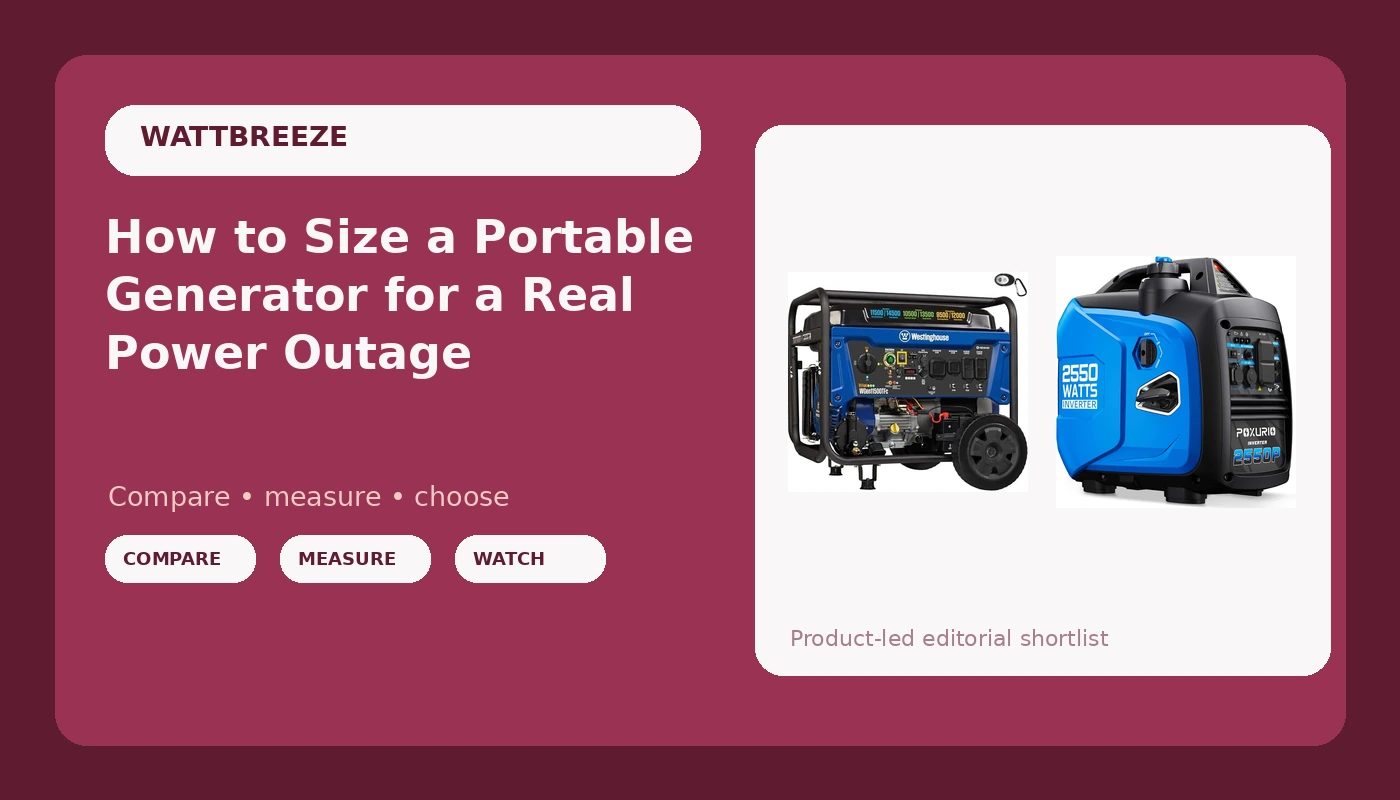
The first question I ask anybody who calls me about a portable generator for home backup is not what their budget is. It is what they cannot live without for nine days. Not eight hours. Nine days.
After Helene took the grid down in Asheville, I watched a street that had been friendly for twenty years turn on each other over a fifty-foot extension cord. One house had a fridge, a sump pump, and a furnace fan running off a 3,500-watt unit. Two doors down, a guy with a 12,000-watt machine could not keep his well pump from tripping the breaker because nobody had ever added up the surge. The difference between those two houses was not money. It was arithmetic, done before the storm instead of during it.
So this is the how-to. We size the load first, then we pick the machine. There are two very different answers at the two ends of that math, and both of them are on this page.
Why you should trust me
I ran a small engine shop in Asheville for 22 years, long enough that I can hear a lean carb from across the parking lot. When the work got quieter, the storms got louder, and after that nine-day outage I bought a load bank, a decibel meter, and a paper logbook, and started testing generators the way I used to rebuild carburetors: take it apart, measure everything, and never trust the sticker.
Over 40 generators have gone through that logbook since. Every one got a real load, a dB(A) reading at 25 feet at quarter load, and a stopwatch on a full fuel jug. I still own the $350 budget unit I tell people to think twice about, and I still write the numbers down by hand because a spreadsheet lets you fudge a memory and a pen does not.
How I test before I recommend anything
The test rig is boring on purpose. A fridge, a sump pump, a space heater, and a 5,000 BTU window AC, all wired through a load bank so I can dial the watts up in steps and watch what actually comes out at the wall. Then the decibel meter at 25 feet, because that is where your neighbor's bedroom window sits, not the one-foot number printed on the box. Then the stopwatch, because run time on the box is measured at 25 percent load, and nobody runs a generator at 25 percent load during an outage.
The numbers I trust are simple. Surge watts are the startup spike a motor needs, usually two to three times running watts, and that is the spec that decides whether your fridge actually turns on. Total harmonic distortion under 5 percent means laptops, TVs, and furnace boards are happy. A dB(A) reading at 25 feet at quarter load is the only honest noise number there is.
I cannot tell you what either unit below will do in your yard with your fuel. I can tell you the questions to ask, and I can tell you which of the two jobs you are actually shopping for.
Two generators, two very different jobs
Most people buy the wrong end of this spectrum. They buy a big loud conventional unit for a job that needed a small quiet inverter, or they buy a 2,000-watt inverter and then wonder why the well pump will not start. Here is the split, and here is the reasoning behind each side of it.
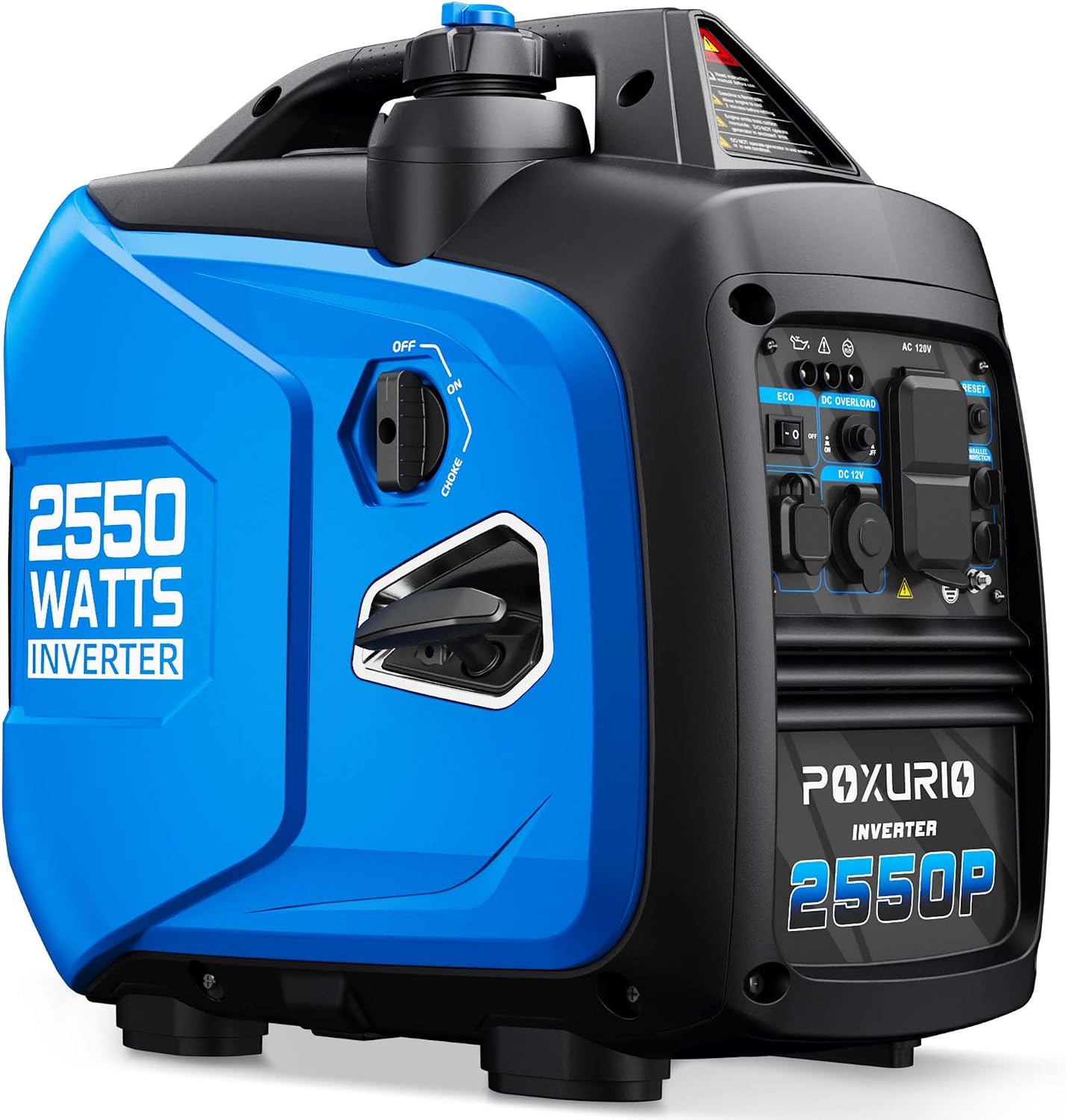
The everyday pick: 2550-Watt Portable Inverter Generator for Home Use, 1.06Gallon Large Fuel Tank Up to 10 Hours Use, 120V Gas Powered Generator Super Quiet - EPA Compliant-Blue
 Visit on Amazon →
This is the class I point people toward when the outage is an inconvenience rather than a disaster, or when the generator has to live on a patio, a tailgate, or a campsite within earshot of somebody trying to sleep. It is an inverter, which means the power is clean enough for a laptop and a TV, and it is quiet enough that the 25-foot conversation with your neighbor does not start with an apology.
The manufacturer lists a 1.06-gallon tank and up to 10 hours of run time. Apply my rule to that claim: run time on the box is measured at 25 percent load. At half load, cut it by a third. At full load, cut it in half. So plan your fuel around roughly six or seven hours of real refrigerator-and-router duty, not ten. The fuel gauge will also lie to you, because they all do. Fill it every morning whether it looks full or not.
Check current Amazon price before you commit, and check it again on a Tuesday, because this class moves around a lot.
Flaws but not dealbreakers: This is a small generator with a small engine, and 2,550 peak watts is a peak number, not a running number. It will not start a well pump and run a fridge at the same time, and if you try, you will find out at 2 a.m. If your outage plan includes a well, a sump pump, and a furnace, this is the wrong machine and you know it by now.
Anyone who needs lights, internet, phone chargers, a fridge, and a fan for a two-day storm will be well served. Anyone planning for a week should keep reading.
The whole-home backup pick: Westinghouse 14500 Peak Watt Tri-Fuel Home Backup Portable Generator, Remote Electric Start, Transfer Switch Ready, Gas, Propane, and Natural Gas Powered
 Visit on Amazon →
This is the other end of the job, and the name tells you what it is built for: home backup, transfer switch ready, tri-fuel, remote electric start. If you have a well pump, a sump pump, a furnace, and a fridge, and you intend to run all four at once for a week, this is the size class you are shopping in. A 14,500 peak watt machine has the surge headroom to start a pump motor without dropping the fridge, which is the single most common failure I get called about.
Tri-fuel is the part I would pay attention to. Gasoline gives you the most output and the shortest shelf life. Propane stores essentially forever, so a couple of 20-pound tanks in the shed are a real outage plan instead of a hope, though you give up some output on it. Natural gas, if your house has a meter, never runs out and never needs to be hauled. The catch is that natural gas is the lowest-output fuel of the three, so a machine this size on a household gas line is doing less than the number on the box. Plan for that.
Remote electric start matters more than people think. A generator that needs a YouTube tutorial and a strong shoulder to start will fail at 2 a.m. in the rain. A button does not.
Check current Amazon price, then budget for the electrician, because "transfer switch ready" means the machine is ready and your house is not.
Flaws but not dealbreakers: This is a conventional generator, not an inverter, and it weighs what a machine this size weighs. It is loud, it is thirsty, and it will announce to the whole street that you have power. It also needs a transfer switch or breaker interlock installed before it can feed your panel, which is a licensed job and a few hundred dollars. If your plan is to run extension cords to a couple of lamps, this is far more machine than the job requires.
Anyone who has already decided they are keeping the furnace and the well running through a multi-day outage should start here.
The actual workflow, step by step
This is the part you came for, and it works whether you own one of the units above or something already sitting in your shed.
Step one: list the loads that matter. Not everything in the house. The fridge, the freezer, the furnace fan (a gas furnace still needs a blower motor), the well pump if you have one, the sump pump if you have one, the internet router, the modem, phone chargers, and two or three lamps. Write them on paper. This is a ten-minute job and it is the whole ballgame.
Step two: find the running watts for each. The nameplate on the appliance is usually close, and a plug-in watt meter is exact. The fridge is around 150 to 200 running watts. A furnace blower is in the same neighborhood. A half-horsepower well pump is around 500 to 750 running. Add them up. That is your running total.
Step three: find the surge. Take the biggest motor on the list and multiply its running watts by three. Add that to the running total of everything else. That number is your real requirement. A fridge that runs at 180 watts can pull 500 or more for a second when the compressor kicks in, and if the generator cannot cover that spike, the fridge will not start no matter how many watts the box claims.
Step four: add 20 percent. Generators do not produce rated watts at altitude, in heat, or on old fuel. If your math lands at 3,000 watts, shop for something that runs 3,600 continuous. Never shop to the peak number in big print. Look for the running watts in the fine print and size to that.
Step five: decide where it sits. Twenty-five feet from any window, door, or vent, with the exhaust pointed away from the house. Never in the garage, not even with the door open. Carbon monoxide kills people every single storm, and a CO sensor with automatic shutoff is non-negotiable on anything that runs near a house. Both units above live outdoors. So does yours.
Step six: decide how you will connect it. Extension cords to the appliances you listed, or a transfer switch into the panel. There is no third option. Backfeeding through a dryer outlet with a homemade double male cord is how people electrocute line workers and burn down their own houses.
Step seven: pick the fuel. Gasoline is the most output and the worst storage. Ethanol fuel left in a carburetor for more than a month turns into varnish and a $200 service call. Use ethanol-free fuel, add stabilizer, and run the carb dry before you store it. Propane stores forever and costs you some output. Natural gas never runs out and costs you more output. Pick based on what you can actually keep on hand.
Step eight: test the whole thing before you need it. Start it cold, in the rain, on the second pull, with the loads you plan to run. If that test fails in September, it would have failed at 2 a.m. in February.
Where people get it wrong
Eco mode and the fridge. Eco mode drops engine RPM to match the load, which saves fuel and noise, and on some units it cannot spool up fast enough for a compressor surge. If your fridge keeps tripping the generator, turn eco mode off and see if the problem disappears.
Extension cords. A 16-gauge cord at 100 feet will drop enough voltage to make a fridge compressor run hot and die young. Keep runs short and cords fat. Twelve gauge for anything with a motor.
The fuel gauge. It reads full until the tank is a third empty. Check the tank by weight or by eye, not by the needle.
The break-in oil. Units that ship with no oil and a sticker that says see manual are the ones that die first. Fill it, run it, change it early, then change it every 50 hours of outage duty.
The 25 percent load fantasy. Every run time you have ever read was measured at quarter load. Do your own math with your own jug and your own stopwatch, and write the number on the machine with a Sharpie.
What this all costs
Check current Amazon price on both units, because these two categories move in opposite directions depending on the season and the storm forecast. Beyond the machine, budget for the things people forget: a transfer switch or interlock installed by an electrician, a couple of heavy-gauge cords, a few cans of ethanol-free fuel and stabilizer, oil for the first two changes, and propane tanks if you go that route. Add it all up and divide by the number of days you expect to actually use the thing over the next five years. The machine is the cheap part. The plan is what you are buying.
The short version
Add up the running watts of what you cannot live without. Multiply the biggest motor by three. Add 20 percent. If that number is small and the generator has to sit near people, buy the quiet inverter. If that number includes a well pump, a sump pump, and a furnace, buy the big tri-fuel machine and pay the electrician. Then test the whole setup on a sunny afternoon so that the night it matters, you are not the guy on the street yelling about a fifty-foot cord.