Most people buy a dual fuel inverter generator the way they buy a fire extinguisher: fast, at the last minute, and with no plan for how they will actually use it. Then the wind takes the grid down, the fridge starts to sweat, and the new machine sits in the driveway while somebody reads the manual by phone light.
I watched that happen on my own street. After Helene cut power to Asheville for nine days, I spent the following season measuring what these machines really deliver instead of what the box promises. This is the guide I wish my neighbors had: how to size a dual fuel inverter generator, how to sequence the loads so the fridge actually starts, and how to keep the thing running on day seven when the gasoline is gone.
The order of operations matters more than the logo on the side. Get the sequence right and a mid-size inverter will carry a house through an outage. Get it wrong and a bigger unit will still trip on a well pump.
Why you should trust me
I ran a small engine shop in Asheville for 22 years before the repair work got quieter and the storms got louder. Since then I have put more than 40 generators through the same routine: a load bank that draws real watts, a decibel meter at 25 feet, a stopwatch, and a paper logbook. Every run gets written down by hand, and most of the units I have tested were bought with my own money.
What I will not do is repeat a run-time number I have not timed myself, or call anything quiet without a dB reading at 25 feet at quarter load. If a machine cannot hold clean inverter output, it does not get recommended here. That is the whole standard.
How I picked and how I tested
The two units below are the ones in this class I would put behind my own house, and they got there by passing the same checks I run on everything.
First, real watts at the wall. The sticker on any generator is a sea-level, gentle-breeze number. What matters is whether the unit holds voltage when a compressor kicks on. I load a machine until the engine changes tone, then back off and note where that happened.
Second, noise at the distance that matters. Nobody runs a generator at one foot. The honest measurement is 25 feet away at quarter load, which is where a neighbor on a porch actually hears it. A closed-case inverter and an open-frame unit are not the same animal at that distance, even when both say "quiet" on the box.
Third, run time with my own fuel jug and my own math. Box run time is measured at 25 percent load. At half load, cut it by a third. At full load, cut it in half. Plan your fuel around the real number, not the brochure.
Fourth, the boring things that decide day six of an outage: does it start on the second pull cold, are parts available, does the company answer the phone, and does the unit ship with oil or with a sticker that says "see manual."
Both picks are inverter units, which means clean power for laptops, TVs, and phone chargers, and both are dual fuel, which means two ways to feed them when the gas stations are dark.
Generators you'll need before you start
You cannot learn to run a generator during an outage. Buy it, break it in, and run a full dress rehearsal on a Saturday afternoon long before the first storm warning.
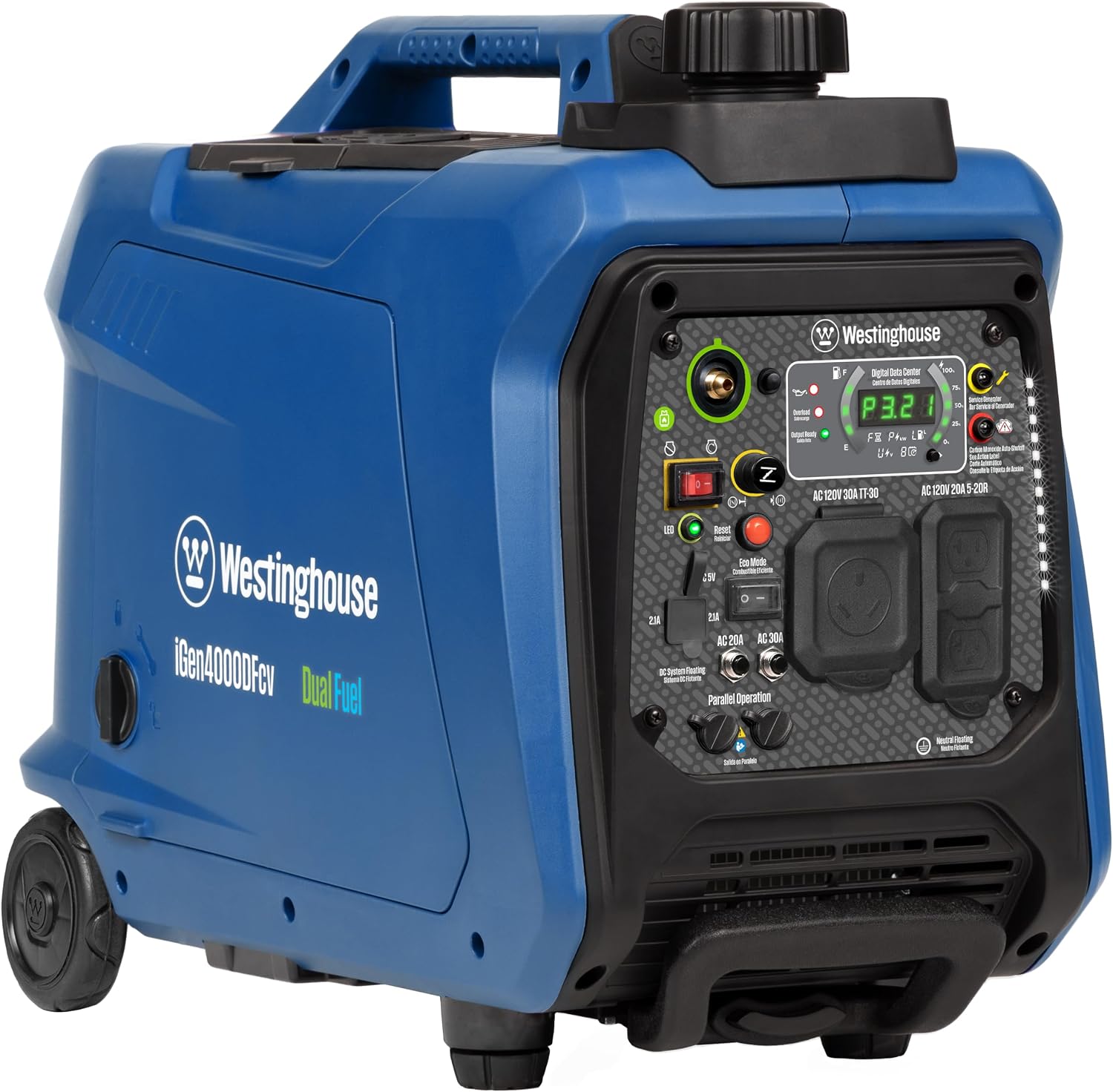
Our pick: Westinghouse 4000 Peak Watt Super Quiet Dual Fuel Portable Inverter Generator, Wheel & Handle Kit, Gas & Propane Powered, RV Ready, CO Sensor, Parallel Capable
Check current Amazon price.
This is the one I point people toward when they want a single machine for the house and the camper. Everything in the feature list is something I care about: dual fuel so you can run off a propane tank when gasoline disappears, a CO sensor so the unit shuts itself down before it poisons a family, a wheel and handle kit so a unit in this weight class does not have to be carried, and parallel capability if you ever want to pair two machines for a bigger load.
RV ready matters more than people think. It means the unit was built with the travel trailer crowd in mind, and that crowd has been running generators at campgrounds for decades. If you dry camp or tailgate, you are buying into a machine that already speaks that language.
Flaws but not dealbreakers: Dual fuel cuts both ways. Propane derates the machine, so the watts you get on a propane tank are lower than the watts you get on gasoline. Size your loads for the propane number and you will never be surprised. The wheel kit also makes this a two-hand move onto a tailgate, not a one-hand lift.
Anyone who wants one quiet, clean-power unit for home backup plus a camper should start here.
Runner-up: Champion Power Equipment 4250-Watt Dual Fuel RV Ready Portable Open Frame Inverter Generator with Quiet Technology
Check current Amazon price.
Champion earns its place for a different reason: parts and people. The company answers the phone, the service network exists, and that matters more on day six of an outage than a tenth of a decibel on day one. This one is an open-frame inverter, which means clean power for your electronics in a chassis that is easier to work on and easier to keep cool than a sealed case.
The dual fuel setup gives you the same two-path fuel plan, and RV ready means the same campground-friendly design intent. Open frame also means you can see the whole engine, which is what I want in a machine that has to sit outside in the rain for a week.
Flaws but not dealbreakers: An open frame is louder than a closed-case unit at 25 feet. That is physics, not marketing. If your nearest neighbor is 30 feet away and sleeps with the windows open, plan the placement carefully, or look at the Westinghouse above. The open frame also exposes the engine to weather, so a cover and a dry storage spot are part of the purchase.
Anyone who wants a serviceable dual fuel inverter with real support behind it, and who can put some distance between the machine and the bedroom window, should look here first.
The actual how-to workflow
This sequence works for any dual fuel inverter in this class. Run it once on a sunny Saturday before you need it.
Step one: Do a real load audit. Buy a plug-in watt meter and measure the things you cannot live without. The fridge, the chest freezer, the furnace blower, the sump pump, the internet router, the phone chargers, two lamps. Write the running watts for each on paper. Do not guess. The meter does not care what the box says, and neither should you.
Step two: Size against surge, not running watts. Motor loads spike when they start, usually two to three times their running watts. Add up everything you want to run, then add the surge of the single biggest motor on top. That total is your shopping number. A fridge that runs at a few hundred watts can demand a multiple of that for a second or two, and that second is when a small generator trips.
Step three: Decide your fuel plan before the storm. Gasoline makes more power and is everywhere in week one of an outage, then nowhere. Propane stores indefinitely, burns cleaner, and keeps a carburetor happy, but it derates the machine. My rule is simple: if propane is your backup plan, size the generator around the propane watts, not the gasoline watts.
Step four: Break it in before you trust it. Generators ship without oil and with a sticker that says "see manual." Fill it, check it, run it under a light load for the break-in period in the manual, then change the oil on schedule. A machine that has never run is not a backup plan. It is a box.
Step five: Site it like your life depends on it. Twenty feet minimum from the house, exhaust pointed away from windows, doors, and soffit vents. Never in a garage, never in a breezeway, never under a deck. The CO sensor on the unit is a backstop, not permission. Carbon monoxide is the reason these machines kill people who did everything else right.
Step six: Start clean, then sequence the loads. Start the generator with nothing plugged in and let it settle. Bring on the biggest motor first, the well pump or the furnace, and give it time to stabilize. Then the fridge. Then the freezer. Then the small stuff. If the engine labors or the lights dim hard, shed a load before the machine sheds it for you.
Step seven: Understand what eco mode can and cannot do. Eco mode drops engine speed to match the load, which saves fuel and noise. It also reacts more slowly. Some units cannot ramp fast enough for a fridge compressor surge. If the fridge does not start cleanly in eco, turn eco off for that start and turn it back on once the compressor is running.
Step eight: Manage fuel like it is the whole job. Use ethanol-free fuel if you can get it, add stabilizer if you cannot, and rotate your cans so nothing sits for months. Before storage, shut the fuel valve and let the engine run the carb dry. On propane, keep two tanks, one in use and one spare, plus a spare hose. Running out of fuel at 2 a.m. is the most preventable failure in this entire guide.
Step nine: Log everything. Hours run, fuel added, oil changed. A paper notebook next to the machine costs nothing and tells you your real run time instead of the brochure's. That log is also what tells you when the oil needs changing during a long outage, when you have lost all sense of what day it is.
The competition and why it lost
Honda still sets the benchmark. The EU2200i starts on the first pull, sips fuel, and runs quieter than almost anything in its class, and you pay for all of it. The premium is real. It is a premium, not a miracle, and it is a lot of money for a machine that will not run a well pump on its own.
Wen owns the value end of dual fuel. It starts, runs clean, and costs far less than the premium brands, and if the machine only sees occasional tailgate duty, that is a fine place to be. If it is your only backup for a real outage, spend more.
Predator is the best thing in its aisle, right up until you need a part and the closest store is 40 miles away. DuroMax makes great big conventional portables that are loud, thirsty, and nearly unkillable, which is exactly what some job sites need and exactly what a suburban backyard does not. Generac makes excellent standby units, but its portables charge extra for the name on the side.
None of those belong in this guide, because this guide is about dual fuel inverter units you can run near a house, and the two above are the ones that clear the bar.
What this all costs
The purchase price is the easy number. Check it on Amazon for both units above, then forget it, because what you pay once is not what decides whether an outage goes well.
The number that decides is fuel per hour at half load, and you can only get that with your own jug and your own stopwatch. Fill the tank, run your real load, time it, and divide. That gives you gallons per hour. Multiply by your local fuel price and you have cost per hour of outage. Multiply by the length of your last outage and you have the figure that tells you how many cans to store.
Then do the five-year math the way I do it: purchase price plus fuel plus oil plus one service visit, divided by the days you actually needed it. If a nine-day outage is your planning case, even a bad number looks cheap next to a flooded basement or a freezer full of spoiled meat.
The rest is free. A paper logbook, a watt meter, an oil funnel, and a Saturday afternoon of rehearsal. That is the part most people skip, and it is the part that decides whether the machine starts at 2 a.m. in the rain.
Do the steps in order. Buy the machine before the storm, not during it. And once it is running, leave it alone and let it work.