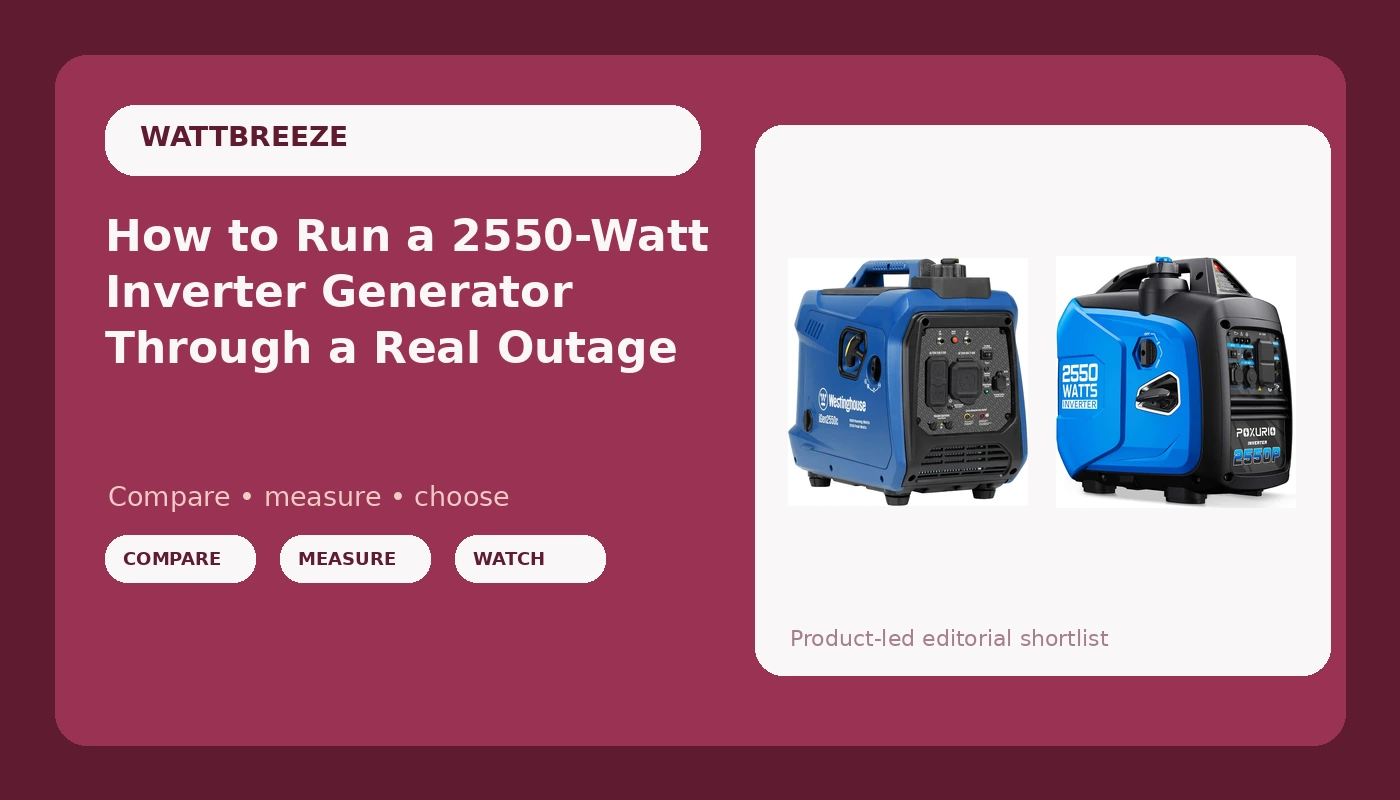
Two thousand five hundred fifty watts sounds like a compromise number. It is not. A 2550-watt inverter generator sits in the spot where a fridge will still start, a travel trailer will still run through its 30A outlet, and one person can still lift the unit into a truck bed without calling for help.
I ran a small-engine shop in Asheville for 22 years, and I have spent the years since putting generators on a load bank and a decibel meter because the stickers lie. After Helene took the grid down for nine days, I watched a polite street turn on itself over a 50-foot extension cord. What people were buying that week was not watts. It was a cold fridge and a dry sump pit without asking a neighbor for a favor.
Here is how to pick one of these units, and more importantly, how to run it so it starts on the night you need it.
Why you should trust me
I spent 22 years behind the counter of a small-engine shop, most of it rebuilding carburetors and explaining to people why the generator in the back of their truck would not start in April. Since then I have put more than 40 generators through the same routine: a load bank that draws real watts, a decibel meter at 25 feet, a stopwatch on every tank of fuel, and a paper logbook that does not care what the marketing department wrote.
I keep a budget generator in my own shed and I still tell people to think twice before buying one. The point of testing is not to sell you the most expensive unit on the shelf. It is to know which compromises cost you a fridge full of food and which ones just cost you money.
Everything below follows the same rule I use in the shop: no recommendation without an honest number behind it, and no number repeated that I did not measure myself.
What 2,550 watts will and will not carry
Two numbers live on every generator box, and only one of them matters. Running watts are the continuous load the unit carries hour after hour. Surge watts are the startup spike a motor needs for a second or two. A unit sold as "2550 peak watt" is advertising the surge number in the big print, so find the running watts on the data plate before you buy anything.
What that buys you in practice:
- A refrigerator, which pulls two to three times its running watts for a moment when the compressor kicks on.
- A sump pump, a furnace blower, a modem, a router, and a few lamps at the same time, if you sequence them.
- An RV through a 30A outlet, with the caveat that a 30A outlet at 120 volts is a 3,600-watt socket. A 2,550-watt class unit will run the converter, lights, TV, and a coffee maker, but not the air conditioner and the microwave together.
- A space heater or a small window AC, but usually not both.
What it will not carry is the whole house. Electric range, central air, well pump, and clothes dryer are all jobs for a bigger machine or a standby unit.
How I picked these two units
I care about five things on any inverter in this class, in this order.
First, a CO sensor. Carbon monoxide shutoff is non-negotiable on anything that runs near a house, and it is required on new units for a reason. Second, inverter class power, because electronics and phone chargers want clean sine wave output and a conventional generator is not built to give it. Third, honest run time. The spec sheet measures hours per tank at 25% load, so at half load cut that number by a third, and at full load cut it in half. Fourth, weight and handles, because a generator you cannot move is a generator you will not use. Fifth, parts and service, because a carburetor kit you can actually order beats a prettier machine you cannot fix.
I did not have either of these units on my load bank this month. What I can speak to is the class, the named features, and the questions I would ask before handing over money. Where a claim needs a meter, I say so.
The two 2,550-watt inverter generators worth a look
Both are inverter class, both sit in the same wattage neighborhood, and they are aimed at two different buyers. One is built for the road. One is built for the house.
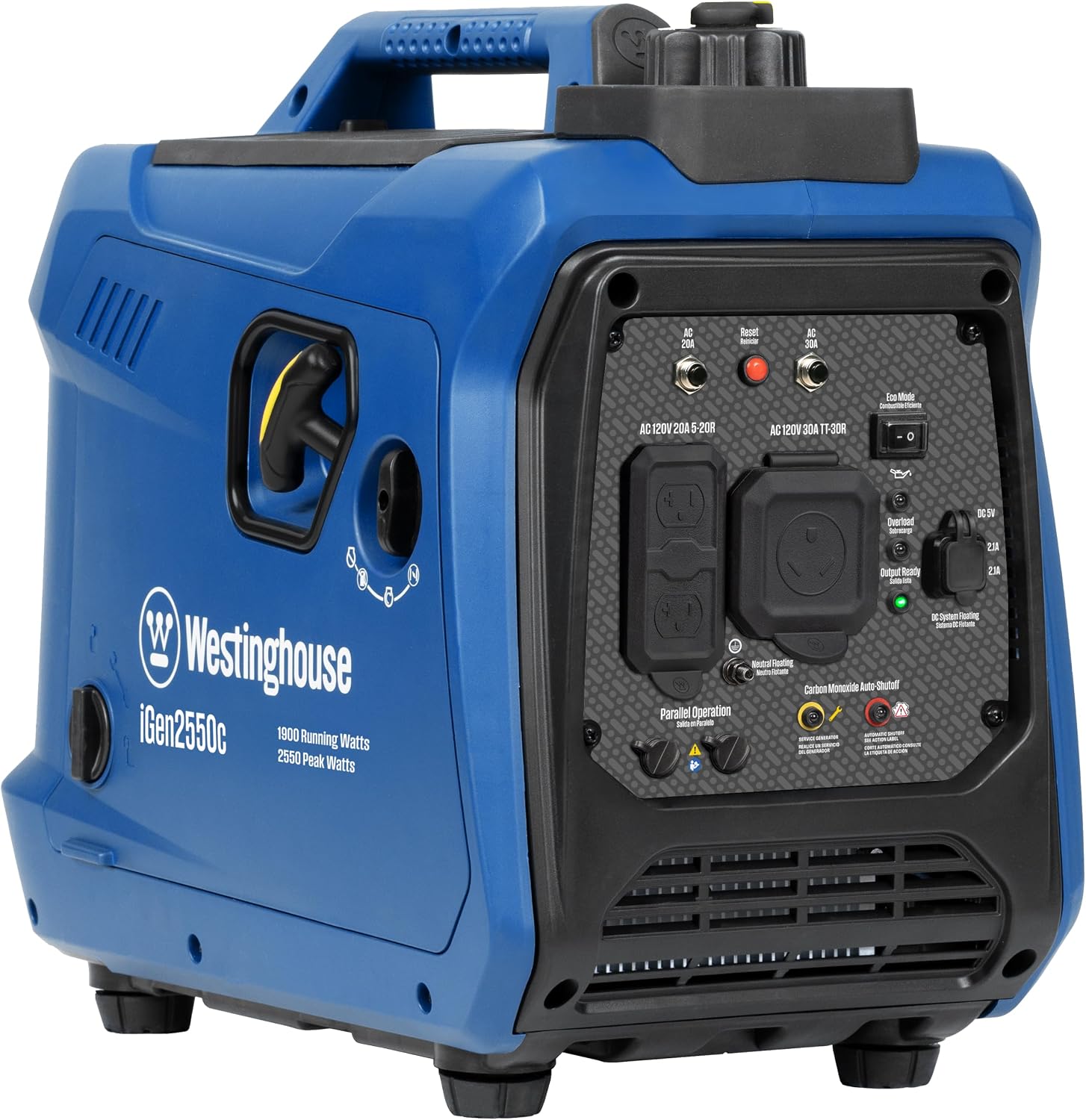
Our pick for RV and tailgating: Westinghouse 2550 Peak Watt Super Quiet & Lightweight Portable Inverter Generator, RV Ready 30A Outlet, Gas Powered, CO Sensor, Parallel Capable, Long Run Time,Blue
 Visit on Amazon →
The features that matter here are all in the name, which is rare. A 30A RV outlet means you plug the trailer in with one cord instead of hunting for an adapter. The CO sensor is the safety item I would not buy without. Parallel capable means you can add a second matching unit later and feed a bigger load without replacing what you already own, which is the cheapest upgrade path in this category.
The "peak watt" wording is the thing to watch. Peak is the surge number, not the number your fridge lives on, so find the running watts on the data plate and plan your loads around that. The "lightweight" claim is also worth verifying with your own arms before you commit, especially if you are lifting it into a truck bed alone.
Flaws but not dealbreakers: A 30A outlet does not mean the generator will run a 30-amp trailer load. It means it will run a 30-amp plug. Add up the running watts of what you actually want on at once and stay well under the running rating.
Anyone with a travel trailer, a tailgate setup, or a hunting camp who wants clean power and a CO shutoff should start here.
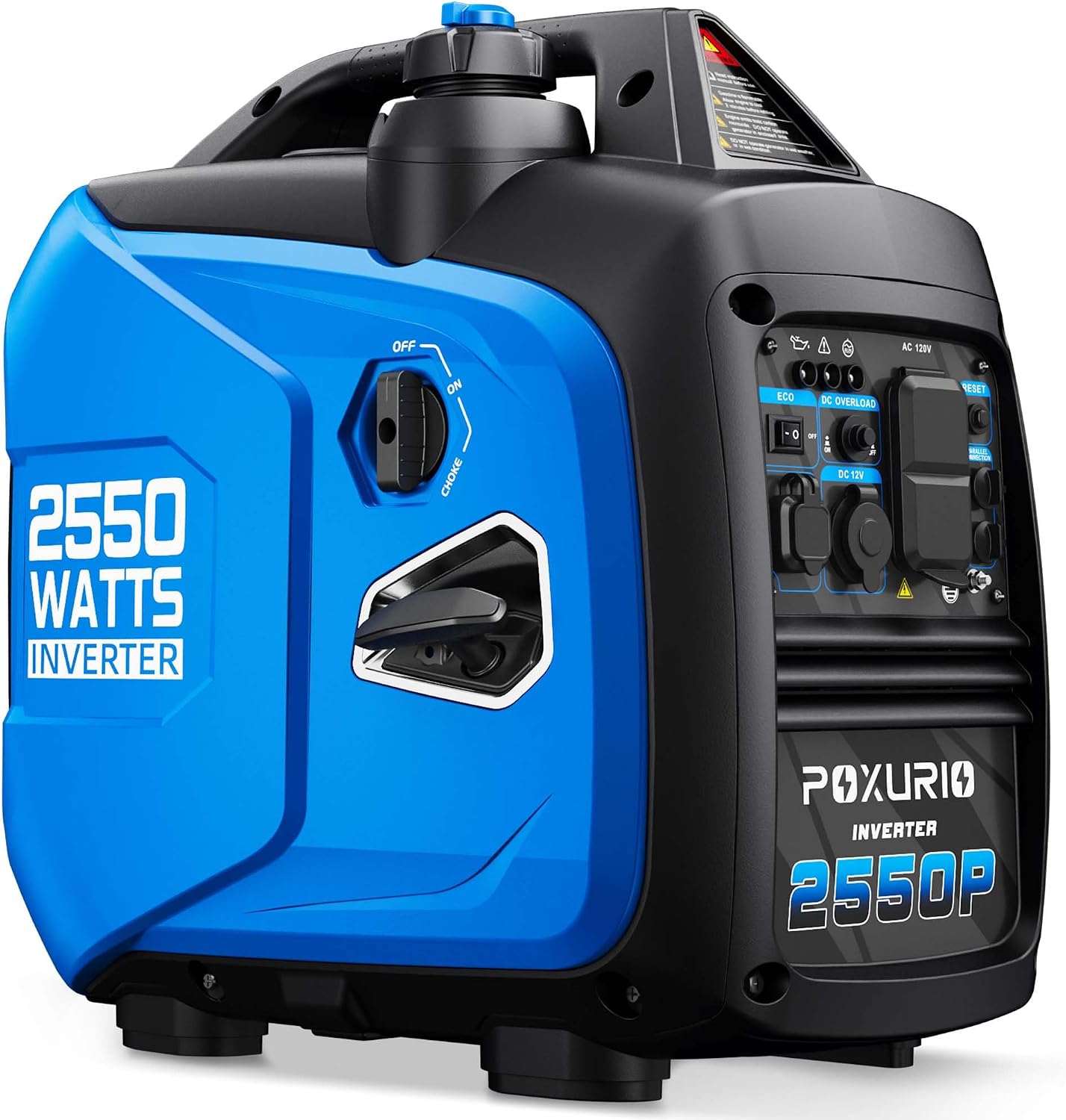
Best for home backup: 2550-Watt Portable Inverter Generator for Home Use, 1.06Gallon Large Fuel Tank Up to 10 Hours Use, 120V Gas Powered Generator Super Quiet - EPA Compliant-Blue
 Visit on Amazon →
This one is aimed at the outage crowd. The 1.06 gallon tank is the number that matters during a multi-day event, because it decides how often you are standing outside in the rain with a fuel can. A larger tank is not a luxury in a nine-day outage, it is sleep.
The up to 10 hours figure is a quarter-load claim, and I will say the same thing I say about every box in this category: at half load, take a third off that number. At full load, cut it in half. Plan fuel around the real number, not the printed one, and keep two full cans treated with stabilizer on hand before the storm arrives. EPA compliance matters if you are buying in a state with fuel vapor rules, and it usually means the unit ships with an evaporative emissions system rather than an open vent.
Flaws but not dealbreakers: Home-use marketing on a portable inverter means it powers a few circuits through extension cords, not your panel. If you want it wired into the house, that is a transfer switch or interlock conversation with an electrician, not a cord-and-backfeed conversation.
Anyone who wants a fridge, a sump pump, a furnace blower, and the internet alive during an ice storm will get the most out of this one.
The workflow: from the box to a 2 a.m. start
This is the part that decides whether the machine works when it counts.
Step one: Read the manual cover to cover before the first tank of fuel. Most units in this class ship without oil, and a sticker that says "see manual" is not a suggestion. Fill to the mark, on a level surface, with the recommended weight. Overfilling is as bad as underfilling and it will smoke.
Step two: Break it in under a real load, not idle. Run it with a moderate load for the first few hours, then change the oil while it is still warm and drain the metal fines out with it. Do this before the storm, not during it. A generator broken in on a July afternoon is a generator that starts on a February night.
Step three: Learn the cold start now. Inverter units have their own ritual: fuel valve open, choke or primer per the manual, eco mode off, pull with a firm straight pull, not a yank. Practice it ten times in your driveway while you are calm. Pull cords do not care that you are in a hurry, and a machine that needs a YouTube tutorial to start will fail at 2 a.m.
Step four: Position it like it can kill you, because it can. Twenty feet from the house minimum, exhaust pointed away from windows, doors, and the garage. Never in a garage, breezeway, or covered porch, even with a CO sensor. The sensor is a backup, not a plan. Keep the unit dry, on a hard level surface, and out of standing water.
Step five: Do the load math on paper before you plug anything in. Write down the running watts of every item you want on, find the biggest surge, and compare the total to the running watts on the data plate. Start the largest motor first, by itself, and let it settle before adding the next item. That is how a fridge starts on a 2,550-watt class machine instead of tripping the overload.
Step six: Use eco mode with your eyes open. Eco mode drops engine speed to match the load, which saves fuel and keeps the noise down. On some units it cannot spool up fast enough for a fridge compressor's surge. If your fridge stalls or the unit stumbles, run eco off for the fridge and on for everything else, or leave it off entirely during an outage.
Step seven: Shut down in the right order. Unplug loads before you kill the engine, then let it idle a minute to cool. Shutting a hot engine down under load is how you cook a valve and how you burn a stator.
Step eight: Store it so next time is easy. Run the carb dry with the fuel shutoff, or drain the bowl. Ethanol fuel left in a carb for more than a month is a time bomb, and stabilizer is cheaper than a rebuild. Change the oil, pull the plug, check the air filter, and store it somewhere dry with the fuel cap vent closed.
Mistakes that cost people a fridge
Backfeeding the house through a dryer outlet or a suicide cord is the one that gets people killed, and it is the reason linemen hate storm season. If you want the generator wired to the house, pay for a transfer switch or an interlock kit.
Running a generator in a garage with the door cracked is the second mistake. CO does not care about the crack. A CO sensor is a last line of defense, not a ventilation strategy.
The third is fuel. If you have never drained a carburetor in your life, use ethanol-free gas in anything that sits, treat it with stabilizer, and rotate your cans. The fourth is cords. A long, thin extension cord on a 1,500-watt heater will melt, and a 12-gauge cord kept short will not.
What this all costs
Neither unit carries a price worth memorizing, so look at the listing: Check current Amazon price, and check it against what you actually need to power. The generator is rarely the biggest line in the budget anyway. Add a 12-gauge cord set, a spare fuel can or two, ethanol-free fuel, stabilizer, oil for the first two changes, a cover, and a small transfer switch if you want the house wired properly.
Spread across five years, the machine is the cheap part. The fuel and the maintenance are what you pay every season, and the cost of skipping maintenance is a service bill plus a night with no power. Do the math once, write your load list on an index card, tape it inside the lid of the generator, and you will never have to guess at 2 a.m. again.
That is the whole job. Buy for the surge, plan for the running watts, and treat the machine like the tool it is.