Hurricane Helene took the grid down here in Asheville for nine days. I watched a street that had been polite for twenty years turn on each other over a fifty-foot extension cord. I watched a guy in a pickup sell "priority hookups" out of the truck bed. And I listened to a thirty-year-old contractor generator rattle windows at 2 a.m. until somebody finally walked over and unplugged it.
That week is why I started load testing generators instead of just repairing them. Most people who buy a portable inverter generator during a storm panic buy the wrong size, run it wrong, and store it wrong. This guide is the order I do it in: size the load, pick the unit, place it, fuel it, and test the whole thing on a Tuesday afternoon instead of at 2 a.m. in the rain.
Why you should trust me
I ran a small engine repair shop in Asheville for 22 years before the work got quieter and the storms got louder. Since then I've put more than 40 generators through a load bank, logged every run by hand in a paper notebook, and measured noise with a decibel meter at 25 feet at quarter load, because that is where a generator actually sits when your neighbors are trying to sleep.
I buy most of my test units myself. I keep the $350 budget generator in my own shed, and I still tell people to think twice about it. My rules are simple: nothing gets recommended without a real load test and a dB reading, no run time gets repeated without my own timer and my own fuel jug, and no inverter gets a clean bill of health without a total harmonic distortion reading under 5%. The watt meter does not care what the box says.
How I picked and how I tested
This is not a list of every inverter generator worth owning. It is the sizing workflow plus two units that cover the two jobs people actually have.
The first job is light duty: camping, tailgating, a tailgate fridge, a CPAP, a laptop, and a few lights during a short outage. The second job is home backup: a fridge that has to stay cold for nine days, a furnace blower in February, an RV hookup, a sump pump in a wet spring. Those are different machines with different fuel systems, and buying for the wrong job is the most common mistake I see.
Every unit I evaluate goes through the same loop. I run it at quarter load, half load, and full load on the load bank. I measure dB(A) at 25 feet. I check THD with a meter. I time a full tank at half load and compare it against the spec sheet, which is almost always measured at 25% load. I check whether it starts cold on the second pull. And I ask the one question that matters: would I bet my fridge and my sump pump on it for nine days?
The numbers I trust: surge watts are the startup spike a motor needs, usually two to three times running watts. Running watts are what the unit carries hour after hour. THD under 5% keeps laptops, TVs, and phone chargers happy. Everything else is marketing.
Two generators, two jobs
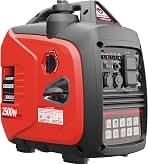
The light one: 2500W Portable Generator Super Quiet Inverter Generator Ultra Lightweight for Home Backup Outdoor Camping, CO Sensor Protect, EPA, ECO Mode
 Visit on Amazon →
This is the class I hand to campers and to people who want something they can actually lift into a truck bed alone. A 2,500-watt class inverter is a one-person machine, and that matters more than any spec, because the generator you cannot carry is the generator you leave in the garage.
The features worth naming are the ones that solve real problems. The CO sensor is a carbon monoxide shutoff, and on any generator that runs anywhere near a house it is non-negotiable. ECO mode drops engine speed to match the load, which saves fuel and noise, though on some units it cannot react fast enough for a fridge compressor's surge, so if you hear the engine stumble when the fridge kicks on, turn ECO off and let it run at full speed. EPA compliance just means it is a legal, current-production unit.
Realistically, this class runs a fridge, a few LED lights, a laptop, a phone charger, and a box fan, and you start the fridge first with everything else off. It is not running a space heater plus a microwave plus a furnace blower. Do the math in the next section before you assume otherwise.
Check current Amazon price on the listing, and confirm the running watts and surge watts in the spec block rather than the headline number.
Flaws but not dealbreakers: Small tanks mean short run times at half load, and light frames mean you feel every pound of fuel you add. Plan a fuel schedule, not a fuel can.
Anyone camping, tailgating, or covering short outages with a short list of critical loads will get the most out of this size.
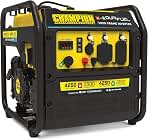
The dual fuel workhorse: Champion Power Equipment 4250-Watt Dual Fuel RV Ready Portable Open Frame Inverter with Quiet Technology
 Visit on Amazon →
This is the home backup answer for most people. Dual fuel means gasoline or propane, and propane is the single best thing you can do for a generator you store for months at a time. Ethanol gasoline left in a carburetor is a time bomb. Propane does not varnish, does not gum, and does not care that you forgot about it since March. You give up some output on propane and you pay more per hour to run it, but you never make a $200 service call in the dark.
RV ready means it has the outlet an RV actually uses, so it doubles as a camping unit for people with a trailer. Open frame means it is louder than a closed suitcase unit, and quiet technology means quieter than a conventional open frame generator of the same wattage. It is still a machine you place away from the house, not under a window.
A 4,250-watt class unit is where you stop rationing. A fridge, a furnace blower, a sump pump, a few lights, and a microwave become a scheduling problem instead of a triage problem. You still do not run the space heater and the microwave and the well pump at the same time. You sequence them.
Check current Amazon price before you order, and read the propane versus gasoline output numbers carefully, because they are not the same.
Flaws but not dealbreakers: Open frame units are heavy and the wheels on this class of machine are functional, not comfortable. If you are lifting it into a truck bed solo, get help. And propane output is lower than gasoline output, which is a tradeoff, not a defect.
Anyone with a house, a fridge full of food, and a spouse who would like the furnace to work in February should look here first.
The actual sizing workflow
This works whether you already own a generator or you are about to buy one. Do it on paper before the storm, not in your head during it.
Step one: list the loads and find the running watts. Write down everything you want on at the same time. A refrigerator, a chest freezer, a furnace blower, a sump pump, a well pump, a microwave, a router, a few LED lights, phone chargers, a TV. Look up the running watts for each on the data plate or in the manual. If you cannot find it, use a plug-in watt meter for a day and write down the real numbers.
Step two: add the surge watts for the single biggest motor. Motors spike when they start. A fridge compressor, a sump pump, a furnace blower, and a well pump all draw roughly two to three times their running watts for a second or two. You add the surge for the one biggest motor to the running watts of everything else. You do not add every surge at once, because they do not all start at once.
Step three: leave 20% headroom. If your total lands at 2,000 running watts, buy or plan around 2,500. Generators run hot, loud, and thirsty at the top of their range, and altitude costs you output on top of that. The extra margin is not waste. It is the difference between a unit that idles through a nine-day outage and one that is screaming at full load the whole time.
Step four: sequence the starts. Biggest motor first, with everything else off. Wait for the fridge or pump to settle, then bring on the small stuff. If your unit has ECO mode and it stumbles when a compressor kicks on, turn ECO off. Fuel savings are not worth a fridge that never starts.
Step five: place it correctly. Twenty feet from the house minimum, exhaust pointed away from windows and doors, never in a garage, never under a deck, never in a breezeway. The CO sensor is a backup, not a plan. If you can smell exhaust inside, you are already wrong.
Step six: do the fuel math before the storm. The run time on the box is measured at 25% load. At half load, cut it by a third. At full load, cut it in half. Plan your fuel around the real number, then add a third on top for the hours you did not expect.
Step seven: store fuel and the machine correctly. Ethanol-free fuel if it will sit more than a month. Stabilizer in everything else. Shut the fuel valve and run the carb dry before storage. Change the oil after the first few hours of break-in and then on the schedule in the manual. This is the part that decides whether the machine starts on the second pull in year three.
Step eight: test the whole setup on a Tuesday. Plug in the real loads, run it for an hour, and time it. Find out now that the cord is too short or the furnace blower trips the unit. A dry run in good weather is worth more than any review.
Step nine: cords and connections. Use 12-gauge cords for anything drawing real current, keep runs under 50 feet where you can, and never daisy chain cords to reach the fridge. Voltage drop is real, and a fridge compressor that browns out is a fridge compressor that dies.
The competition and why it lost
Honda still builds the benchmark. The EU2200i starts on the first pull and sips fuel, and you pay a premium for it. The EU3200i is the best one-generator-for-everything unit Honda makes. Neither is a bad choice. Both belong in a different guide, and both cost more than most people need to spend on their first backup unit.
Wen's dual fuel units are the value play in this category and their 2,000-watt class machines are fine for occasional use. Predator's 3500 is the best thing Harbor Freight sells, right up until you need a part and the nearest store is 40 miles away. DuroMax builds big conventional portables that are loud, thirsty, and unkillable, which is exactly right for a job site and exactly wrong for a street full of sleeping neighbors.
None of those are in this guide because this guide is about sizing and running what you own, and the two units above cover the light duty and home backup jobs that most people are actually shopping for.
What this all costs
The honest way to think about cost is per outage, not per box. A 2,500-watt class inverter is the cheapest way into clean, quiet power, and it covers a short list of critical loads. A 4,250-watt dual fuel unit costs more upfront and buys you the ability to run a house's essentials on a schedule.
Then there is the fuel. Gasoline is cheaper per hour and goes bad faster. Propane costs more per hour and sits in the tank for years without turning into varnish. Over a single nine-day outage, the fuel bill is real, and the maintenance bill for a gummed-up carburetor is worse. Stabilizer is cheaper than a carburetor rebuild. That sentence has paid for itself in my shop more times than I can count.
Spread over the years you will own it, a generator is one of the cheapest insurance policies in your garage. Spread over the one outage you did not prepare for, it is the most expensive way to buy extension cords at 11 p.m.
Do the load math once, write it in the back of the manual, and tape the fuel schedule inside the cabinet door. When the lights go out, you want a checklist, not a decision.