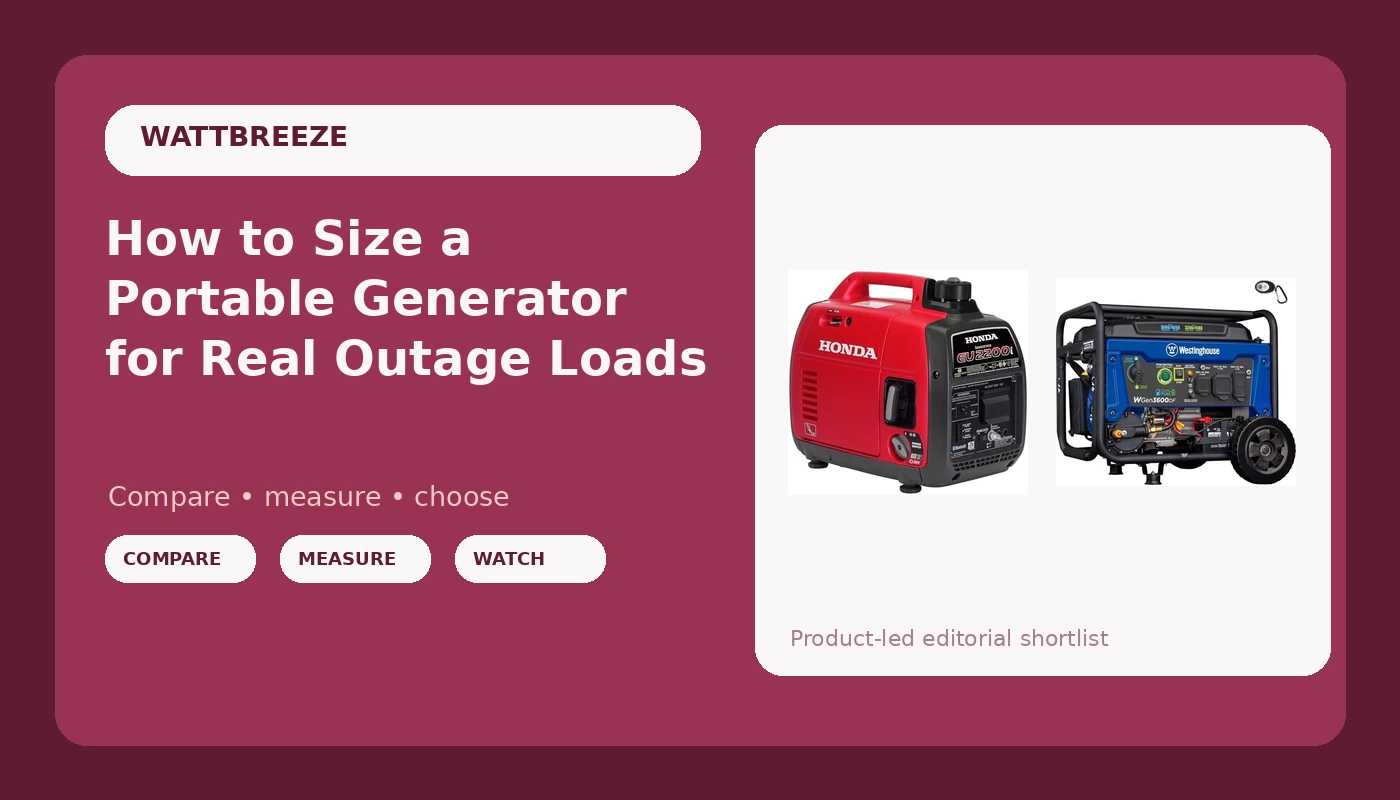
Portable generator sizing is the part of storm prep nobody enjoys, and it is the part that decides whether the food in your fridge is still good on day three. Most people buy by the big number printed across the front of the box, get the thing home, and find out in the dark that their refrigerator trips the overload every time the compressor kicks on. The watt meter does not care what the box says.
I ran a small-engine repair shop in Asheville, North Carolina, for 22 years. After Hurricane Helene took the grid down for nine days, I watched a normally polite street turn on each other: two neighbors shouting over a 50-foot extension cord, a guy in a pickup selling "priority" hookups out of the bed, and a 30-year-old contractor unit rattling windows at 2 a.m. When the lights came back I bought a load bank, a decibel meter, and a paper logbook, and I started testing generators the way I used to rebuild carburetors. Take it apart, measure everything, and never trust the sticker.
I have put over 40 generators through the same sequence since then. What follows is the sizing procedure I actually use, plus the two machines I would put at opposite ends of it.
Why you should trust me
The load bank is the whole reason this article exists. Spec watts are measured at sea level with a gentle breeze, and your kitchen on day four of an outage is not that. Every unit that comes through my shop goes onto the same bench: a refrigerator, a sump pump, a space heater, and a 5,000 BTU window air conditioner, one at a time and then in combinations, with a decibel meter parked 25 feet away and a stopwatch on every fuel jug.
I still own the cheap budget unit I tell people to think twice about, and I will tell you when the honest answer is "spend more." I also keep the logbook in pencil, because fuel and weather change the numbers and a pencil lets me fix them.
How I size a machine and how I test it
Sizing is arithmetic first and shopping second. You add the running watts of everything you want on at once, add the surge of the biggest motor, and compare that total to the generator's continuous rating, not its peak. For noise I only use dB(A) at 25 feet at quarter load, because that is where a machine actually sits during an outage: on a patio or beside a garage, not one foot from your ear. For power quality, anything I call inverter-clean has to hold total harmonic distortion under 5 percent. Under 5 percent means laptops, televisions, and phone chargers behave.
For run time I take the spec sheet number as the ceiling, then do my own math: the printed figure is at 25 percent load, at half load cut it by a third, at full load cut it in half. That is how I plan fuel. Then I start every unit cold, in the rain, and count the pulls.
The two machines I would shortlist
One is a small inverter that runs quiet and sips fuel. The other is a dual-fuel unit with enough peak watts to carry a real house load. They are not competitors. They are two different answers to two different questions, and the sizing math below tells you which question you are asking.
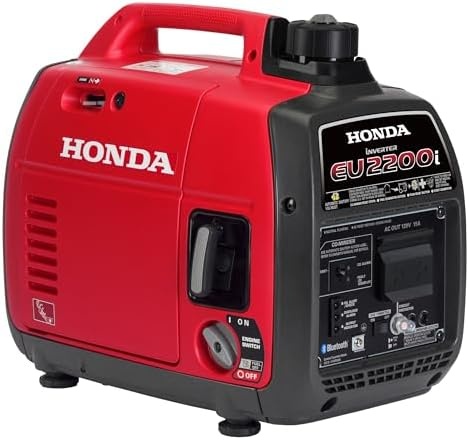
The small-load pick: Honda EU2200i 2200 Watt Inverter Generator (EU2200ITAN)
 Visit on Amazon →
The EU2200i is still the benchmark in the small inverter class after all these years. It is quiet, it starts on the first pull, and it sips fuel. The premium is real, and it is a premium, not a miracle.
This is the machine for the person whose critical loads are a fridge, a few lamps, a router, laptops, and a phone charging station. It is also the one I would hand somebody who camps, tailgates, or dry camps in an RV and wants to run a coffee maker and a laptop without hearing the engine from inside the camper. In the inverter class, the clean power and the low noise are genuinely worth the extra money, and this is where the class sets the bar.
What it is not: a whole-panel unit. If your hot water heater, well pump, and a window air conditioner all want power at the same time, no amount of careful cord management gets you there, and you should be looking at the second machine below.
Flaws but not dealbreakers: You pay for the name and for the quiet. If the unit only ever powers a job-site radio and a work light, the math does not favor this machine. But if people sleep within earshot, buy the quiet one.
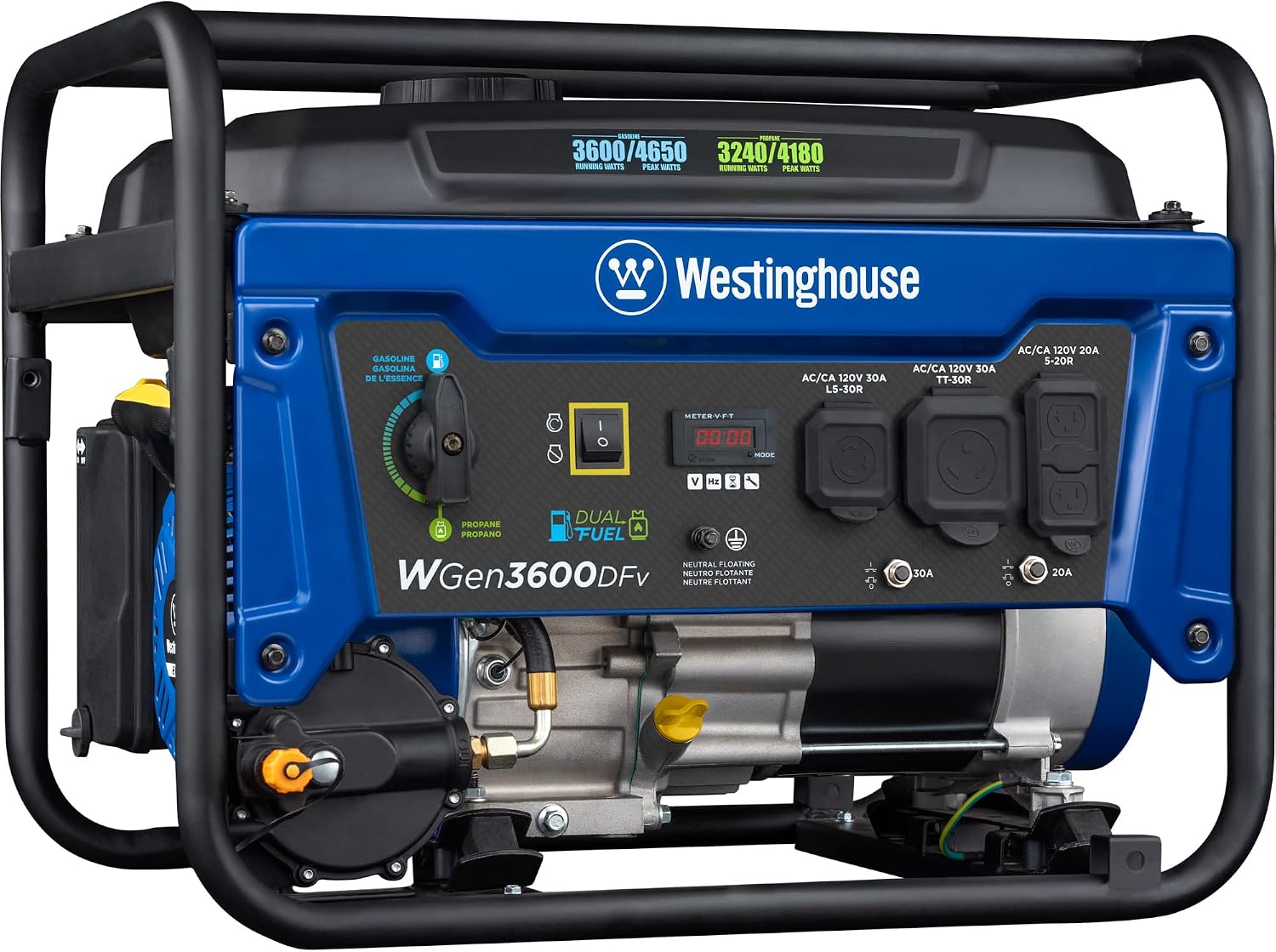
The heavy-load, dual-fuel pick: Westinghouse 4650 Peak Watt Dual Fuel Portable Generator, Remote Electric Start with Auto Choke, RV Ready 30A Outlet, Gas & Propane Powered
 Visit on Amazon →
This is the other end of the sizing conversation: more peak watts, two fuel options, and convenience features that matter at 2 a.m. in a storm. Remote electric start with auto choke is not a gimmick. A generator that needs a YouTube tutorial and a second person to start will fail when you are tired, wet, and standing in the dark, and pull cords do not buffer.
The dual-fuel part is the quiet advantage. Propane stores indefinitely, which means you are not rotating gasoline or gambling on fuel that sat in a can since last winter. The tradeoff is that propane delivers fewer watts than gasoline on a dual-fuel machine, so you size the propane side against your load, not the gasoline side. If you have a propane tank already, that math often works out fine.
The RV-ready 30A outlet is what makes this class genuinely useful for travel trailers and motorhomes, and it is also the outlet that lets you feed a transfer switch or a panel setup without a pile of adapters. The cost of all that capability is noise and fuel burn. A machine in this class is louder than any inverter, it drinks more per hour, and it is heavy enough that you want the wheels and handle to be decent. That is the deal: you get watts, and you pay for them in decibels and gallons.
Flaws but not dealbreakers: It is not a nightstand unit. Place it far from bedrooms and windows, and never in a garage, breezeway, or any space attached to the house, no matter how cold it is.
The actual sizing workflow
Here is the procedure. Write it down on paper before you shop, because shopping first is how people end up with the wrong machine.
Step one: List your loads and their running watts. Go through the house and write down what you genuinely need during an outage. Refrigerator and freezer. Furnace blower if you heat with gas or oil. Sump pump. Well pump. A few lamps. Router and modem. Phone chargers. Space heater if it is an ice storm. Read the nameplate on each appliance, or buy a plug-in watt meter and measure the real draw, which is almost always different from the nameplate.
Step two: Add the surge for motor loads. Motors draw two to three times their running watts for a second or two when they start. That spike is the number that decides whether your fridge actually turns on. Identify which motors can start at the same time and add the largest surge to the running total of everything else. Do not add every surge at once unless your appliances really do all kick on together, which they usually do not.
Step three: Decide what runs simultaneously. This is the step people skip. If the well pump and the space heater never run together, you do not need to size for both. Stagger the big loads by hand or by habit and you can run a smaller, quieter, cheaper machine. During a nine-day outage the neighbor who plans his loads lives better than the neighbor who bought the biggest box in the aisle.
Step four: Match continuous watts, not peak watts. Compare your running total plus the largest surge against the generator's continuous rating. The number in big print is usually peak, and the running number is in the fine print for a reason. Buy for running watts with a little headroom, not for the peak figure.
Step five: Check the outlets and the plug types. Count the household outlets, check whether there is a 30A RV outlet if you need one, and look at whether the 120-volt receptacles are on separate circuits so you can spread the load. The wrong outlet means adapters and cords, and cords are where voltage drop and heat live.
Step six: Do the fuel math. Gasoline is convenient and gives you the most watts per gallon. Propane stores forever and burns cleaner in a carburetor. Ethanol fuel left in a carburetor is a time bomb, and stabilizer is cheaper than a carburetor rebuild. Whatever you choose, take the spec run time, cut it by a third at half load and by half at full load, and plan how many jugs you need to get through four days. Store ethanol-free fuel if anything is going to sit more than a month.
Step seven: Check the noise number honestly. Look for dB(A) at 25 feet at quarter load. If the box says "whisper quiet" and prints no decibel figure, that is marketing. Inverters hold lower engine speed under light load, which is why they are quieter and why their eco mode saves fuel. One caveat: on some units eco mode cannot react fast enough for a refrigerator's surge, so if the fridge trips, turn eco off and try again.
Step eight: Test it before you need it. Break the unit in per the manual, check the oil, change it after the break-in hours, and then run a real test on a Saturday: start it cold, plug in your actual loads one at a time, and listen to the engine change pitch as each one comes online. Confirm the carbon monoxide shutoff works on any unit that runs near a house. CO sensors are non-negotiable, and they are required on new machines for a reason.
Where sizing goes wrong
The most common mistake is buying for peak watts and running at half the number. The second is forgetting surge entirely, then blaming the generator when the fridge trips the breaker. The third is ignoring noise until the neighbors complain, which is a problem you can solve with money up front and cannot solve at all on day two of an outage.
Keep the generator outside, well away from windows, doors, and vents, with the exhaust pointed away from the house. Use heavy enough extension cords for the run length, because a thin cord on a long run drops voltage and heats up. And do not chain the unit to a panel unless it is done correctly with a transfer switch or an interlock. Backfeeding a house through a dryer outlet is how people electrocute linemen.
What this all costs
Cost is where this gets honest. The small inverter class costs more per running watt and gives you less total capacity. The larger dual-fuel class costs less per watt and gives you more capability, in exchange for noise, weight, and fuel burn. Neither is the wrong answer, which is why sizing comes first and shopping comes second.
The way to think about it is cost per day of use. A machine you pull out for a weekend camping trip every summer and a handful of outages is doing different work than a machine that carries your house through a nine-day grid failure. If your loads fit the small inverter, the quiet and the fuel economy pay you back every single time you run it. If your loads need the bigger unit, no amount of clever cord management will substitute for watts you do not have.
Do the list. Add the surge. Buy for running watts. Then start it cold in the rain once, before the storm does it for you. That is the whole job.