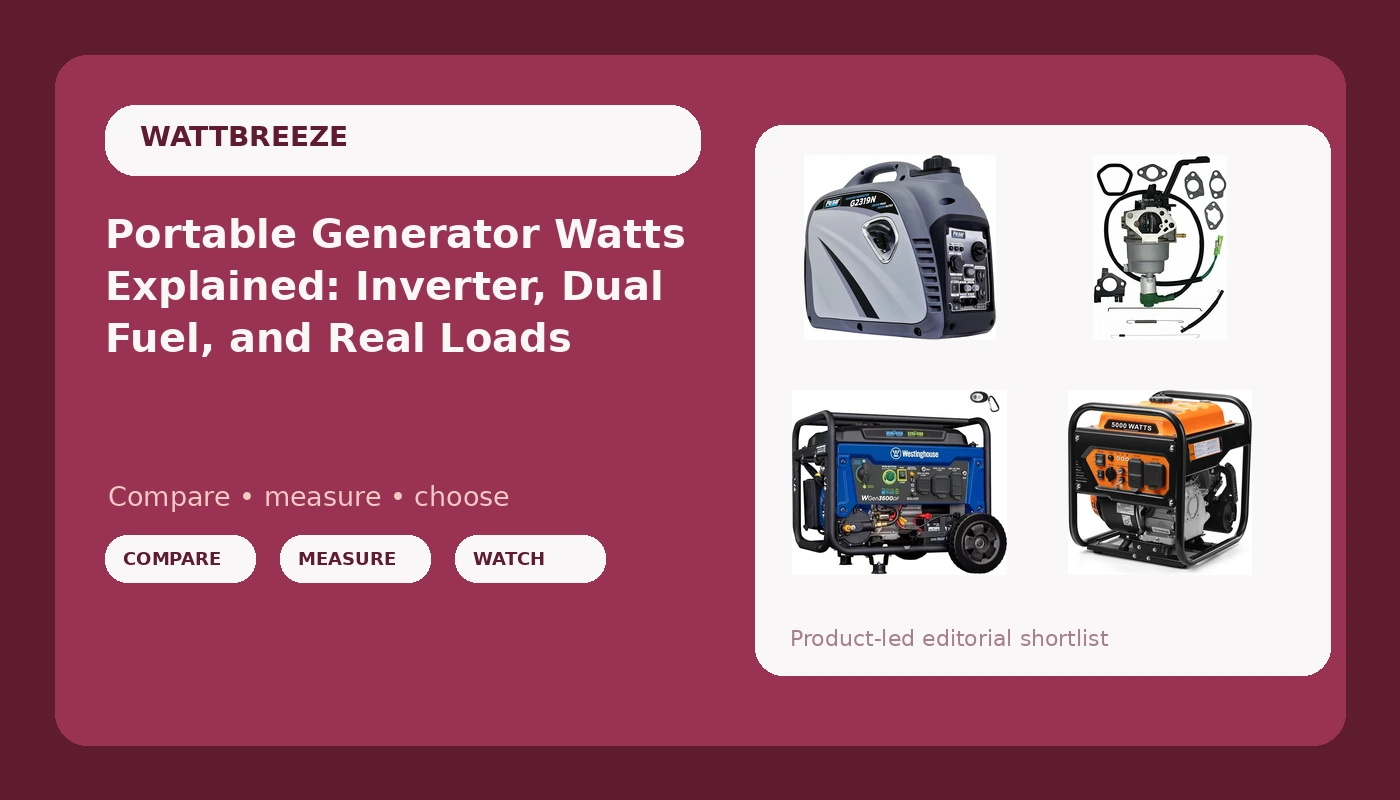
The number printed on the front of a generator box is a sales pitch. The number at the wall is the truth. Anyone shopping for a portable inverter generator is really shopping for three separate specs squeezed into one big font: running watts you can hold for hours, surge watts that decide whether a fridge compressor turns over, and a noise figure almost nobody publishes honestly at 25 feet.
That gap between the sticker and the wall is where neighborhoods fall apart. During a nine day outage, the generator you own either carries your loads or it does not, and the fuel jug does not care how the marketing copy read. This explainer covers what the watt ratings on a portable inverter generator actually mean, where a dual fuel unit earns its place, and why a small replacement part decides whether a Champion or Predator unit starts at 2 a.m. or sits in the shed until spring.
Related: How to Size a Generator for a Refrigerator and a Sump Pump →
Quick answer
Match the generator to the load you need to carry, not to the largest number on the box. A 2,300-watt class inverter covers a fridge, some lights, a laptop, and phone chargers, and its parallel capability lets you add a second matching unit later instead of buying bigger now. A 5,000-watt class inverter adds headroom and a 30A outlet for an RV or a transfer switch circuit in a body listed at 60 lbs. A 4,650 peak watt dual fuel unit runs on gasoline or propane with remote electric start and auto choke, which matters when you are starting it in the rain. A replacement carburetor, such as the Huayi P27-1D pattern part for Champion and Predator units, is what brings an engine back after ethanol fuel has varnished the bowl. None of these is the quietest, safest, or best in absolute terms, and no honest page can claim that without a decibel meter and a load bank in hand.
Four useful options
| Model | Best fit | What stands out |
|---|---|---|
| Oxseryn 5000-Watts Portable Inverter Generator | Backup circuits and RV hookups | 5,000-watt class inverter, 30A outlet, ECO mode, listed at 60 lbs |
| Pulsar 2,300W Portable Gas-Powered Quiet Inverter Generator, G2319N | Camping, tailgating, light backup | 2,300-watt class inverter with USB outlet and parallel capability |
| Westinghouse 4650 Peak Watt Dual Fuel Portable Generator | Household backup where propane is easier to store | Runs on gasoline or propane, remote electric start with auto choke, 30A outlet |
| YAMAKATO Huayi P27-1D Gasoline Generator Carburetor | Reviving a Champion or Predator engine | Replacement carburetor for gasoline generator engines |
The big inverter: Oxseryn 5000-Watts Portable Inverter Generator, Gas Generator for Home Backup, 30A Outlet, RV Ready, ECO Mode, 60Lbs, EPA Compliment
Five thousand watts of inverter output changes what you can leave plugged in. This is the class where a fridge, a furnace blower, some lights, and a router can share the load without you jogging outside to shed a circuit every time a compressor kicks on, and the 30A outlet means an RV or a transfer switch connects with one cord instead of an adapter chain. ECO mode is the trade to understand before you lean on it: the engine drops to a lower rpm under light load, which saves fuel and noise, but a throttle that has idled down can be slow to answer a motor surge. The 60 lb figure is light enough for one person to lift into a truck bed, heavy enough that you will want a cart if you move it often. Gasoline only, so plan your fuel rotation.
The compact inverter: Pulsar 2,300W Portable Gas-Powered Quiet Inverter Generator With USB Outlet & Parallel Capability, Carb Compliant, G2319N
Parallel capability is the feature that keeps a small unit from becoming a mistake. A 2,300-watt class inverter will not run your whole house and was never meant to. What it will do is carry a fridge, some lights, a laptop, and phone chargers, and if you later decide you need more, a second matching unit plus a parallel kit gets you there without starting over from scratch. The USB outlet is a small convenience that saves digging out a wall adapter in a tent or a truck bed. The honest caveat is noise. The listing calls it quiet, and the box does not hand you a decibel number at 25 feet, which is the only figure that predicts whether your neighbor comes knocking at midnight.
The dual fuel option: Westinghouse 4650 Peak Watt Dual Fuel Portable Generator, Remote Electric Start with Auto Choke, RV Ready 30A Outlet, Gas & Propane Powered
Dual fuel is not a gimmick, it is a fuel plan. Propane cylinders store for years without going stale, which is exactly what you want from a machine that sits untouched for eleven months and then has to start during an ice storm. Remote electric start with auto choke takes the pull cord out of the equation, and a pull cord you cannot reach in bad weather is one of the most common reasons a working generator stays in the garage. The trade is output: dual fuel units generally make less power on propane than on gasoline, so read both numbers before you size your circuits. This listing does not carry an inverter label either, so if a documented low distortion figure for sensitive electronics is a hard requirement, confirm it before buying.
The replacement part: YAMAKATO Huayi P27-1D Gasoline Generator Carburetor for Champion Predator
Most no-start generators are not broken, they are pickled. Fuel left sitting in a carburetor bowl over a season turns to varnish, plugs a jet, and converts a machine that ran fine in October into a machine that will not fire in July. The repair order never changes: drain the bowl, try fresh ethanol-free fuel, and only then replace hardware. When replacement is the answer, a Huayi P27-1D pattern carburetor is the kind of part that puts a Champion or Predator unit back on the job. Match the engine family and carburetor pattern to your specific model first, because these parts are matched to engines rather than to brand names, and listings vary.
Prices and availability may change. Product images, names, and retailer links are matched to verified listings. No current price, rating, stock status, or measured result is stated here without current evidence.
Surge watts, running watts, and the loads that actually matter
Running watts are the continuous load a generator carries hour after hour. That is the number that keeps a fridge cold through a nine day outage. Surge watts are the startup spike a motor needs, usually a multiple of its running watts rather than a small bump, and they last only a moment. The moment is the whole problem.
Anything with a motor in it surges. A refrigerator compressor, a sump pump, a furnace blower, a window air conditioner, a well pump, and a chest freezer all draw a spike on startup and then settle into a much smaller draw. A generator that meets your running watt total but not your largest surge will trip its breaker or stall the engine at the worst possible second.
The practical rule is to add up running watts for everything you want on at once, then add the surge of the single largest motor, then ask whether the second largest motor can start while the first is already running. If it cannot, you sequence loads by hand, which is fine at noon and miserable at 2 a.m. Headroom is not vanity. It is the difference between a machine that works while you sleep and one that needs a babysitter.
Inverter power, dual fuel, and fuel that sits too long
Inverter generators convert AC to DC and back to clean AC, which holds total harmonic distortion under 5 percent. That matters because electronics, laptop bricks, phone chargers, and modern furnace boards expect a clean sine wave. Conventional generators are cheaper per watt and perfectly fine for power tools and job sites. They are a worse fit for a house full of electronics and a worse fit for a neighborhood where people sleep with windows open.
Fuel choice is a storage question as much as a power question. Gasoline gives you the most output and the easiest refill from a can, but it goes stale and it is the reason carburetors die. Propane stores for years and burns cleaner, at the cost of some output on the same machine. Ethanol blends left in a bowl for a month are the single most common cause of a spring no-start.
- Add running watts for every load you want powered at the same time.
- Add the surge of your largest motor to that total.
- Decide whether your second largest motor can start while the first runs, or whether you will sequence loads by hand.
- Convert spec sheet run time to real run time. The box number assumes a light load, so cut it at half load and cut it harder at full load.
- Choose fuel by how you store it, not by how it smells on paper. Gasoline for output and refills, propane for shelf life.
Practical guidance for storm season
- Store ethanol-free fuel or treat every can with stabilizer, and run the carburetor dry before long storage.
- Check oil before every run. Many generators ship without it, and a sticker pointing at the manual is not a substitute.
- Run the unit outdoors, well away from windows, doors, and vents, and keep a working carbon monoxide alarm inside the house.
- Use one heavy gauge cord sized for the run, or a properly installed transfer switch. Never backfeed a dryer outlet.
- Log hours, fuel used, and what was running in a notebook so your next storm starts with real numbers instead of guesses.
- Test the whole setup under load once a season, in daylight, before you need it in the dark.
Which option should you choose?
Choose the Oxseryn 5000-Watts Portable Inverter Generator when you want inverter power with enough headroom for a fridge, a blower, and a 30A RV or transfer switch connection, and you can lift 60 lbs. Choose the Pulsar 2,300W Portable Gas-Powered Quiet Inverter Generator, G2319N when your loads are modest, your storage space is small, and you like the idea of adding a second unit in parallel later instead of buying big today. Choose the Westinghouse 4650 Peak Watt Dual Fuel Portable Generator when propane storage fits your household better than gasoline, and you want remote electric start with auto choke instead of a pull cord in the rain. Choose the YAMAKATO Huayi P27-1D Gasoline Generator Carburetor for Champion Predator when the diagnosis is fuel varnish and a Champion or Predator engine needs its carburetor replaced.
Watt ratings, run times, and noise figures are only as good as the conditions behind them. Confirm the specifications for your exact configuration, especially propane output on a dual fuel unit, and verify carburetor fit against your engine before ordering.
The bottom line
Buy for the load you will actually carry at 2 a.m., not the load you imagine at the register. Inverter output is worth paying for where people sleep and where electronics plug in, dual fuel is worth paying for where fuel sits in storage for months at a time, and a small replacement carburetor is worth keeping on the shelf if you own a gasoline unit you only start twice a year. Size the surge first, plan fuel around the real run time rather than the box number, and treat every watt claim as a claim until your own meter agrees.