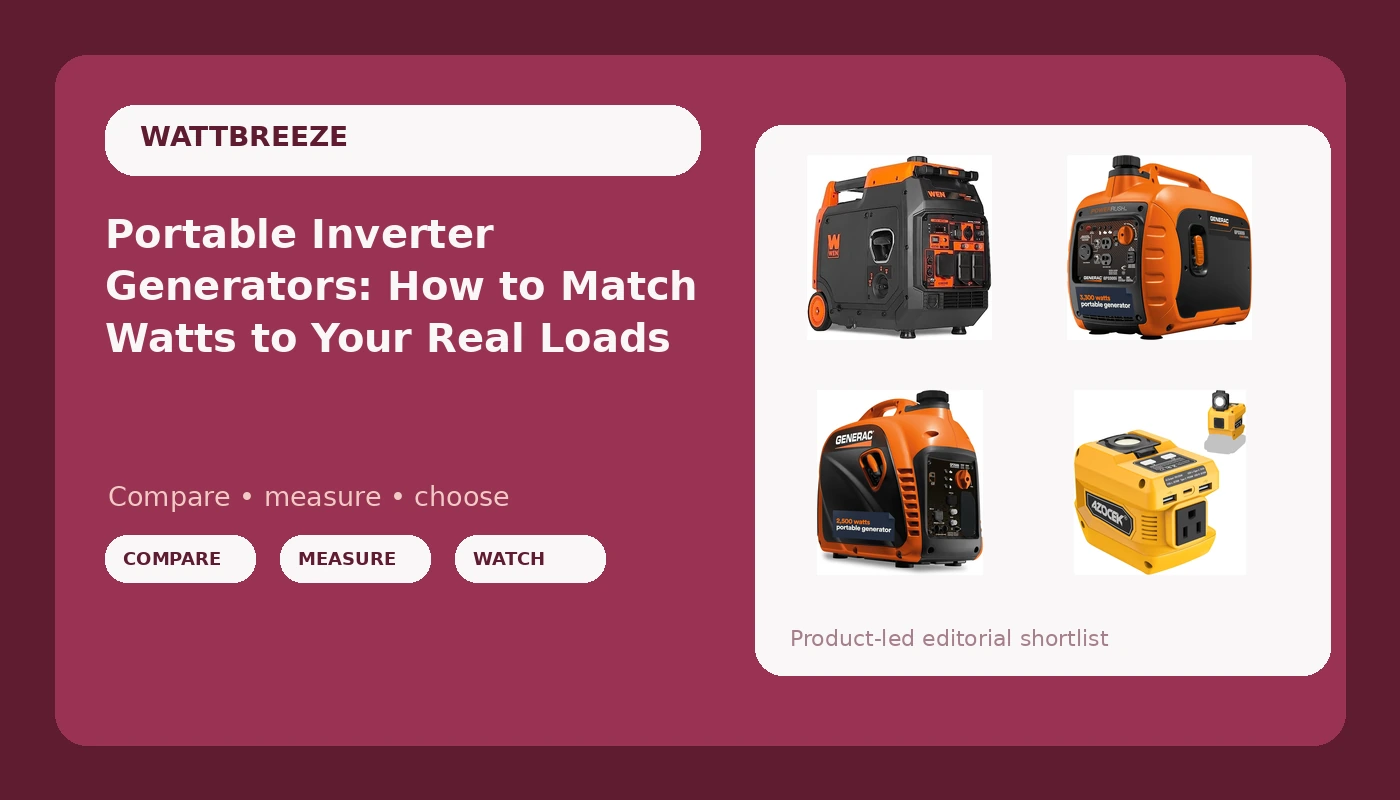
A portable inverter generator is the piece of equipment most people buy twice: once on price, once on reality. The box promises a number, your refrigerator asks for a different number, and the gap between them usually shows up at 2 a.m. during an outage, in the rain, with a phone flashlight clamped in your teeth. This article is about closing that gap before you spend anything. It covers how inverter generators are sized, what running watts and surge watts actually mean, why total harmonic distortion matters if you are charging laptops and phones, and how four specific options in this category fit very different jobs. Two of them are gasoline inverter generators with real household capability, one is a smaller gas unit aimed at light outdoor use, and one is not a generator at all: it is a battery-powered inverter that turns tool batteries into household AC power.
Related: How to Size a Generator for a Fridge, Sump Pump, and Furnace →
Quick answer
Match the generator to your load list, not to the size of your house. Add up the running watts of everything you need on at the same time, then add the single largest surge watt figure from that group, because motor-driven loads like refrigerators, sump pumps, and air conditioners pull roughly two to three times their running watts for a second or two on startup. In this group, the WEN 56477i carries the highest watt rating, the Generac 3,300 watt unit sits in the middle, the Generac 2,500 watt unit is the compact gas option, and the Azocek 220W inverter is a fuel-free way to get a small amount of AC power from Dewalt 20V batteries. If your must-run list is a fridge plus a sump pump plus a furnace blower, you are shopping in the higher-watt end. If your list is a phone, a laptop, and a fan, the battery inverter is a different kind of tool entirely.
Four useful options
| Model | Best fit | What stands out |
|---|---|---|
| WEN Quiet and Lightweight 4800-Watt RV-Ready Portable Inverter Generator with Fuel Shut Off (56477i) | Whole-home essentials and RV use | Highest watt rating in this group, RV-ready naming, fuel shut off |
| Generac 3,300 Watt Gas Powered Portable Inverter Generator, USB Charging | Mid-size outage backup with device charging | 3,300 watts with USB charging built into the panel |
| Generac 2,500 Watt Gas Powered Portable Inverter Generator, Outdoor Use | Light outdoor jobs and small essential loads | Compact gas inverter rated for outdoor use |
| Azocek 220W Power Inverter Compatible with Dewalt 20V Battery | Fuel-free AC power for small electronics | Runs from Dewalt 20V batteries, no fuel or oil to manage |
Highest output in this group: WEN Quiet and Lightweight 4800-Watt RV-Ready Portable Inverter Generator with Fuel Shut Off (56477i)
The fuel shut off is the feature I would look at first, and not because it is exciting. It is boring in the best way. Shutting off the fuel and letting the engine run the bowl dry is the difference between a carburetor that starts on the second pull next spring and a carburetor that needs to come apart on a bench. Ethanol-blended gas left sitting in a float bowl turns to varnish, and varnish is a service bill. On the output side, 4,800 watts gives you genuine headroom: a refrigerator, a furnace blower, a router, and a few lights can share a unit like this if you stagger the big motor starts instead of letting everything kick on at once. The trade-offs are the usual ones for more watts: more weight to move, more fuel burned per hour, and a bigger footprint in the garage.
The middleweight: Generac 3,300 Watt Gas Powered Portable Inverter Generator, USB Charging
This is the size most households actually land on after they do the math honestly. Three thousand three hundred watts covers a refrigerator, a few lights, a router, a laptop, and a phone or two without much drama, and the built-in USB charging means one less brick to lose in a dark kitchen. What it will not do is carry a central air conditioner, an electric range, or a big well pump alongside everything else. If your must-run list has more than one large motor on it, this unit either needs load management or it needs a bigger sibling. Generac's advantage here is not the spec sheet, it is the fact that the name on the side is a company with a parts and service footprint, which matters more in year four than in week one.
The compact gas option: Generac 2,500 Watt Gas Powered Portable Inverter Generator, Outdoor Use
Two thousand five hundred watts is a real number, and it is enough for a specific kind of outage. A refrigerator, a modem, a router, a couple of lamps, and a phone charger fit inside that budget with room to spare. What does not fit is a second big motor starting while the fridge is already running. This is the unit for a tailgate, a campsite, a small job site, or a household that has already decided the sump pump and the furnace are someone else's problem. It is also the one in this group that is easiest to carry, which sounds trivial until you are moving it in the dark on wet grass. Outdoor-use labeling is not decoration: every gasoline generator in this group produces carbon monoxide and belongs outside, well away from windows, doors, and vents.
Prices and availability may change. Product images, names, and retailer links must be matched by verified ASIN. Do not state a current price, rating, stock status, or measured result without current evidence.
Not a generator: Azocek 220W Power Inverter Compatible with Dewalt 20V Battery
The honest framing here is that this belongs in a different conversation from the three gasoline units above. It makes no electricity of its own. It converts what is already stored in a Dewalt 20V pack into AC power, up to 220 watts. That ceiling rules out refrigerators, sump pumps, space heaters, and anything else with a compressor or a heating element. What it does cover is the small stuff: a laptop, a phone, a camera battery, a fan, a string of LED lights, a CPAP machine if the draw is modest enough. The upside is that there is nothing to maintain. No ethanol turning to varnish, no oil to change, no exhaust, no pull cord. Runtime is limited by how many charged batteries you own, which is a very different planning problem than how much gasoline is in the can.
Running watts, surge watts, and why the sticker is not the answer
Every appliance has two numbers that matter. Running watts is the continuous draw, the load the generator has to carry hour after hour. Surge watts, sometimes called starting watts, is the brief spike a motor needs to get spinning, and it is typically two to three times the running figure. A refrigerator that runs at a few hundred watts might demand well over a thousand for a second when the compressor kicks in. A sump pump is worse. A well pump is worse still.
The mistake almost everyone makes is adding up running watts, comparing that total to the generator's running watt rating, and calling it done. That works right up until the compressor starts and the generator either stalls, trips its overload, or browns out everything on the circuit. The correct method is to total the running watts of everything you intend to run simultaneously, then add the largest single surge figure in the group, because motors rarely start at the exact same instant. That combined number is what you compare against the unit's capability.
There is a second reason not to trust the sticker: ratings are published under idealized conditions. Altitude reduces engine output, heat reduces it further, and aging reduces it again. Building in a margin of twenty to twenty-five percent above your calculated number is not being paranoid, it is being realistic about a machine you will depend on in bad weather.
Inverter output, THD, and what clean power buys you
An inverter generator produces AC power electronically rather than directly from the alternator winding, and the practical result is total harmonic distortion, or THD, under five percent. Under five percent is the threshold where laptops, televisions, phone chargers, and modern furnaces stop caring that the power is coming from a generator instead of the grid. Cheap conventional generators often run well above that, which is why some electronics hum, run hot, or refuse to charge at all when connected to one.
This is the reason inverter units cost more per watt than open-frame conventional generators. If you only need to run power tools at a job site, a conventional generator is cheaper and nobody will notice the waveform. If you need to run the things people actually live with, the ones with circuit boards inside them, the inverter premium is doing real work.
The second benefit is noise. Inverter units throttle engine speed to match the load instead of running wide open the entire time, which means at quarter load, where most people actually run them, they are substantially quieter than a conventional unit of similar output. Quiet is not a luxury feature. It is the difference between a generator your neighbors tolerate and a generator that turns a street into a argument at two in the morning. Manufacturer claims about noise should always be read alongside a decibel number measured at a real distance under a real load, not the number printed on the box.
- List every load you must run at the same time, not every load you own.
- Write down the running watts for each one from the appliance label or the owner's manual.
- Add those running watts together to get your continuous load.
- Find the largest surge watt figure among the motor loads and add it to the total of the others.
- Add twenty to twenty-five percent headroom and compare the result to the generator's running watt rating.
Practical guidance before you buy
- Store ethanol-free fuel if the generator will sit for more than a month, and treat anything else with stabilizer.
- Run the unit under a real load every month or two, not just idling in the driveway.
- Never operate a gasoline generator indoors, in a garage, or near a window, door, or vent, no matter how cold it is outside.
- Choose a CO sensor equipped unit for anything that runs near a house, and treat the shutoff as a feature you hope never activates.
- Match your extension cord gauge to the distance and the load, because an undersized cord turns watts into heat.
- Keep a paper log of oil changes, fuel dates, and run hours, since memory is the first thing to fail during an outage.
Which option should you choose?
Choose the WEN Quiet and Lightweight 4800-Watt RV-Ready Portable Inverter Generator with Fuel Shut Off (56477i) when you want the most output in this group and you plan to run multiple household essentials or feed an RV, and when the fuel shut off matters to you for long-term storage. Choose the Generac 3,300 Watt Gas Powered Portable Inverter Generator, USB Charging when your must-run list is a refrigerator plus lights plus communications and you want USB charging without extra adapters. Choose the Generac 2,500 Watt Gas Powered Portable Inverter Generator, Outdoor Use when you need a smaller, lighter gas unit for light loads, camping, or tailgating and you are not trying to carry a whole house. Choose the Azocek 220W Power Inverter Compatible with Dewalt 20V Battery when you already own Dewalt 20V batteries and only need to run small electronics without fuel, exhaust, or maintenance.
The caveat that applies to all four: watt ratings describe what a unit is built to deliver, not what your specific appliance combination will demand. The only reliable way to know is to read the labels on your own equipment and do the arithmetic. Anything beyond that requires measurement with a load bank and a meter, and no spec sheet substitutes for it.
The bottom line
The right portable inverter generator is the one whose real running capacity clears your real must-run load with margin left over. In this group that means deciding first whether you are solving an outage problem or a convenience problem. An outage problem points at the higher-watt gas units, where the WEN 56477i leads on output and the Generac 3,300 watt unit covers a typical essentials list with USB charging on the panel. A convenience problem, the kind measured in laptops and LED lights rather than refrigerators and sump pumps, points at the Azocek 220W inverter and the batteries you already own. Buy for the load you will actually run at 2 a.m., not the load you imagine running on a sunny afternoon.