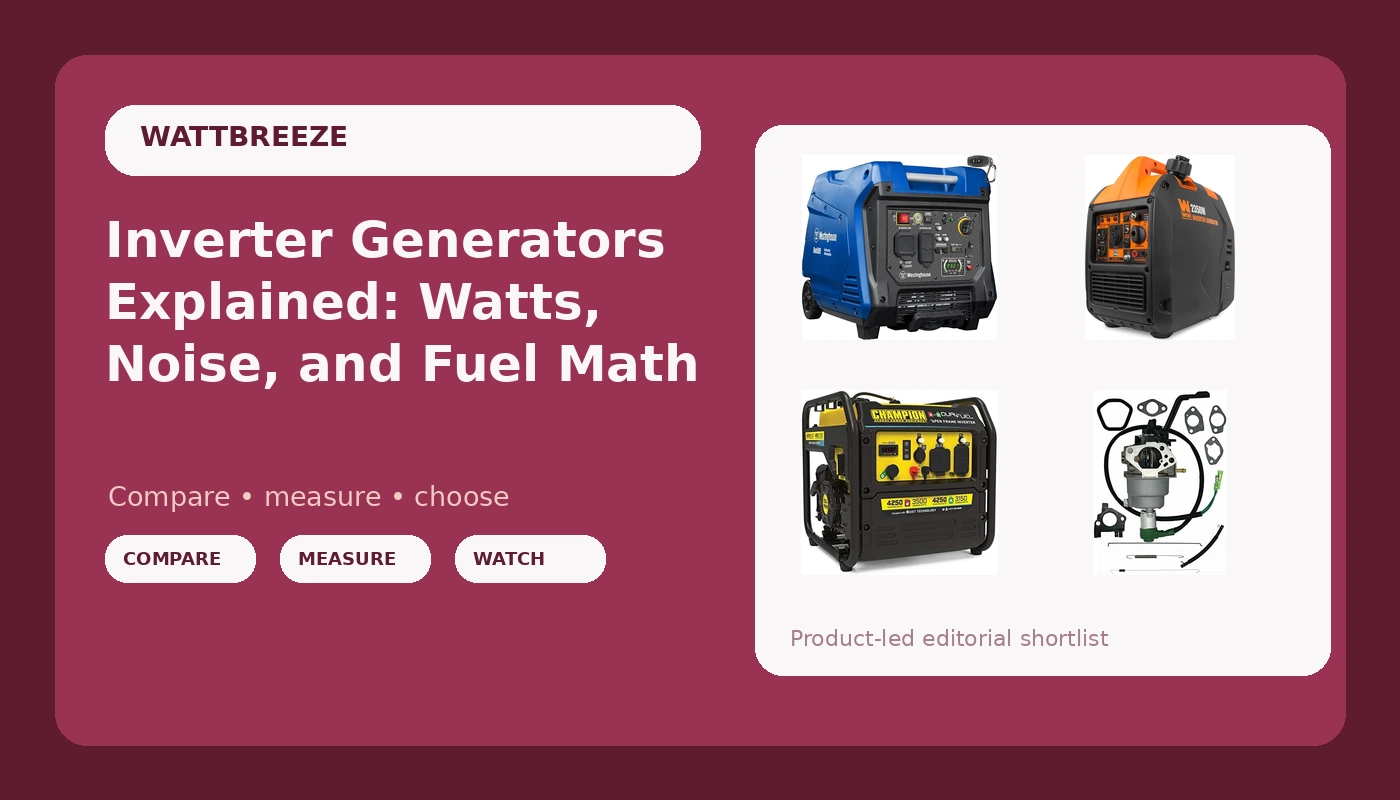
A portable inverter generator is three things bolted together: a small gasoline engine, an alternator, and a power-conditioning board that cleans up the current before it reaches your outlets. That third piece is what separates an inverter from a cheap conventional unit, and it is also why the price climbs. If you are shopping for storm backup, a campsite, or a tailgate spot, the real question is not which box has the biggest number printed on it. It is which unit will turn your fridge over at 2 a.m., run long enough to matter, and keep the people next door from counting the hours until you shut it down. This explainer walks through four portable inverter generator options, including one replacement part that keeps an older machine running, and covers the numbers worth checking before you spend anything.
Related: How to Size a Generator for a Fridge and Sump Pump →
Quick answer
Sizing comes before shopping. Write down the running watts of everything you want powered at the same time, then add the surge spike of the largest motor in that group, which is usually a fridge, a well pump, or a window air conditioner. That total is your ceiling, not the peak number on the front of the box. Past watts, three things separate a good experience from a bad one: total harmonic distortion under 5 percent so electronics behave, a decibel figure taken at 25 feet instead of one foot, and a fuel plan built on half-load consumption rather than the quarter-load number in the brochure. A compact 2,000-watt class inverter covers small loads you can carry easily. For a fridge, a sump pump, and some lights, a 4,000-watt class dual fuel unit or a 5,000 peak watt model gives you headroom. If an older Champion or Predator has quit on you, a replacement carburetor is often the answer before a whole new generator is.
4 useful options
| Model | Best fit | What stands out |
|---|---|---|
| WEN Super Quiet 2350-Watt Portable Inverter Generator (56235i) | Small loads, camping, tailgating, easy carrying | Lightweight class with a fuel shut off for cleaner storage |
| Champion Power Equipment 4250-Watt Dual Fuel RV Ready Open Frame Inverter | Home backup and RV use where two fuel types help | Dual fuel capability with quiet technology and an RV ready design |
| Westinghouse 5000 Peak Watt Super Quiet Portable Inverter Generator | Larger household loads and remote start convenience | Remote electric start with auto choke, wheel and handle kit, parallel capable |
| YAMAKATO Huayi P27-1D Gasoline Generator Carburetor | Repairing a Champion or Predator generator that will not run right | A replacement carburetor built for a specific family of units |
Compact pick: WEN Super Quiet 2350-Watt Portable Inverter Generator
The appeal here is weight and simplicity. A unit in this class handles phone chargers, laptops, a small fan, lights, and a modest fridge if you are careful about what runs at the same time. What it will not do is carry a well pump, a space heater, and a microwave together. The first thing to check on any unit in this size is which figure the model number refers to. A wattage in a product name may be a peak or starting number, and the running watts are the number that matters hour after hour. Read the label on the unit itself, not the listing headline, and confirm the running rating before you plan loads around it.
Dual fuel pick: Champion Power Equipment 4250-Watt Dual Fuel Open Frame Inverter
Dual fuel is genuinely useful, and it comes with a caveat worth understanding before you buy. Propane typically produces fewer watts than gasoline on the same machine, so the gasoline rating is not the number you plan around when you are running off a tank. Propane also needs the correct hose and regulator, and it stores far better than gasoline does, which matters if the unit sits for months between outings. The open frame design is the other trade-off. It keeps the unit lighter and easier to service than a fully enclosed suitcase, but an open frame generally makes more sound. If noise is the deciding factor for you, insist on a decibel number measured at 25 feet at quarter load instead of accepting the word quiet as a specification.
Larger pick: Westinghouse 5000 Peak Watt Super Quiet Portable Inverter Generator
Electric start is not a luxury once you have tried to start a cold engine in a downpour at night. Auto choke takes the guesswork out of the first thirty seconds, and the wheel kit matters more than people expect, because a machine in this class is heavy enough that carrying it is a two-person job you will not want to do twice. Parallel capability means you can pair it with a compatible second unit and a parallel kit to increase available output, which is a real option if your load grows later, though it does mean buying and storing a second generator. Note also that 5,000 peak watt is a starting figure in the product name. Running watts are what you plan around, and they will be lower.
Repair part: YAMAKATO Huayi P27-1D Gasoline Generator Carburetor
A carburetor is not magic, just math and patience. What kills them is ethanol fuel left sitting in the bowl, which turns to varnish, plugs the jets, and turns a working generator into a driveway ornament. Before you order any carburetor, confirm the model number on your engine and match it against the part you are buying, because the same engine family uses several different carburetor configurations and a near match is not a match. If you can clean and rebuild the original instead, that is usually the better path. If the body is corroded or a jet is seized, replacement is simpler than a rebuild. Either way, the fix only holds if you change your storage habits afterward.
Prices and availability may change. Product images, names, and retailer links must be matched by verified ASIN. Do not state a current price, rating, stock status, or measured result without current evidence.
Running watts, surge watts, and the math that decides your fridge
Marketing leads with the biggest number, and the biggest number is almost always the peak or starting figure. The number that actually runs your house is the running watt rating, the continuous load a generator can carry hour after hour. A motor driven appliance draws two to three times its running watts for a fraction of a second at startup, and that spike, called surge, is what makes a fridge compressor click off instead of kicking in. This is why a generator with a generous peak rating can still fail on a fridge that a smaller unit with a realistic running rating handles fine.
Do the arithmetic on paper. List each device, its running watts, and whether it has a motor. Total the running watts of everything you want on at once, then add the surge spike of the single largest motor in that list. That gives you the minimum your unit has to deliver, and you should still leave headroom, because motors age and draw more as they wear. Sump pumps and well pumps are the sneaky ones. They cycle on without warning, and they surge hard. If your backup plan is a basement full of water, that pump gets priority over the space heater every time.
Why THD and dB numbers matter more than the word quiet
THD stands for total harmonic distortion, and it describes how clean the power coming out of the outlets really is. Under 5 percent is the working threshold for laptops, televisions, and phone chargers. Inverter generators exist specifically to deliver that clean waveform, while cheap conventional units often do not, which is why an inverter costs more per watt and why it is worth the difference if anything with a circuit board is plugging in. The word inverter on a listing is a claim. The THD figure in the manual is evidence.
Noise works the same way. Any manufacturer can print the word quiet. A useful measurement is taken 25 feet from the unit at quarter load, which is where neighbors and campsite rules actually live. A one foot, no load reading tells you almost nothing about the sound your family will hear through a bedroom wall at midnight. If a listing does not publish a decibel figure with a distance attached to it, treat the noise claim as unverified until you hear it yourself.
- Total the running watts of every device you need at the same time.
- Identify the largest motor in that list and add its startup surge.
- Confirm the generator's running watt rating from the unit or manual, not the listing headline.
- Check THD if electronics are on the load, and check a dB figure with a distance if people sleep nearby.
- Plan fuel using half-load consumption, since quarter-load numbers are optimistic in real outages.
Fuel, oil, and storage habits that save the machine
- Keep ethanol-free fuel for anything that will sit more than a month, and use stabilizer if you cannot.
- Run the carburetor dry with the fuel shut off before storage, then drain the bowl.
- Change oil on the schedule in the manual, not on the schedule you remember, and check it before every storm.
- Test under a real load before the season starts, not during the first hour of an outage.
- Store fuel safely and rotate it, so the jug in the shed is not two years old when you need it.
Which option should you choose?
Choose the WEN Super Quiet 2350-Watt Portable Inverter Generator when your loads are small, you move the unit by yourself, and you want a fuel shut off to make storage easier. Choose the Champion Power Equipment 4250-Watt Dual Fuel RV Ready Open Frame Inverter Generator when you want the option of propane, need more output than a compact unit gives, and can live with an open frame design. Choose the Westinghouse 5000 Peak Watt Super Quiet Portable Inverter Generator when remote electric start, a wheel kit, and room to expand through parallel capability are worth the extra weight. Choose the YAMAKATO Huayi P27-1D Gasoline Generator Carburetor when the machine you already own has stopped running right and the carburetor is the culprit.
Two things I will not do for you here. I will not call any of these the quietest or the best, because a noise claim without a decibel reading at a stated distance is marketing, and a wattage in a product name is not a running rating. Confirm the numbers in the manual for the exact model you receive, then load test it yourself before you need it. A generator you have never run under load is a hope, not a plan.
The bottom line
Buy for the load you actually have, not the number that looks best on a shelf. Add up running watts, account for the biggest surge, verify the running rating on the unit itself, and pick an inverter if anything with a circuit board is going to plug into it. A compact unit like the WEN covers small loads and moves easily. A dual fuel Champion gives you fuel flexibility and more capacity. The Westinghouse adds remote start and expansion room. And if the generator in your shed already turns over but runs badly, a carburetor and better fuel habits cost far less than a new machine.