I spent 22 years rebuilding small engines, and the question I hear most after any storm is simple: what do I actually need? Not the biggest generator on the lot, not the one with the loudest sticker, but a portable inverter generator sized to the loads that keep a house livable. This guide explains the numbers that matter, the ones the marketing copy hopes you skip, and how to pick a unit that starts on the second pull and runs until the fuel runs out. I test generators with a load bank and a decibel meter at 25 feet, and I have zero patience for peak watts printed in big type while running watts hide in the fine print.
Related: Gas vs Solar Generators: Which Backup Power Makes Sense →
Quick answer
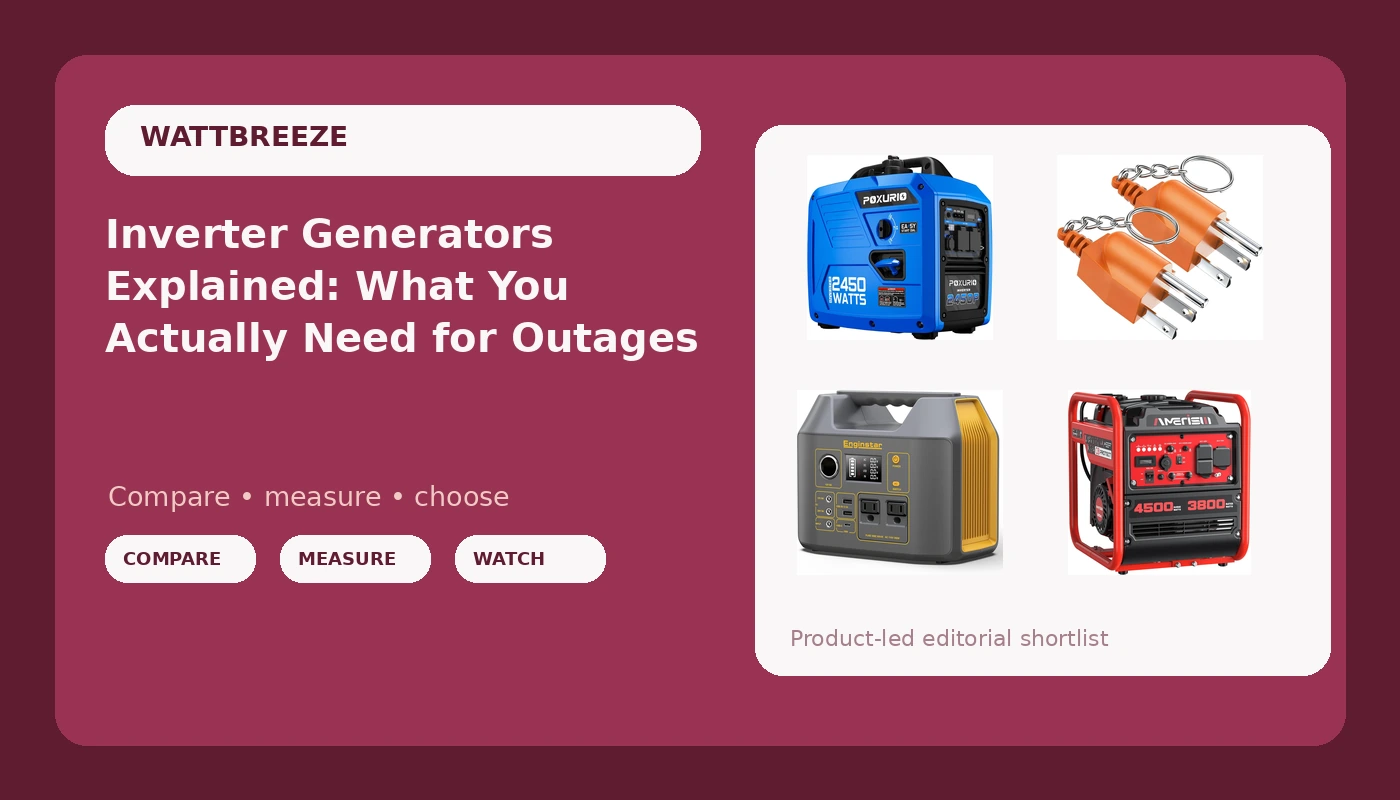
A portable inverter generator is the right choice for most homes, campers, and tailgates because it delivers clean power with total harmonic distortion under 5 percent, runs quieter than a conventional open-frame unit, and sips fuel when the load drops thanks to eco mode. Size it by surge watts, not by the biggest number on the box: add the running watts of your fridge, sump pump, and a few lights, then account for the startup spike of the largest motor. The four options here cover the range, from a 2450-watt camping unit with an 8.3-hour fuel rating to a 4500-watt open-frame inverter with a carbon monoxide alarm, plus a small solar power station and a grounding accessory that solves a real safety problem.
4 useful options
| Model | Best fit | What stands out |
|---|---|---|
| 2450-Watt Portable Inverter Generator | Small loads, camping, apartment balconies | 120V gas unit, 1.6-gallon tank, EPA compliant |
| AMERISUN 4500W Open Frame Gas Inverter Generator | Fridge plus sump pump, RV, job sites | CO alarm, parallel ready, 4500W capacity |
| EnginStar 296Wh Portable Solar Generator | Phones, laptops, CPAP, LED lights | Pure sine wave output, solar input |
| Generator Grounding Plug with Keychain | Bonding neutral to ground on inverter units | NEMA 5-15P to 5-15R/TT-30R, 2-pack with keychain |
The small gas inverter: 2450-Watt Portable Inverter Generator
Here is the trade-off, plain and simple: 2450 watts will run a modern refrigerator, a handful of LED lights, a phone charger, and a box fan at the same time, but it will not start a well pump, a 5,000 BTU window AC is borderline, and a space heater on high will eat most of the budget before anything else gets plugged in. The 8.3-hour run time on the box is measured at a quarter load, which is the industry standard. At half load, plan on roughly two-thirds of that. At full load, cut it in half. That is the math I use for every unit, and the math you should use for fuel planning. The quiet claim is believable for an inverter of this size, but you should still set it up at least 20 feet from any window and never inside a garage. This unit is the right call if your outage plan is a fridge, a lamp, and a way to charge phones.
The big-value inverter: AMERISUN 4500W Open Frame Gas Inverter Generator
This is the unit I would point a homeowner toward when the fridge is not the only load. At 4500 watts you can run a refrigerator, a sump pump, a chest freezer, and still have room for lights and a router, which is the difference between an inconvenience and a livable nine-day outage. The open-frame design means it is louder than a closed-frame inverter of the same wattage, so do not believe anyone who calls it whisper quiet. Set it outside, downwind of open windows, and at least 20 feet from the house. The CO alarm is the feature that earns my respect because it removes the worst failure mode of portable generators: carbon monoxide buildup in a partially enclosed space. Parallel ready is a genuine bonus if you ever need to double your capacity for a bigger load or a second property. The trade-off is weight and noise versus the closed-frame units, but for the money, this is the realistic whole-house backup most people actually need.
The solar option: EnginStar 296Wh Portable Solar Generator
Here is the honest limit: 296 watt-hours is about enough to run a 60-watt LED light for four hours, charge a laptop twice, or keep a CPAP machine going through the night. It will not run a refrigerator, and it will not run a sump pump. What it does well is the job no gas generator should do: powering small electronics quietly and safely inside a tent, a bedroom, or a hotel room. I keep one of these in my kit for the nights when I do not want to listen to an engine, and it pairs beautifully with a gas generator, covering the tiny loads while the big unit handles the fridge. The pure sine wave output matters because cheap modified sine wave inverters make some laptop chargers and CPAP units hum or misbehave. If your outage plan is mostly about communication, medication, and light, this is the piece that fills the gap without burning fuel.
The safety accessory: Generator Grounding Plug with Keychain
Grounding confuses more people than any other part of generator setup, so let me explain it in one breath. Some inverter generators float the neutral, meaning the neutral and ground are not connected internally. When you plug that generator into an RV or a transfer switch that expects a bonded neutral, you can get a shock hazard or a tripped GFCI. This plug creates that bond at the receptacle, which is exactly what the RV or the transfer switch wants to see. It is a two-dollar part that solves a real problem, and the keychain means it stays with the generator instead of in a drawer. The trade-off is knowing when you need it: if your generator manual says the neutral is floating and you feed an RV or a house panel, you want this. If your generator is already bonded, you do not. Read the manual first, then decide. This is the kind of accessory I recommend because it prevents the 2 a.m. surprise, not because it adds power.
Prices and availability may change. Product images, names, and retailer links must be matched by verified ASIN. Do not state a current price, rating, stock status, or measured result without current evidence.
Surge watts, running watts, and the sticker math
Every generator box lists two numbers, and the marketing department wants you to read only one. Surge watts, sometimes called peak or starting watts, is the brief spike a motor needs when it first spins up, usually two to three times its running draw. A refrigerator compressor can surge to 1,200 watts for a fraction of a second even though it runs at 400. Running watts is the continuous load a generator can carry hour after hour, and that is the number that decides whether your fridge actually turns on and stays on. When a generator is overloaded, the inverter shuts down or the engine bogs, and a fridge that cycles on and off can trip a marginal unit every time the compressor kicks in. That is why I tell people to add the running watts of everything they plan to run, then add the surge of the single biggest motor, and buy a unit with at least that much surge capacity. Eco mode complicates the math on some units because it drops engine speed to match the load, which saves fuel and noise but can react too slowly for a sudden fridge surge. If your eco mode ever lets the lights blink when the compressor kicks in, turn it off and run at fixed RPM. Run time on the box is rated at 25 percent load, so plan fuel around the real number: at half load, cut the rating by a third, and at full load, cut it in half.
Why THD and clean power matter
Total harmonic distortion, or THD, is the measure of how clean the electricity is, and it is the difference between an inverter generator and a conventional one. A conventional generator produces power with THD that can climb past 20 percent under load, which makes some electronics hum, run hot, or simply refuse to charge. Inverter generators rectify the raw AC to DC and then rebuild a clean sine wave, holding THD under 5 percent, which is the threshold where laptops, TVs, phone chargers, and CPAP machines are happy. If you are only running a heater, a sump pump, and incandescent lights, a conventional generator is cheaper per watt and perfectly fine. If you are charging a laptop, running a router, or powering anything with a switching power supply, the inverter is worth the extra money. This is also why a small solar power station with pure sine wave output can handle electronics that a cheap conventional generator would stress. Clean power is not a luxury for most modern households, it is the difference between charging your phone and frying its charger.
- Write down the running watts of every device you need during an outage: fridge, sump pump, freezer, lights, router, phone chargers, and any medical equipment.
- Add the surge watts of the single largest motor, usually the fridge or the sump pump, to that running total.
- Compare the total to the surge rating of the generator you are considering, and make sure the running total stays under the running watts rating.
- Decide whether your loads include sensitive electronics, and if they do, limit your search to inverter units with THD under 5 percent.
- Plan fuel around the real run time, not the sticker, and always store enough ethanol-free fuel with stabilizer to cover at least half again as many days as you expect.
Fuel, storage, and the 2 a.m. start
- Use ethanol-free fuel whenever you can find it, and add stabilizer to any fuel that will sit in the tank or a jug for more than a month.
- Never run a generator inside a garage, a porch, or a partially enclosed space, even with the door open, and keep it at least 20 feet from windows and doors with the exhaust pointing away.
- Start the generator once a month, let it run under a small load for 15 minutes, and drain the carburetor bowl before long-term storage.
- Keep a spare spark plug, a small funnel, and a fuel jug with a dedicated siphon in the same bin as the generator, because the 2 a.m. failure is almost always fuel or spark related.
- Test your generator with the actual loads you plan to run before an outage, not after, and time how long a full tank lasts at half load so the fuel plan is based on your unit, not the box.
Which option should you choose?
Choose the 2450-Watt Portable Inverter Generator when your outage plan is a fridge, a few lights, and phone charging, or when you camp and want a quiet 120V unit that sips fuel. Choose the AMERISUN 4500W Open Frame Gas Inverter Generator when you need to run a fridge, a sump pump, and a chest freezer at the same time, or when you want a unit that can grow with a parallel kit. Choose the EnginStar 296Wh Portable Solar Generator when your needs are tiny loads only, phones, laptops, CPAP, and LED lights, and you want silence and no fuel. Choose the Generator Grounding Plug with Keychain when your inverter generator floats the neutral and you feed an RV or a transfer switch that expects a bonded ground.
The evidence here is the spec sheet, not a load test, and specs are the starting point, not the verdict. My rule stands: whatever unit you buy, run it under load before you need it, measure the real run time, and confirm the CO alarm works. The sticker is a promise, and a generator only earns your trust after it starts on the second pull in the rain.
The bottom line
A portable inverter generator is the right tool for most storm prep, camping, and tailgate setups because it pairs clean power with reasonable noise and honest fuel economy. The 2450-watt unit covers the small-load crowd, the AMERISUN 4500W handles a real house load with a CO alarm and parallel capability, the EnginStar power station fills the silent, fuel-free niche, and the grounding plug solves a safety problem most owners do not know they have. Buy the size that matches your actual loads, plan fuel around the real run time, and test everything before the storm, not during it. That is the whole secret, and it has not changed in 22 years.