Most people buy backup power backwards. They buy the unit first, then find out the hard way that the number on the box was written at sea level with a gentle breeze at a 25 percent load. A working inverter generator home backup plan runs the other direction: measure the load, decide how many days you have to carry it, then buy the hardware that matches the math.
I learned that in Asheville. After Helene took the grid down for nine days, I watched a polite street turn on each other over a 50 foot extension cord while a contractor generator rattled windows at 2 a.m. That week is why I bought a load bank, a decibel meter, and a paper logbook, and why I stopped believing spec sheets.
This is the setup I would run today. A gas inverter generator does the heavy, dirty work while fuel is available. A battery system covers the hours when you cannot stand the sound of an engine, and covers the refrigerator at 3 a.m. when you are not getting up to pull a cord. Two machines, one plan, and a list of steps you can finish this weekend, long before anything shows up on the radar.
Why you should trust me
I ran a small engine repair shop in Asheville for 22 years, until the work got quieter and the storms got louder. Since then I have put more than 40 generators through a load bank with a decibel meter parked 25 feet away and a stopwatch on every fuel jug.
I do not repeat a run time claim I have not timed myself, and I do not call anything quiet without a dB reading to back it up. I still own the $350 budget unit I tell people to think twice about, so this is not a pitch for the most expensive thing on the shelf. It is a pitch for measuring first.
What backup power actually means at the wall
Five numbers decide whether your plan survives contact with a storm.
Surge watts. The startup spike a motor needs, usually two to three times its running watts. This is the number that decides whether your fridge compressor actually turns over or just hums and trips the overload.
Running watts. The continuous load a unit can carry hour after hour. During a nine day outage, this is the number you live inside.
THD. Total harmonic distortion. Under 5 percent means laptops, televisions, and phone chargers are happy. Inverter generators deliver that. Cheap conventional units do not, which is why your electronics whine on them.
dB(A) at 25 feet. The honest noise measurement, taken at quarter load where people actually run these things. A box that says "whisper quiet" with no decibel number is telling you nothing.
Run time. Spec sheets measure it at 25 percent load. At half load, cut it by a third. At full load, cut it in half. Plan your fuel around the real number, not the brochure number.
The watt meter does not care what the box says. Neither should you.
The two units this plan is built on
One of these makes watts out of gasoline, which is cheap and loud and unlimited as long as you keep driving to the pump. The other stores watts in a battery, which is silent and finite and needs no fuel at 3 a.m. Together they cover the whole outage, including the parts nobody plans for.
The fuel side: Pulsar PGD40ISCO Ultra Light Quiet 4000W Portable Gas Inverter Generator, white
 Visit on Amazon →
This is the machine I would hand someone who wants a 4,000 watt class inverter generator that one person can actually move. Inverter output is the point here. Clean power means your fridge control board, your modem, and your laptop chargers do not care that the grid is gone.
It burns gasoline, which means it needs three things from you before it ever earns its keep: oil in the crankcase, ethanol free fuel in the tank, and a place to sit that is at least 20 feet from any window, door, or intake vent. Carbon monoxide is the part of generator ownership that kills people, and it kills them in garages. Set it up outside, every single time, no exceptions for rain.
Confirm two things on the listing before you buy, because I do not repeat claims I have not measured: the carbon monoxide shutoff and the noise rating at load. If a seller will not publish a dB number at 25 feet, assume it is louder than you want.
Flaws but not dealbreakers: It is a gas engine, so it is loud enough to be a neighbor problem during quiet hours, and it needs fuel hauled to it. That is exactly why the second unit exists in this plan.
Anyone who needs to carry a fridge, a freezer, a few lights, and a router through a multi day outage should start here.
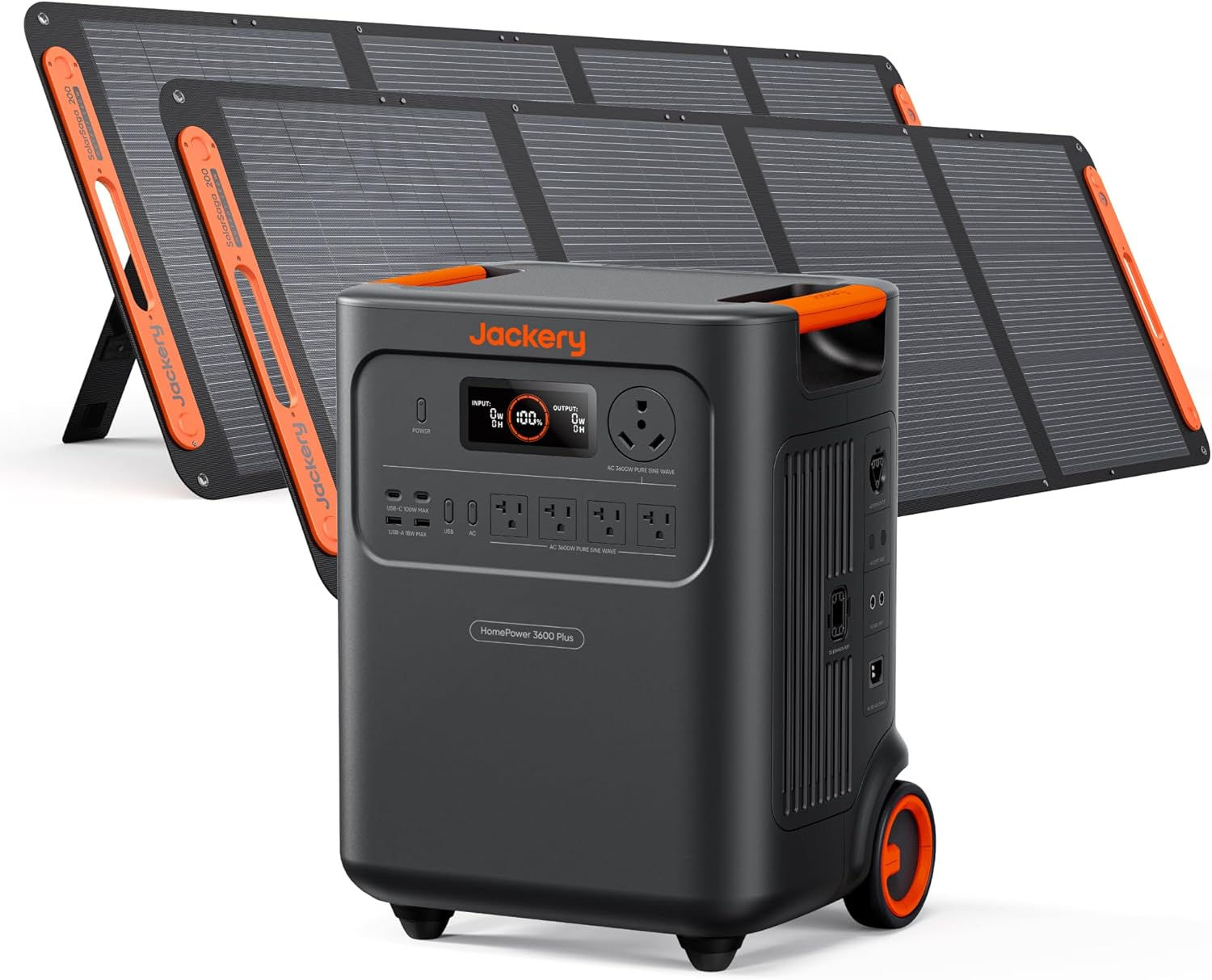
The battery side: Jackery HomePower 3600 Plus Portable Power Station with 2X 200W Solar Panels, 3600W AC Output, 3584Wh LFP Solar Generator, Expandable up to 21kWh, Essential Home Backup for Home Use, Emergencies, RV
 Visit on Amazon →
This is the quiet half of the plan. A 3,584 watt hour LFP battery with 3,600 watts of AC output and two 200 watt solar panels is enough to run a refrigerator, a modem, lights, and phones overnight without a single decibel. LFP chemistry is the part I care about most, because it holds up to being charged and discharged for years without the capacity slide you get from cheaper cells, and it does not need to be at 100 percent for storage the way older chemistries did.
The expandability matters more than the headline capacity. Starting at 3,584 watt hours and scaling up to 21 kWh means you can buy into the system now and add capacity later, which is a much easier conversation with your budget than buying the whole house solution on day one.
The two 200 watt panels are the reason this belongs in an outage plan and not just a tailgating plan. Nine days of grid down is a fuel logistics problem, and solar is the one input that keeps arriving whether or not the gas station has power.
Flaws but not dealbreakers: Solar charging is weather dependent. On day four of rain, this is a top-up system, not a primary one. Plan for the generator to carry the heavy loads and the battery to carry the quiet ones.
Anyone who wants the fridge and the internet to keep running at 3 a.m., or who dry camps and tailgates the rest of the year, will get the most out of this.
How to size your load before you spend a dollar
Do this before you buy anything. It takes 20 minutes and it is the difference between a plan and a guess.
Step one: List the circuits that matter. Not the whole house. Pick the refrigerator, the freezer, the sump pump if you have one, the well pump if you are on a well, the modem, the router, and a couple of lamps. That is the list.
Step two: Write down running watts for each. Every appliance has a data plate or a manual. Fridges and freezers are usually a few hundred watts running. Sump pumps and well pumps vary widely, so look yours up rather than guessing.
Step three: Add the surge. Take your single largest motor and multiply its running watts by three. That spike is what the generator has to survive, and it is the number people miss when they buy a small unit and watch the fridge fail to start.
Step four: Add them up honestly. The sum of the running watts plus the largest surge is your target. If that number is over the running rating of the unit you were considering, you have your answer.
Step five: Measure instead of guessing, if you can. A plug in watt meter costs less than a tank of fuel and will show you what your fridge actually draws at compressor start. Real numbers beat data plates every time.
How to place and fuel the generator side
Placement first. Outside, at least 20 feet from the house, with the exhaust pointed away from windows, doors, and any intake vent. Never in a garage, never in a breezeway, never under a carport with one open side. If you are running it in rain, you need a purpose built cover or an open sided structure with the exhaust clear, not a tarp draped over a hot muffler.
Cords second. Use one heavy gauge cord rated for the run and the load rather than daisy chaining three light ones. Voltage drop over a long cheap cord is how people burn up fridge compressors.
Never backfeed. Do not plug a generator into a wall outlet or a dryer receptacle. If you want whole house coverage, that is a transfer switch installed by an electrician, not a suicide cord from a forum.
Fuel third. Ethanol free fuel is the only fuel I let sit in a carburetor for more than a month. E10 turns into varnish and a service bill. Fill the tank before the storm, not during it, and keep a stabilized can in reserve.
Start it before you need it. Run the unit for 20 minutes under a real load once a month. A generator that needs a YouTube tutorial to start will fail at 2 a.m. in a storm. Pull cords do not buffer.
Eco mode caveat. Eco mode saves fuel and noise by dropping engine speed to match the load, but on some units it cannot react fast enough to catch a fridge surge. If your fridge trips the overload in eco mode, take it out of eco mode for that appliance.
How to set up the battery side for quiet hours
Charge the battery to full while the grid is still up, and top it off any day the forecast turns. Then treat it as the night shift.
Run the fridge, the modem, the router, and phone chargers off the battery overnight. Shut the generator down at a reasonable hour, which is the single best thing you can do for your relationship with the people next door. During the day, run the generator for the heavy loads and let the two 200 watt panels push charge back into the battery, so you are not burning fuel to top off a battery you could have filled with sunlight.
Keep the battery inside, in a conditioned space, and keep it off a concrete floor in a cold garage if you can help it. Cold capacity is real capacity lost.
How to run a nine day outage
Fuel math comes first. If a spec sheet says 12 hours at 25 percent load, plan on eight hours at half load and six at full load. Multiply that by the number of days and you have your fuel list. Buy it early, store it safely, and rotate it into your car so it does not go stale.
Rotation comes second. Generator during the day for the heavy loads, battery at night for the quiet ones. Run the fridge in two hour blocks if you have to choose, and keep the freezer closed.
Neighbor math comes third. Noise is a neighbor problem until it is your problem. A dB reading at 25 feet, an extension cord run politely discussed in advance, and a shutdown time everyone agrees on will do more for your street than any feature on the box.
How to store everything between storms
Drain the carburetor or run it dry, add stabilizer to whatever fuel stays in the can, change the oil on schedule, and pull the spark plug once a season to look at it. Exercise the generator monthly under load.
For the battery, keep it out of extreme cold, keep the solar panels clean, and check the state of charge every couple of months. LFP handles partial charge storage well, which makes it the easier of the two to park for a season.
What this all costs
Two units, two roles, one plan. The gas inverter generator carries the surge loads and the long days. The battery and panels carry the quiet hours and keep arriving when the fuel runs out.
You do not have to buy both at once. Start with whichever failure mode scares you more, the noise and the fuel, or the silence at 3 a.m. Either one alone beats a dark house and a 50 foot cord argument.
Check current Amazon price on each listing and do the math against your own load list. The load bank does not care what the box says, and neither should your checkbook.