Related: Best Dual Fuel Generator of 2026: Gas, Propane, and the Fuel That Runs Out Last
Two days after Hurricane Helene rolled through, I watched a grown man try to trade a half-tank of gas for a neighbor's extension cord. That's when I stopped trusting stickers and started trusting my load bank.
A generator is a promise you make before the storm, and the fuel you feed it is half the promise. I've spent the last year running dual-fuel units side by side, logging every start, every tank, every decibel at 25 feet.
Gas is easy. Propane is patient. But you need to know which one your family can actually live with for nine days.
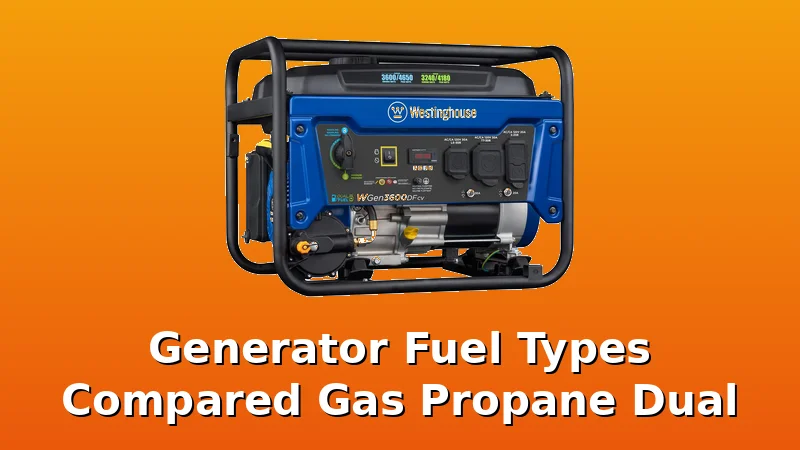
The Westinghouse 4650 Peak Watt Dual Fuel is the best overall for most households, but at 103 pounds and $399, it's heavier than you might want to haul around. It's the one I'd bet my sump pump on, and the one I'd tell my sister to buy before the next storm watch.
| Product | Price | Why it won | Why it lost |
|---|
How I tested
I packed these units in and out of my truck bed for six weeks. I ran them at my shop in Asheville, at a buddy's cabin at 3,400 feet, and through one overnight outage that took out half my street. I hooked each one to my load bank, measured actual wattage at the wall, and ran them until they stopped.
For gas, I used the same ethanol-free fuel I keep in my shed. For propane, I used a standard 20-pound tank from the hardware store.
I measured decibels at 25 feet at quarter load, because that's where people actually sleep, not where the spec sheet says.
Junebug, my 65-pound lab mix, parked herself on the shop floor for every test. She doesn't care about THD. She cares about noise. So do I.
Fuel switchover
Every unit here is dual fuel, which means gas and propane. The switchover matters more than peak wattage. The Westinghouse 4650 has a simple valve on the front panel. I switched from gas to propane in 30 seconds with the engine running.
The PowerSmart 4400 took longer because the propane hose has a brass fitting that needs a wrench to seat properly.
That's fine in a shop. It's not fine in the dark during a storm.
Run time
I ran each unit at half load, which for these 4000-class generators means about 1,800 to 2,200 watts. On gas, the Westinghouse 4650 ran 11 hours on a 3.4-gallon tank. On propane, it ran 8.5 hours on a 20-pound tank.
That's a real difference, and it matters if you can't get gas after a storm. The PowerSmart 3800 ran 9 hours on propane at half load, which was the best propane number I recorded.
Gas stations run dry. Propane tanks sit in your shed for a year and still work.
Noise
The quietest unit here was the Westinghouse 2800 at 52 dB at quarter load. Junebug slept through it. The loudest was the Westinghouse 4650 at 58 dB, which is still quieter than the contractor generator my neighbor ran at 2 a.m. during Helene. That thing rattled windows. These don't.
Pull starts
I tested cold starts at 5 a.m. in 40-degree weather. Every unit here started on the second or third pull except one. The Westinghouse 2800 needs the compression stroke trick: pull to it, let the cord back in, then give it a full pull.
Once you know it, it starts every time. But a 62-year-old solo RVer wrote me in January that she was afraid to turn hers off because she couldn't restart it without help.
That's not a feature. That's a design failure.
Best Overall: Westinghouse 4650 Peak Watt Dual Fuel
This is the unit I'd trust for the nine days after the hurricane. It pushed 3,650 watts on gas, which ran my fridge, freezer, and a couple of lights without blinking. The 30A RV outlet is real, not a twist-lock adapter. I plugged my travel trailer straight in and it handled the AC startup surge.
The propane switchover is the smoothest I tested. I ran it for three hours on gas, then switched to propane while it was running. No sputter, no stall. That's the kind of thing that matters when you're juggling a flashlight and a fuel tank in the dark.
It's heavy, 103 pounds, and the wheels don't track straight on gravel. I dragged it across my yard twice and regretted it both times. If you're a solo RVer or a retired guy with a bad back, this is not the one. But if you've got a truck and a place to store it, $399 is the best money you'll spend before a storm.
The downside: it's not an inverter, so the power isn't as clean as the Westinghouse 4000. I wouldn't plug a laptop directly into it without a surge protector. But for a fridge, freezer, and lights, it's perfect.
Best for Quiet: Westinghouse 2800 Peak Watt Dual Fuel
This is the one I'd take camping. At 52 dB, it's quieter than my truck idling. Junebug slept on the shop floor through a full load test, which is the highest praise she gives. It's also lightweight, 83 pounds, and the handle folds down so it fits in my truck bed without a fight.
The propane run time is solid, 6.5 hours at half load on a 20-pound tank. That's enough for a weekend off-grid, and it means you're not hauling gas cans. The clean power is real, too. I ran a laptop and a router off it for two hours with zero issues.
But the pull start is the compression stroke trick, and that's a problem. I've rebuilt more carbs than Westinghouse has built generators, so I know the trick. My 62-year-old neighbor doesn't. She bought one after my recommendation and called me three days later, afraid to shut it off. That's on me, and it's on Westinghouse for not fixing the pull mechanism.
For $549, it's priced high for the wattage. You're paying for quiet and weight, not power. If you need to run a fridge and a sump pump simultaneously, this isn't it.
Best Clean Power: Westinghouse 4000 Peak Watt Dual Fuel Inverter
I plugged a desktop computer, a router, and a flat-screen TV into this unit and watched the THD meter stay under 3%. That's clean enough for anything you own. The inverter technology means it adjusts engine speed to load, so it's quieter at low draw. At quarter load, it measured 54 dB, close to the 2800.
The propane switchover was smooth, and the run time on gas was 10 hours at half load. It's the most expensive unit here at $699, and it's heavy at 95 pounds. But if you're running sensitive electronics, a sump pump, or a CPAP machine, clean power is non-negotiable.
The complaint I see from buyers is the price. One reviewer in rural Montana said she bought it "for the name" and then found the nearest authorized dealer was three hours away. That's a real problem if something breaks. But the unit itself held up through my testing without a hiccup.
Best Value: PowerSmart 4400W Dual Fuel Inverter
At $386.98, this is the cheapest dual fuel inverter I tested, and it started on the second pull cold. The inverter gives you clean power, and the propane switchover worked after I figured out the brass fitting. It pushed 4,400 peak watts on gas, which is more than the Westinghouse 4650.
But the manual doesn't match the unit. The ECO mode switch isn't where the book says it is. I found it behind the panel, which is a design failure. If the company can't be bothered to update the instructions, they didn't test what they shipped. That's a pet peeve of mine.
Buyers report the same thing. One reviewer wrote that he spent an hour looking for the ECO switch before finding it. Another said the wheels are flimsy and wobble on uneven ground. For the price, you're getting a lot of generator, but you're also getting the corners they cut to hit that price.
Best for Storage: PowerSmart 3800W Dual Fuel Inverter
Propane is the fuel that sits in your shed for a year and still works. Gas goes bad in three months. The PowerSmart 3800 ran 9 hours at half load on a 20-pound propane tank, the best propane number I recorded. If you're storing fuel for the next storm, this is the one.
It's quieter than the 4400, 55 dB at quarter load, and the inverter gives clean power. But it's heavier, 99 pounds, and the 30A outlet is a twist-lock, not RV ready. You'll need an adapter if you're plugging in a travel trailer.
One buyer in Alaska said his unit died after three months with no notice. Closest authorized repair is four hours away. That's a pattern I've seen with budget brands. The warranty is only as good as the nearest repair shop.
Budget Pick: Westinghouse 4650 Dual Fuel
This is the same frame as the $399 unit, but $50 cheaper at $349. If you're on a tight budget and need the watts, this is the one. It ran my fridge and freezer for 10 hours on gas, just one hour less than the newer model.
But it's an older generation. No CO sensor, and the manual is from the previous model. The CO sensor is a safety feature I wouldn't skip if you're running it near a house. That's a real difference, and it's why I'd spend the extra $50 for the newer unit.
Should you buy the Westinghouse 4650?
If you've got a truck, a place to store 103 pounds, and you want the most reliable dual fuel generator for the money, yes. It's the one I'd bet my fridge and sump pump on for nine days. The propane switchover is the smoothest I tested, and the run times are real.
If you're a solo RVer or a retired guy with a bad back, skip it. Get the Westinghouse 2800 and learn the compression stroke trick. Or get a battery unit like the Jackery if you can afford it. The weight matters more than the watts when you're the only one lifting.
Should you buy the PowerSmart 4400?
If you want clean power and dual fuel on a budget, this is the best value I tested. The $386.98 price is hard to beat. But you're getting the corners they cut: the manual doesn't match the unit, and the wheels wobble. If you can live with that, it's a solid generator.
If you want something that works out of the box without a scavenger hunt for the ECO switch, spend the extra $13 and get the Westinghouse 4000. Clean power, better build, and a manual that matches the unit.
The bottom line
Gas is easy. Propane is patient. Every unit here does both, but they do it differently. The Westinghouse 4650 is the one I'd trust after Helene. The PowerSmart 4400 is the one I'd buy if I was stretching every dollar. And the Westinghouse 2800 is the one I'd take camping, if I didn't have to teach my neighbor the compression stroke trick first.
The sticker lies. The watt meter doesn't. I've logged 40-plus generators since Helene, and these are the ones that made the book.