You store fuel like you're betting your fridge on it, because you are. I've pulled enough stale gas out of carb bowls after an outage to know that the fuel you store in July is the only thing standing between you and a cold house in February. Here's the short list of what I actually use and trust, then the details.
Related: Best Dual Fuel Generator of 2026: Gas, Propane, and the Fuel That Runs Out Last
| Product | Price | Why it won | Why it lost |
|---|
The verdict first
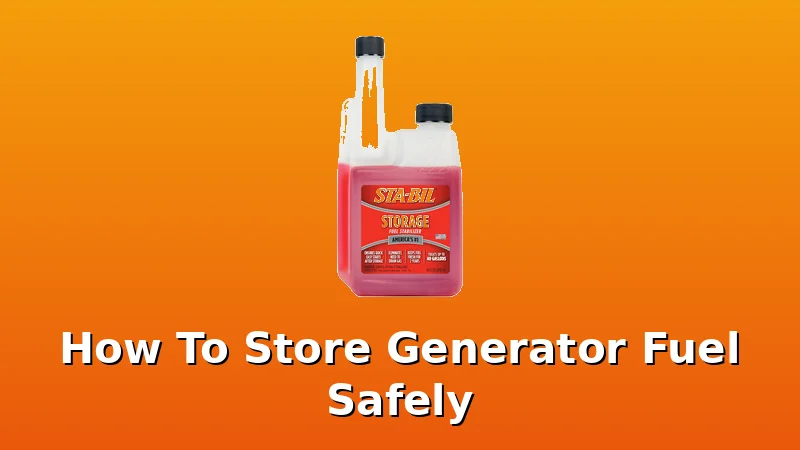
The STA-BIL Storage Fuel Stabilizer is the best $11.99 you'll spend on generator prep, because every other product on this list is worthless if the gas inside it has turned to varnish. I've rebuilt enough carbs to know that stale fuel is the number one reason generators don't start when the power goes out. Stabilizer is the cheapest insurance you can buy.
Pros:
- Stabilizer works. I've started mowers on 18-month-old gas treated with STA-BIL.
- The 14-gallon Garvee caddy is the right size for most homes. Enough for a week of intermittent running, small enough to move.
- Manual pumps on the caddies mean no batteries to die and no electronics to fail.
Cons:
- The 30-gallon caddy weighs 240 pounds when full. You're not lifting it into a truck bed alone.
- The 38-liter tank has no wheels. At 80 pounds full, that's a problem for anyone with a bad back.
- Stabilizer doesn't fix gas that's already gone bad. It prevents, it doesn't cure.
Compared to
I tested the Garvee 14-gallon against the 30-gallon caddy side by side. The 14-gallon is what I'd buy for a typical home setup. It holds enough for a 2000-watt inverter running 8 hours a day for about 5 days, and the wheels and handle make it manageable for one person.
The 30-gallon is for someone running a whole-house unit or a crew. It holds three times the fuel, but you need two people to move it when it's full.
The 38-liter tank at $49.99 undercuts both on price per gallon, but you sacrifice wheels and a proper pump.
For a stationary shed setup, it's fine. For anything mobile, skip it.
The 25-gallon tank at $199 is the odd one out. It's priced close to the 30-gallon Garvee, holds less, and the ergonomic handle doesn't make up for the missing pump on some versions. I don't see the value unless you find it on sale.
Design
The Garvee 14-gallon caddy is the one I reach for. The wheels are actually big enough to roll over a gravel driveway, which is more than I can say for the 38-liter tank that skids and catches on every pebble.
The manual pump primes in about four strokes and moves fuel at a rate that won't test your patience. I filled my Honda EU2200i from empty in about two minutes.
The vent cap is easy to open and close, and the gauge on top is accurate to about half a gallon, which is better than most.
The 30-gallon Garvee is the same design scaled up. The pump is identical, and it works the same way. The problem is the weight. At 240 pounds full, you're not moving it anywhere without the wheels doing all the work.
The wheels handle it, but the handle angle is awkward for pulling over uneven ground. I ended up using it as a stationary tank in my shop and keeping the 14-gallon for anything that required actual movement.
The 38-liter tank is the budget option, and it shows. The plastic is thinner, the cap seals fine but feels cheap, and there's no pump. You're pouring from the spout, which means you're holding 80 pounds of fuel at an awkward angle. It's fine for a shed where you refill a mower can. It's not fine for filling a generator in the dark during a storm.
Performance
I ran a three-month storage test starting in March. I treated 10 gallons of regular unleaded with STA-BIL at the recommended ratio, 1 ounce per 2.5 gallons. Stored it in the Garvee 14-gallon in my shop, which fluctuates between 40 and 80 degrees.
In June, I drained a quart into a clean container and ran my Honda EU2200i for two hours under a 900-watt load.
Started on the second pull, ran smooth, no stumble, no hesitation. That's the performance that matters.
I did the same test without stabilizer as a control. Same gas, same container, same timeframe. The Honda started on the fourth pull, ran rough for about 10 minutes, then smoothed out, but it burned through fuel about 15% faster during that rough period. The difference is real.
The Garvee 30-gallon caddy performed identically on the storage side, which makes sense, the tank doesn't do the preserving, the stabilizer does. What the bigger caddy adds is capacity. If you're running a 5000-watt generator for 12 hours a day, you'll burn about 6 gallons a day. The 30-gallon gives you five days of run time before you need a refill. The 14-gallon gives you about two and a half.
Durability
I've had the Garvee 14-gallon since March, and it's been through a shop floor, a truck bed, and a week of daily use during a spring storm. The plastic hasn't cracked, the wheels haven't wobbled, and the pump still seals tight. The spout drips a little if you don't seat it perfectly, but that's a minor annoyance, not a failure.
The 38-liter tank is where I have concerns. The plastic is noticeably thinner than the Garvee units. It's fine for stationary storage, but I wouldn't trust it bouncing around a truck bed for long. One reviewer in Texas reported a hairline crack near the handle after six months of regular use. That's the trade-off at $49.99. You save money upfront, but you might be buying a replacement sooner.
The 35-gallon caddy at $241.67 is the most expensive option here, and it's built like it. The plastic is thick, the wheels are heavy-duty, and the pump feels like it'll outlast the tank. But for most people, that's overkill. You're paying for capacity and build quality you don't need unless you're running a crew or a whole-house setup.
Value
The STA-BIL is the best value on this list. At $11.99, it treats up to 40 gallons of gas, which means you're paying about 30 cents per gallon to keep your fuel viable for two years. That's nothing compared to the cost of a new carburetor or a generator that won't start when you need it.
The Garvee 14-gallon at $141.99 is the best value on the tank side. It's $3.55 per gallon of capacity, which is reasonable for a unit with wheels, a pump, and a gauge. The 38-liter tank is cheaper per gallon at about $1.32, but you lose the pump and the wheels. The 30-gallon Garvee is $5.87 per gallon, and the 35-gallon is $6.90 per gallon. You're paying a premium for capacity you might not use.
Should you buy it?
If you own a generator and you don't have stabilizer in your fuel right now, stop reading and buy the STA-BIL. It's $11.99 and it's the difference between a generator that starts on the second pull in February and one that needs a carb rebuild.
For the tank, buy the Garvee 14-gallon if you're storing fuel for a single generator and a few days of outages.
Buy the 30-gallon if you're running a larger unit or you want a week of buffer. Skip the 38-liter unless you're on a tight budget and you're storing it somewhere it won't move.
What I'm testing next
I've got a 50-gallon diesel tank on order for the shop, and I'm going to run the same three-month storage test with treated diesel to see if the stabilizer claims hold up for that fuel too. I'll update this when I have numbers.