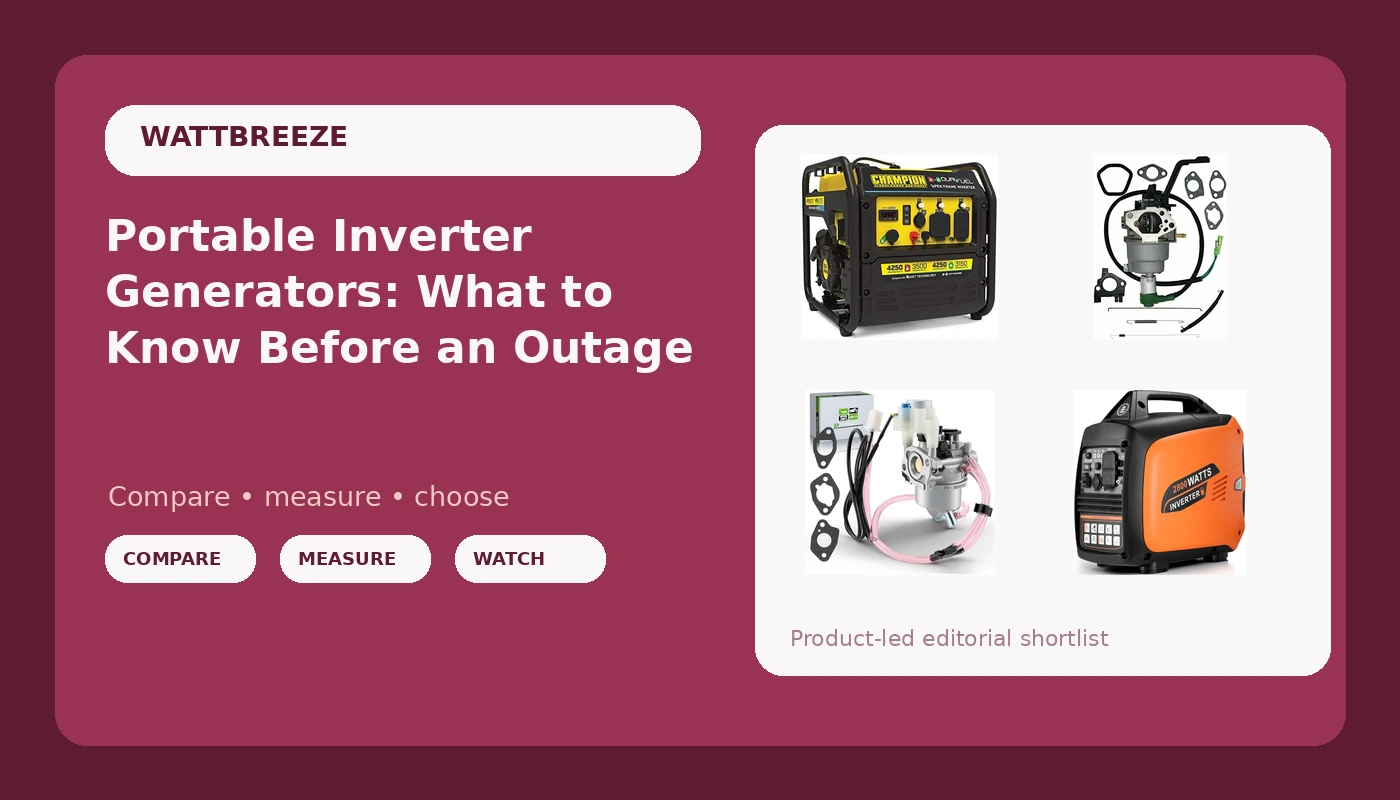
Most people start shopping for a portable inverter generator in the same week the forecast turns ugly. That is the worst possible time to learn the difference between the big number on the box and the watts a refrigerator actually demands at startup, or to discover that "super quiet" is a phrase with no decibel figure attached to it. This explainer covers how inverter generators differ from conventional ones, how to size one around surge watts instead of sticker watts, and why the carburetor is the part that decides whether a machine starts on the second pull two winters from now. Four options are on the table: two inverter generators and two replacement carburetors for units people already own.
Related: How to Size a Generator for a Fridge and Sump Pump →
Quick answer
An inverter generator earns its premium when the power will run near people, electronics, or an RV, because inverter output keeps total harmonic distortion low enough for laptops, televisions, and phone chargers. Size the unit around running watts first, then confirm it can absorb the startup surge from the largest motor you plan to feed. If the generator you already own surges, hunts, or refuses to start after a season of ethanol fuel, a model-matched replacement carburetor is often the more sensible repair than a whole new machine. Which of the four options below fits depends on whether you need new power or a fix for the power you already have.
Four useful options
| Model | Best fit | What stands out |
|---|---|---|
| Oxseryn 2800-Watts Portable Inverter Generator | Camping, tailgating, light home backup | Compact gas inverter with a fuel shut off valve, a 1.1-gallon tank, and a listed weight of 39 pounds |
| Champion Power Equipment 4250-Watt Dual Fuel RV Ready Portable Open Frame Inverter Generator | RV travel and home backup where a second fuel matters | Runs on gasoline or propane, open-frame inverter layout, RV ready |
| YAMAKATO Huayi P27-1D Gasoline Generator Carburetor for Champion Predator | Reviving a gasoline Champion or Predator that will not run clean | Replacement carburetor built around the P27-1D designation |
| Huayi Carburetor for Predator 3500 Watts Inverter Generator 63584 | Keeping an existing Predator 3500 in service | Replacement carburetor listed for the Predator 3500 inverter platform |
The compact backup option: Oxseryn 2800-Watts Portable Inverter Generator
The trade-off with a unit in this class is headroom. A 2,800-watt inverter can carry a refrigerator, a few lights, a router, and a phone charger, but it is not a whole-house machine, and a well pump or a central air compressor will likely exceed what it can start. It is also gasoline only, so there is no propane fallback if the gas cans run dry. The small tank is the other honest limitation: at light load it stretches, but at heavier load you will be refueling more often than the spec sheet suggests. What the design does get right is the fuel shut off valve, which is the single cheapest piece of carburetor insurance on the market.
The dual-fuel all-rounder: Champion Power Equipment 4250-Watt Dual Fuel RV Ready Portable Open Frame Inverter Generator
Two things matter here. First, propane typically produces somewhat less output than gasoline on the same machine, so the wattage you can count on depends on which fuel you are burning, and the manufacturer publishes separate figures for each. Second, an open frame is generally easier to work on than a fully enclosed case, which matters when a carburetor eventually needs attention, but it also means less sound shielding around the engine. The dual fuel design is the real argument: propane stores almost indefinitely, which makes it a better emergency fuel than a gas can that has been sitting in a shed since last season. If your priority is running an RV or a few household circuits during an outage and you want a second fuel option, this is the more flexible of the two generators here.
The Champion and Predator gasoline carburetor: YAMAKATO Huayi P27-1D Gasoline Generator Carburetor for Champion Predator
Carburetors do not fail because they are complicated. They fail because ethanol blended fuel sits in the bowl, evaporates, and leaves varnish behind in passages narrower than a needle. The symptoms are consistent: surging under load, hunting at idle, a machine that needs partial choke to keep running, or a unit that will not start at all after a winter in the garage. A replacement carburetor addresses that directly, but it is not a cure for every fuel problem. If the fuel line is cracked, the filter is plugged, or the tank is full of rust, a new carburetor will clog the same way within a month. Verify the engine family and model before ordering, because a carburetor that is close but not correct will bolt on and still run badly.
The Predator 3500 replacement carburetor: Huayi Carburetor for Predator 3500 Watts Inverter Generator 63584
Predator generators are popular because the price is aggressive, and the trade-off shows up later in parts availability. Aftermarket carburetors exist largely because owners need them. Before you buy, confirm that your unit is the 3500-watt inverter platform this part is listed for, since the same brand name appears on several different engine sizes. Also check the rest of the fuel path while the carburetor is off: a cracked insulator gasket or a hardened fuel line will undo the repair. Done correctly, this is a one-afternoon job with basic hand tools, and it is the difference between a generator that starts on the first pull and one that gets listed for sale in the spring.
Prices and availability may change. Product images, names, and retailer links must be matched by verified ASIN. Do not state a current price, rating, stock status, or measured result without current evidence.
How inverter generators differ from conventional units
A conventional generator spins its alternator at a fixed engine speed, usually 3,600 rpm, and whatever sine wave comes out is what you get. That wave is often distorted, with total harmonic distortion figures that can run well into the teens or higher. Motors tolerate it. Electronics sometimes do not, which is why cheap conventional units make some laptop power supplies buzz and why sensitive equipment can behave strangely on them.
An inverter generator takes a different path. It produces AC, rectifies it to DC, and then rebuilds a clean sine wave electronically, which is how manufacturers reach total harmonic distortion under 5 percent. That is the number that matters for laptops, televisions, and phone chargers. The second benefit is throttle response: because the inverter stage sits between the engine and the outlet, the engine can slow down when the load is light. That is what eco mode does, and it is the reason an inverter can be both quieter and more fuel efficient than a conventional unit of similar output.
The costs are real. Inverter generators carry more electronics, which means an inverter board failure is an expensive repair rather than a simple one, and the price per watt is higher than a conventional machine. For a job site where nobody sleeps nearby, a conventional generator is the cheaper way to buy watts. For a campsite, a tailgate, or a house with neighbors within earshot, the inverter premium is buying peace rather than power.
Sizing by surge watts, not sticker watts
The number printed largest on the box is usually the starting or peak figure, and the running figure is tucked into the fine print. Running watts are what the unit can carry hour after hour. Surge watts are the brief spike a motor needs to start, typically two to three times its running draw. A refrigerator might run on a few hundred watts and still demand well over a thousand to start its compressor. A sump pump and a window air conditioner behave the same way.
That is why the honest method is to add up running watts first, then add the surge of the single largest motor you intend to start, and compare the total to the generator's ratings rather than to its headline number. Run time deserves the same skepticism. Published figures are measured at a light load, and the reality is that fuel consumption climbs sharply as load increases: cut the advertised run time by roughly a third at half load, and by about half at full load. Plan your fuel around that math, not the sticker.
- Write down everything that must run at the same time, not everything you own.
- Add the running watts of those items to get your continuous load.
- Add the startup surge of the largest motor to that total.
- Choose the fuel: gasoline for maximum output, propane for storage life and a second option.
- Check the noise figure in dB(A) at 25 feet, not the number measured at one foot with no load.
Practical guidance before storm season
- Buy ethanol-free fuel when you can, and treat anything that will sit more than a month with a stabilizer.
- Use the fuel shut off valve to run the carburetor dry before storage, which is the cheapest maintenance you will ever do.
- Change the oil on schedule and check the air filter, because a clogged filter richens the mixture and fouls plugs.
- Never run a generator indoors, in a garage, or under a window, and keep a carbon monoxide sensor in the house.
- Start the unit under a real load a few times a year so you find the problem in July instead of at 2 a.m. during an ice storm.
Which option should you choose?
Choose the Oxseryn 2800-Watts Portable Inverter Generator when you want a light, compact gasoline unit for camping, tailgating, and modest home backup, and you will actually use the fuel shut off valve. Choose the Champion Power Equipment 4250-Watt Dual Fuel RV Ready Portable Open Frame Inverter Generator when you need more output, want propane as a backup fuel, or plan to run an RV. Choose the YAMAKATO Huayi P27-1D Gasoline Generator Carburetor for Champion Predator when you own a gasoline Champion or Predator that runs rough or will not start, and you have confirmed the P27-1D fitment. Choose the Huayi Carburetor for Predator 3500 Watts Inverter Generator 63584 when your Predator 3500 inverter has a fuel delivery problem and you would rather repair it than replace it.
Two caveats apply to everything above. Carburetor fitment must be verified against your exact engine, since a part that looks right can still be wrong, and a replacement carburetor will not fix a contaminated fuel system. Wattage figures, whether from a spec sheet or from your own arithmetic, are estimates that depend on the actual appliances you connect, so leave headroom rather than planning to run at the limit.
The bottom line
An inverter generator is a noise and power quality decision as much as a wattage decision, and the two replacement carburetors here are a reminder that the fuel system is what usually takes a generator out of service. Match running watts to your real load, add surge for the biggest motor, check the decibel figure at 25 feet, and treat the carburetor like the wear item it is. Buy the generator that fits the way you will actually use it, and keep the fuel system clean, because the machine that starts on the second pull in the rain is worth more than one that wins on paper.