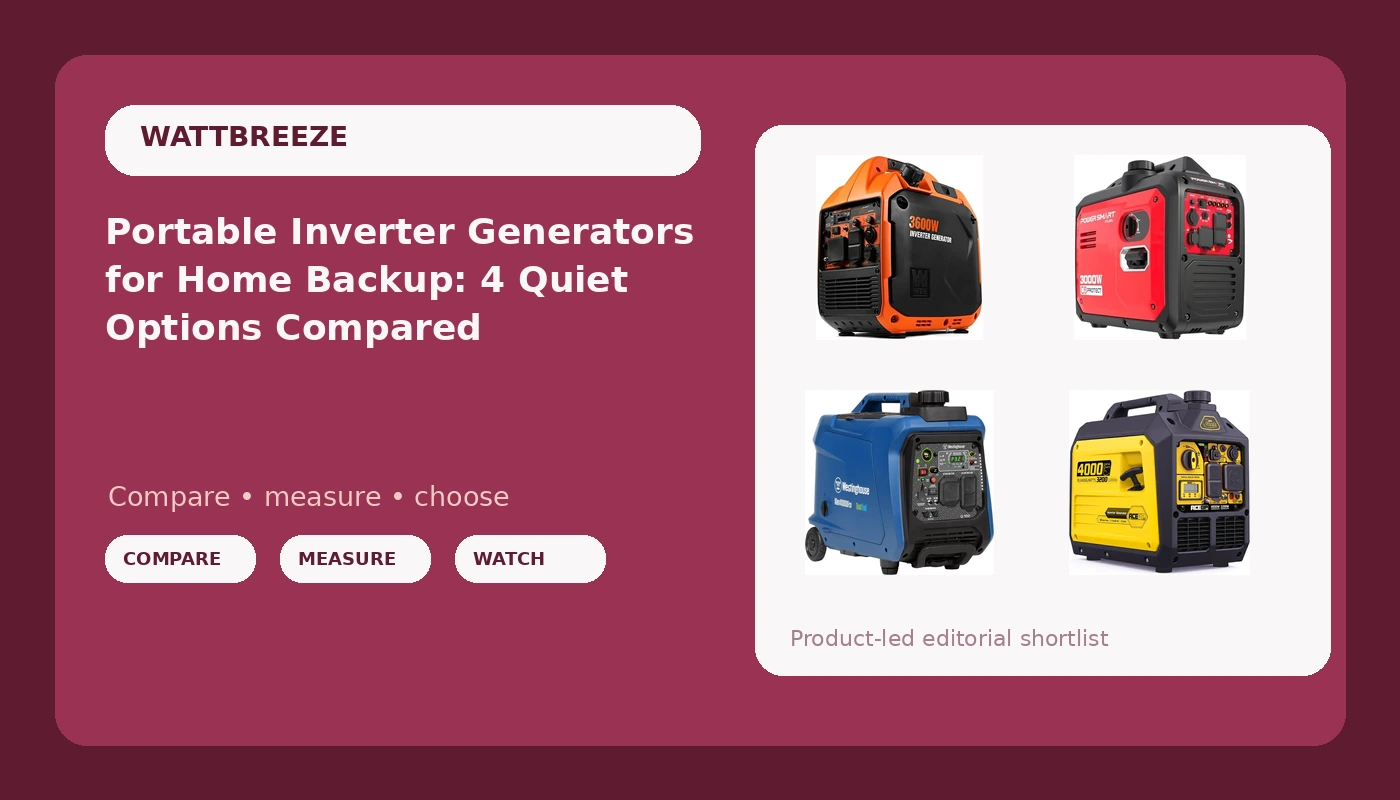
A portable inverter generator is one of those purchases that looks simple until you start reading spec sheets. Every listing leads with a big peak wattage number, a vague promise about quiet operation, and a photo of somebody smiling next to a camper. What the listing rarely tells you is what the unit will carry hour after hour, how loud it actually is at the distance your neighbor will hear it, or whether it will start the one appliance you bought it for in the first place.
That gap between the sticker and the driveway is where generator regret gets born. A 4,000-watt label does not mean 4,000 watts of continuous, usable power, and a "quiet" badge means nothing without a decibel number attached to it. The four units below cover the range most households and campers actually shop in, from a 3,000-watt class camper unit up to a dual fuel model with a carbon monoxide sensor and a wheel kit.
Related: How to Size a Generator for a Fridge, Sump Pump, and a Few Lights →
Quick answer
Match the generator to the load you need to run, not to the biggest number on the page. A 3,000-watt class portable inverter generator such as the PowerSmart 3000 Watt covers camping, tailgating, and light backup duty. Move up to the 3,600 to 4,000-watt class and you are in range for a refrigerator, a few LED lights, a router, and a phone charger running at the same time. If fuel flexibility matters to you, the Westinghouse unit is the only model on this list built to run on gasoline or propane. Everything else comes down to how you will move it, how often you will use it, and how carefully you plan to store it between seasons.
Four useful options
| Model | Best fit | What stands out |
|---|---|---|
| WEN 3600-Watt Portable Inverter Generator, RV-Ready, Quiet and Lightweight with Fuel Shut Off (56360i) | RV travel and tailgating | 3,600-watt inverter class, RV-ready configuration, fuel shut off for storage |
| PowerSmart 3000 Watt Portable Inverter Generator for Camping or Home Use | Camping and light home backup | 3,000-watt class, built for camping or home use |
| Westinghouse 4000 Peak Watt Super Quiet Dual Fuel Portable Inverter Generator, Wheel & Handle Kit, Gas & Propane Powered, RV Ready, CO Sensor, Parallel Capable | Home backup with fuel flexibility | Runs on gasoline or propane, CO sensor, wheel and handle kit, parallel capable |
| Aceup Energy 4000 Watt Gas Inverter Generator Portable Quiet for Home Use | Budget home backup | 4,000-watt gas inverter class, single fuel simplicity |
The RV-ready middleweight: WEN 3600-Watt Portable Inverter Generator (56360i)
The trade-off with any 3,600-watt class inverter is that it is a compromise by design. It will happily run a refrigerator, a laptop, a modem, and a handful of lights, and it will do it on a campground pad without drawing complaints. What it will not do is carry a central air conditioner, an electric water heater, or a well pump at the same time as everything else. If your outage plan includes any of those, you are shopping in the wrong watt class.
The fuel shut off is the detail worth paying attention to. Running the carburetor dry before storage is the single cheapest habit in small engine ownership, because ethanol blended gasoline left sitting in a bowl turns to varnish and takes a carburetor with it. A valve that makes that easy is worth more over five years than a slightly larger tank.
The small-load specialist: PowerSmart 3000 Watt Portable Inverter Generator
Here is the honest math on a 3,000-watt class inverter. A modern refrigerator draws a modest continuous load, somewhere in the range of a few hundred watts once it is running, but its compressor can pull two to three times that for a second or two on startup. A sump pump or a window air conditioner does the same thing, only harder. Add up the running watts of everything you want on at once, then add the largest single motor's surge on top of that. That total, not the peak number in the product name, is what tells you whether a unit in this class is enough.
For camping and tailgating, a 3,000-watt class inverter is usually more than enough, and the smaller frame is a real benefit when you are lifting it in and out of a truck bed by yourself. For whole-home outage duty, it is a starting point rather than a solution.
The dual fuel home backup: Westinghouse 4000 Peak Watt Dual Fuel Portable Inverter Generator
Dual fuel is the feature that separates this unit from the rest of the list. Propane does not go stale the way gasoline does, so a tank in the garage is still a tank in the garage two years later. During a long outage, when every station in a fifty-mile radius has a line around the block, that matters more than any spec sheet number. The trade-off is that propane generally produces somewhat less output than gasoline in the same engine, so plan your loads around the fuel you expect to actually burn.
Two other details deserve a mention. The CO sensor is not a marketing extra; carbon monoxide shutoff is the reason new generators ship with it, and it belongs on any unit that runs within cord distance of a house. The wheel and handle kit addresses the other complaint that shows up in every generator review section, which is that a 4,000-watt class machine is heavy enough that carrying it is a two-person job. And because this model is parallel capable, it can grow later if your needs do.
Note the wording in the name: 4,000 peak watt. Peak and running watts are not the same figure, and the running number will be lower. Confirm both on the current listing before you buy.
The budget 4,000-watt: Aceup Energy 4000 Watt Gas Inverter Generator
Single-fuel machines ask more of the owner. There is no propane fallback when the gas cans run dry, and there is no way to burn a fuel that stores for years without going bad. That does not make it a bad choice, it makes it a choice with a maintenance clause attached. If you go this route, treat fuel as part of the equipment: use ethanol-free gasoline when you can get it, add stabilizer when you cannot, run the carburetor dry before storage, and change the oil on the schedule in the manual rather than on the schedule of your good intentions.
The appeal of a gasoline-only 4,000-watt class inverter is straightforward. You get into the watt class that can carry a fridge, a furnace blower, some lights, and a router without paying for a second fuel system you may never use. If your outages are short and your fuel discipline is good, that is a reasonable trade.
Prices and availability may change. Product images, names, and retailer links must be matched by verified ASIN. Do not state a current price, rating, stock status, or measured result without current evidence.
Running watts vs surge watts: the two numbers that decide everything
Every motor in your house has two power figures. Running watts is the continuous load it draws once it is spinning, and that is the number your generator has to carry hour after hour. Surge watts is the startup spike, the brief draw a compressor or pump needs to get moving from a dead stop. For most household motors, surge runs two to three times the running figure, and it lasts only a second or two.
That short spike is why generator shopping goes wrong so often. A unit that can carry your refrigerator's running load all day may still trip its overload when the compressor kicks on, because the surge demand arrives faster than the engine can respond. Add up the running watts of everything you want on simultaneously, then add the surge of the single largest motor on top of that total. That sum is your real requirement.
This is also where eco mode earns its caveat. Throttling engine speed down to match a light load saves fuel and noise, which is exactly what you want at a campsite. On some units the throttle response is not fast enough to catch a compressor surge before the overload trips. If your backup plan depends on a fridge or a sump pump, test that combination before you need it, or run with eco mode off during the critical load.
Fuel choice, noise, and clean power
Three things separate inverter generators from the cheaper conventional units on the same shelf. The first is total harmonic distortion, or THD. Inverter output holds distortion under about 5 percent, which is the threshold where laptops, televisions, and phone chargers stop caring what they are plugged into. Conventional generators often run well above that. If you are powering electronics rather than a circular saw, the inverter premium buys you something real.
The second is noise. A decibel rating is only meaningful when it comes with a distance and a load attached, because a number taken one foot from the unit at no load tells you nothing about what your neighbor hears at 25 feet. Ask for dB at 25 feet at quarter load, or accept that you are guessing.
The third is fuel. Gasoline is available everywhere and delivers full output, but it goes stale in weeks and turns to varnish in a carburetor if you leave it there. Propane stores for years and burns clean, at the cost of somewhat lower output and the need for a tank. There is no universally correct answer, only the one that matches how you actually store and rotate fuel.
Working through the decision in order:
- List the appliances you want to run at the same time, and write down the running watts of each.
- Add the surge of the single largest motor to that running total. That is your real requirement.
- Decide which fuel you will realistically keep on hand, and whether you need propane's long storage life.
- Check the weight and whether the unit ships with wheels, because you will move it more often than you think.
- Confirm the CO sensor, the outlet configuration, and the actual running watts on the current listing before you order.
Living with an inverter generator
- Use ethanol-free fuel for anything that will sit more than a month, and add stabilizer when you cannot find it.
- Run the carburetor dry before storage using the fuel shut off, and drain the bowl if the unit will sit through a season.
- Change the oil on the manual's schedule. Small engines that fail early usually fail on oil, not on hours.
- Place the unit outside, well away from windows, doors, and vents, and let the CO sensor do its job rather than working around it.
- Do the math on run time yourself. Published figures are typically measured at a light load, and at half load you should plan on meaningfully fewer hours per tank.
- Keep a dedicated heavy-gauge extension cord sized for the run, not the cheapest one in the garage.
Which option should you choose?
Choose the WEN 3600-Watt Portable Inverter Generator (56360i) when you want one unit that travels to campgrounds and tailgates and still has enough headroom for a fridge and a few lights at home. Choose the PowerSmart 3000 Watt Portable Inverter Generator when your loads are light, your storage space is tight, and you would rather carry something smaller. Choose the Westinghouse 4000 Peak Watt Dual Fuel Portable Inverter Generator when fuel flexibility, a CO sensor, wheels, and the option to parallel a second unit later are worth paying for. Choose the Aceup Energy 4000 Watt Gas Inverter Generator when you want the 4,000-watt class for home backup, you are comfortable with gasoline-only fueling, and you will keep up with fuel and oil maintenance.
None of these units will run a central air conditioner, an electric range, or a whole house. That is not a flaw in the list, it is the reality of the portable inverter class. Watt ratings in product names describe the class the manufacturer puts the unit in, and running watts, weight, outlet layout, and noise figures should be confirmed on the current listing, since manufacturers revise specifications between production runs.
The bottom line
The right portable inverter generator is the one that matches your real load, your real fuel habits, and your real willingness to move it. A 3,000-watt class unit covers camping and light backup. A 3,600 to 4,000-watt class unit covers a refrigerator and the small stuff alongside it. Dual fuel adds storage-friendly propane and a fallback when gasoline runs short. Pick the watt class first, decide on fuel second, and treat the CO sensor and the wheel kit as requirements rather than extras, because the night you need this machine is not the night to discover it is too heavy to move or too loud to run.