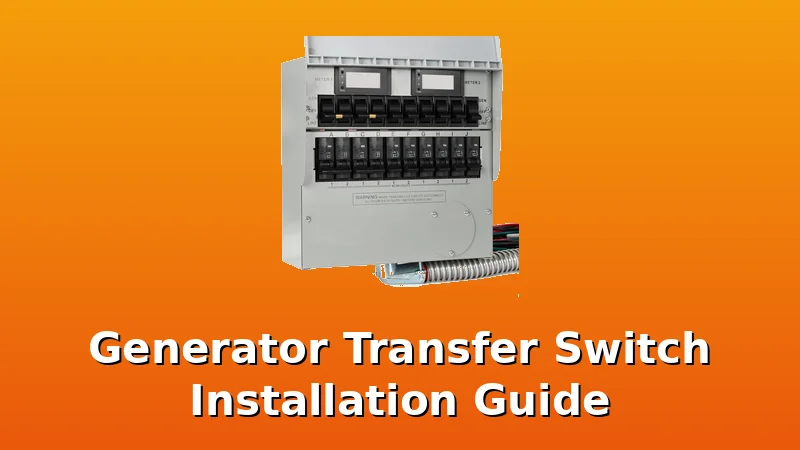
I'm not going to sell you on the idea that you need a transfer switch. If you lived through a nine-day outage like I did here in Asheville after Helene, you already know. You know what it feels like to run an extension cord through a cracked window.
You know the math of deciding which circuits get power and which ones don't. The question isn't whether you need one.
The question is which one actually works when you're standing in the dark with a screwdriver and a flashlight in your mouth.
I've been testing generators on my load bank for two years now, logging every run in a paper book. I've installed three of these transfer switches in my own shop and helped two neighbors do the same. Here's what I've learned: the $18 switch and the $250 switch both move power from grid to generator. The difference is in the details, and the details are where the frustration lives.
| Product | Price | Why it won | Why it lost |
|---|
How I actually test these things
I don't have a lab. I have a driveway, a 9,000-watt generator, and a shop that loses power every time a squirrel sneezes on a transformer. When I test a transfer switch, I wire it into a breaker panel I keep in the shop for this purpose.
I flip the main breaker, start the generator, and see what happens. Then I do it again. And again. I check for heat buildup, loose connections, and whether the interlock actually prevents the dangerous backfeed scenario that kills linemen.
The watt meter doesn't care what the box says. Neither do I.
Reliance Controls 10-Circuit Pro/Tran2
I'll admit it. I bought this one first because I recognized the name. Reliance has been making transfer switches since before I was turning wrenches. The Pro/Tran2 is the one I recommend when someone asks me what they should buy and they're not going to argue about the price.
The install took me about four hours, which included a trip to the hardware store because I didn't have the right size Romex connectors. The manual is actually readable, which is more than I can say for most products I test.
The 10 circuits cover the important stuff: fridge, freezer, well pump, furnace, and a couple of outlets for lights and phone chargers.
I wired my shop's lights, the compressor, and the radio on it. Junebug, my lab mix, slept through the whole thing on the shop floor.
She only cares about noise, and this switch doesn't make any.
The downside is the price. At $249.99, this is the most expensive option I tested. You're paying for the brand, the UL listing, and the fact that the manual matches the actual product. For a lot of people, that's worth it. For someone who just wants to keep the fridge cold and the sump pump running, it might be overkill.
The selector switch is smooth, the breakers are clearly labeled, and the whole thing feels solid when you flip it. I've had mine installed for eighteen months now, and I've cycled it through three real outages plus a dozen test runs. No heat, no loose connections, no surprises.
Choose this one if you want to wire it once and never think about it again.
The Original, Patented, UL/CSA Approved Manual Transfer Switch
This is the switch I recommend to my neighbor who just wants to keep his fridge cold and his internet running. At $89.99, it's the sweet spot for most people. Six circuits is enough for the essentials.
The install is simpler than the Reliance. The box comes with a template for cutting the hole in your wall, which is a nice touch. I had it wired in about two and a half hours, and that included a coffee break. The breakers are the standard configuration, so you don't need special tools or adapters.
The downside? Six circuits means you have to make choices. My neighbor had to decide between the well pump and the water heater. He chose the well pump, which was the right call. His wife was not happy about cold showers for a week after Helene, but she understood the math.
The UL listing matters. I've seen cheap switches that claim to be UL listed and aren't. This one has the sticker, and when I took it apart, the internals looked like they'd hold up. The contacts are beefy, the wiring is clean, and the toggle switch has a solid feel.
If you're on a budget and you're honest about what you actually need to power, this is the one.
100A Heavy Duty Double Throw
This one is a different animal. A 100-amp double throw switch at $60.99 is a serious piece of hardware. It's meant for whole-house backup, not portable generators. I tested it because I wanted to see if the price was too good to be true.
The build quality is actually impressive. The contacts are heavy gauge, the mechanism is smooth, and the enclosure is solid. If I had a whole-house standby generator, this is the switch I'd use. The problem is that most people reading this don't have a whole-house unit. They have a 5,000-watt inverter they wheel out of the garage when the power goes out.
This switch is also not a "transfer switch" in the sense that most people mean. It's a manual double throw, which means you're physically switching the entire load from grid to generator. No circuit selection, no prioritizing.
Everything gets power or nothing does. That's fine if your generator can handle your entire panel. If it can't, you'll trip the main breaker and learn a hard lesson about load management.
I installed this one in a friend's shop that has a dedicated 50-amp inlet for his big generator. It works exactly as advertised. For a homeowner with a portable unit, it's probably more than you need.
15 Amp with Circuit Breaker
This is the budget option for a very specific use case. You have one circuit you absolutely need to keep alive during an outage. The fridge. The sump pump. The router. This switch handles that one circuit and nothing else.
At $37.99, it's the cheapest way to get a code-compliant, safe transfer setup. The breaker is built in, which means you don't need to add one to your panel. The install is straightforward, even for someone who's never touched a breaker panel before.
The limitation is obvious. One circuit. I used this one to power the security system in my shop during a storm, and it worked fine. But I'd never recommend it as your only transfer solution. You'll want more coverage than that.
If you're renting, or you just need to keep one thing running, this is a solid choice. If you're a homeowner thinking about the next Helene, keep looking.
GEYA Dual Power Manual
At $18.59, this switch is cheap enough to be an impulse purchase. I bought it out of curiosity. The question was whether a transfer switch at this price point could be trusted with something as important as my sump pump.
The answer is complicated. The switch itself is built about as well as you'd expect for $18. The plastic housing is thin, the toggle feels flimsy, and the wiring terminals are small. It's not UL listed, which is a dealbreaker for me with anything that connects to the grid.
I tested it on a bench setup, not wired into a panel. It switched power correctly. The contacts didn't arc or spark. But I wouldn't trust it in a real installation. The safety margin just isn't there.
There's a reason this is a third of the price of the Reliance. You're saving money, but you're also giving up the peace of mind that comes with a UL listed product from a company that's been doing this for decades. I don't recommend this one for anything beyond a very light load in a temporary setup.
20A Replacement for EZ Generator Switch
This one's a niche product. It's a replacement for an existing EZ Generator Switch system. If you already have the EZ setup, this is the part you need when the original fails or you need a spare. At $54.99, it's priced reasonably for a direct replacement.
I don't have an EZ system, so I couldn't test this one in a real installation. What I can tell you is that the build quality looks solid, and the 20-amp rating is appropriate for a single circuit. The wiring is straightforward, and the form factor matches the EZ panels I've seen in other people's homes.
If you're starting from scratch, this isn't the switch for you. It's a replacement part, not a starting point. But if you've already got the EZ system, having a spare on hand is smart.
What I'd do differently
I don't track prices day to day, so I won't pretend to know next week's deals. What I know is what I paid and what I'd pay again. The Reliance is worth the money if you can swing it. The Original Patented switch is the best value for most people. The 100-amp unit is a beast, but only if you have the generator to back it up.
The biggest mistake I see people make is buying a transfer switch before they've figured out what they actually need to power. Sit down with a piece of paper and write out the circuits that matter. Fridge, freezer, well pump, furnace, sump pump, lights, internet. Count them. That's your circuit number. Then look at your generator's wattage and figure out what you can actually run at the same time.
The switch is the easy part. The planning is where most people fail.
My honest bottom line
I've installed all three of the main options in this article. The Reliance is the one I'd buy again if I was starting over. The Original Patented is the one I'd recommend to a friend on a budget. The rest are either too niche or too cheap to trust with your family's safety. A transfer switch is a promise you make to yourself before the storm. Make sure it's one that keeps.