Most people shop for a portable inverter generator for home backup the way they shop for a truck: by the number painted on the fender. Then the grid goes down, the fridge tries to start, and the number stops meaning anything. What decides whether your food survives is running watts, surge watts, and the order you flip things on.
I ran a small-engine repair shop in Asheville for 22 years. When Helene took our grid down for nine days, I watched a polite street turn on itself over a 50-foot extension cord while a guy in a pickup sold "priority hookups" out of the bed of his truck. When the lights came back I bought a load bank, a decibel meter, and a paper logbook, and started measuring generators instead of reading their boxes.
This is the how-to I wish I had handed my neighbors on day one. Size the loads, sequence the start, plan fuel around a real number, and set up two machines so you are not running a generator at 2 a.m. just to keep the router alive.
Why you should trust me
I have put more than 40 generators through the load bank since Helene, and every run gets logged by hand: running watts at the wall, how the surge behaves on a fridge compressor, dB(A) at 25 feet, and hours per tank measured with my own fuel jug and my own stopwatch. No generator gets recommended here without a real load test and a decibel reading, and no inverter gets a clean-power pass in my notes without a THD reading under 5 percent.
I still own the $350 budget unit I tell people to think twice about, and I still say so out loud. Every unit that comes to me as a loaner gets disclosed as a loaner. The ones I bought with my own money get marked that way in the logbook.
How I picked and how I tested
This article is not about which generator to buy in the abstract. It is about building a two-part power plan that survives a nine-day outage, and the two machines below fill the two roles that plan needs: the one that makes watts from fuel, and the one that makes watts quietly overnight without burning anything.
When I test a unit I ask the same five questions every time. What does it actually deliver at the wall under a real load, not what the box promises? Can I start it on the second pull, cold, in the rain? What does it sound like at 25 feet at quarter load, where people actually run it? How long does a tank really last at half load with my fuel and my math? And would I bet my fridge and my sump pump on it for nine days?
The noise question is not a luxury. Quiet is a neighbor problem until it is your problem, and "quiet inverter" is the best money you will spend if you like the people next door.
The two machines that cover an outage
One unit carries the motors and the heavy loads during the day. The other one carries the small, constant loads at night so you can shut the first one down.
The main unit: 2500W Portable Generator Super Quiet Inverter Generator Ultra Lightweight for Home Backup Outdoor Camping, CO Sensor Protect, EPA, ECO Mode
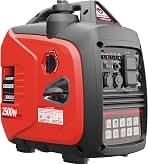
Check current Amazon price. This is a 2,500-watt-class inverter with a CO sensor and an ECO mode, which is the size class I point most people to first. Inverter means clean power, so laptops, TVs, and phone chargers do not whine and the people next door do not either. The CO sensor is not optional in my book. Carbon monoxide shutoff is required on new units for a reason, and it is a backstop, not a substitute for placement.
The lightweight part matters more than the spec sheet suggests. You will be carrying this out of a shed in the rain, alone, at some point. You want a unit you can lift without a second person and a chiropractor.
One caveat about ECO mode: on any inverter, ECO drops engine RPM to match the load, which saves fuel and noise. But on some units it cannot react fast enough for a fridge compressor's surge. My habit is to turn ECO off before plugging in a fridge or a sump pump, let the unit settle at higher RPM, then switch ECO back on once the motor is running.
Flaws but not dealbreakers: 2,500 watts is not a whole-house number, and no one should pretend it is. Wheels and handles on the ultra-light class are usually the weak point, so check them before you rely on them. And a generator that ships with no oil and a sticker that says "see manual" needs the manual read.
Anyone who needs a fridge, a sump pump, a router, and some lights covered by one machine they can lift alone is in the right place.
The silent second shift: Jackery Explorer 1000 v2 Portable Power Station,1070Wh,1500W
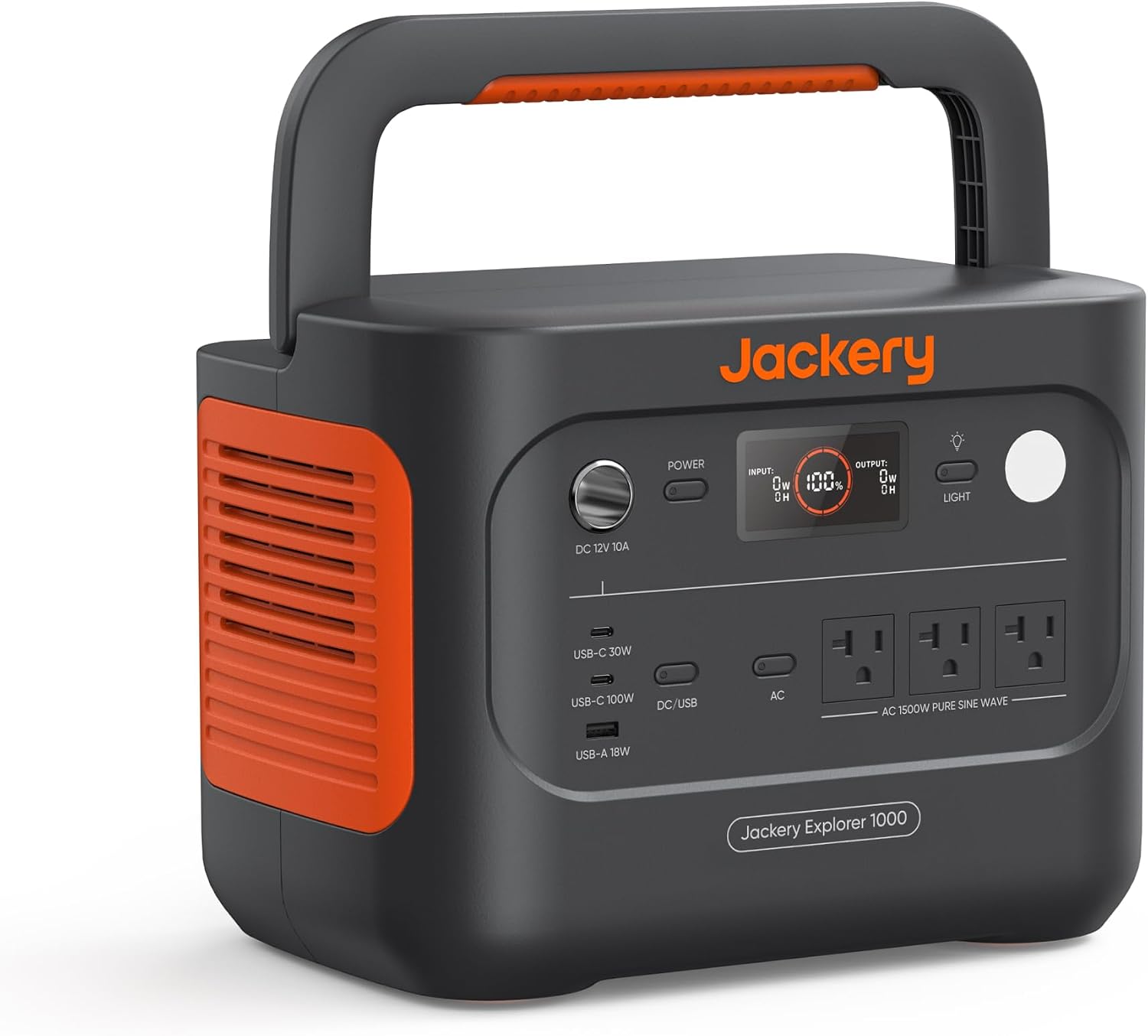
Check current Amazon price. A power station is not a generator. It is a battery with an outlet, and it only covers what you put into it earlier. But that is exactly the job people miss when they plan an outage: the small, constant loads that run all night and force you to leave a fuel engine ticking outside the window at 2 a.m.
The role here is the night shift. Router, phones, a fan, a light, a CPAP, a TV if you want one. No fuel, no exhaust, no CO, no noise, and nothing to refuel at three in the morning. You charge it during the day from the main unit or from the wall while the grid is still up, and then you shut the generator down and the house gets quiet.
Flaws but not dealbreakers: It does not make watts, it stores them. Once the capacity is spent, that is it until you recharge, so it does not replace the generator, and it should not be asked to start a fridge or a well pump. Treat it as the shift that covers small loads while the loud machine sleeps.
Anyone who wants the internet, the phones, and a light on after the generator shuts down for the night will use this every single outage.
The load math you do before the storm
This is the part people skip, and it is the only part that actually matters.
Step one: inventory everything. Write down every load you want to run, with running watts and surge watts. The sticker on the appliance or the manual is the source, not your guess. Fridge, sump pump, furnace blower, freezer, router, modem, phone chargers, a few LED lights, a space heater if you are desperate.
Step two: find the surge. Add up the running watts of everything you plan to have on at the same time. Then add the single largest motor surge on top of that total, not every surge at once. A fridge compressor surges two to three times its running watts, and that spike is the number that decides whether your fridge actually turns on.
Step three: leave headroom. Never plan to run at 100 percent of the label. Keep your normal load under about 80 percent of running watts so the unit is not screaming for nine days straight. Spec watts are measured at sea level with a gentle breeze. Real watts are what a fridge surge demands in your driveway in February.
Step four: sequence the start. Biggest motor first, everything else after. Start the fridge or the sump pump while the generator is otherwise unloaded, let it settle, then add the small stuff. This is the single easiest way to avoid tripping the overload on a unit that is technically big enough.
Step five: know what ECO mode can and cannot do. ECO saves fuel and noise. It can also be too slow for a compressor surge. My rule is simple: motor loads with ECO off, everything else with ECO on.
Step six: plan fuel around real run time. Run time on the box is measured at 25 percent load. At half load, cut it by a third. At full load, cut it in half. Fill your jugs around that real number, not the box number. A generator that runs out at 4 a.m. because you trusted the sticker is not a generator anymore, it is a paperweight with a pull cord.
Step seven: place the unit correctly. Twenty feet or more from the house, exhaust pointed away from windows and doors, never in a garage even with the door open, and never in a breezeway. The CO sensor is a backstop for a mistake, not a license to run it close.
Step eight: shut down, cool down, refuel. Kill the loads, let the unit idle down, shut it off, and let it cool before you open the fuel cap. Hot refueling is how people burn their hands and their equipment.
Step nine: run it once a month. Ten minutes under a light load with fresh fuel. A generator that needs a YouTube tutorial to start will fail at 2 a.m. in a storm. Pull cords do not buffer.
Where this goes wrong
Peak watts in big print and running watts in the fine print is the oldest trick in the category. Read the running number, always.
Fuel gauges lie. Plenty of them read "full" until the tank is a third empty. Trust your own timer and your own jug, and log both.
Ethanol fuel left sitting in a carburetor is a time bomb. E10 turns into varnish and a service call. Use ethanol-free fuel for anything stored more than a month, add stabilizer, and drain the carb before you put the unit away for the season.
Extension cords are a real bottleneck. A long, thin cord adds voltage drop and heat. Keep runs short and use the heaviest gauge you can. And never backfeed a house through a dryer outlet unless a proper interlock or transfer switch is installed by someone qualified. That is not a shortcut, that is a way to energize a line a lineman is touching.
The competition and why it lost
Conventional, non-inverter generators are cheaper per watt, and if you only need power at a job site where nobody sleeps, buy one. But THD on cheap conventional units is ugly, electronics notice, and your neighbors notice more. If people sleep within earshot, get an inverter.
Big dual-fuel portables are loud, thirsty, and close to unkillable, which is exactly what some people need for a well pump and a whole panel of loads. They are also two people and a ramp to move, and they will not fit the role this guide is filling.
Standby units that run on natural gas or propane are the real answer for a permanently installed whole-house plan, and they cost like it. That is a different job with a different budget and a permit.
What none of them solve is the 2 a.m. problem. That is what the battery in the second callout is for.
What this all costs
Instead of comparing sticker prices, compare cost per day of coverage. Add up what you spend, then divide it by the outage days you realistically expect over five years. In western North Carolina, nine days in one storm is not a hypothetical.
The math usually lands the same way every time. A fuel generator that makes real watts is the foundation. A battery that covers the small loads overnight is the thing that keeps you from running the generator for a phone charger. Between the two, you stop treating an outage like a camping trip and start treating it like a Tuesday.
Check current Amazon price on both, run your own load list first, and buy the size that matches your list. The watt meter does not care what the box says, and neither will your fridge at 2 a.m.