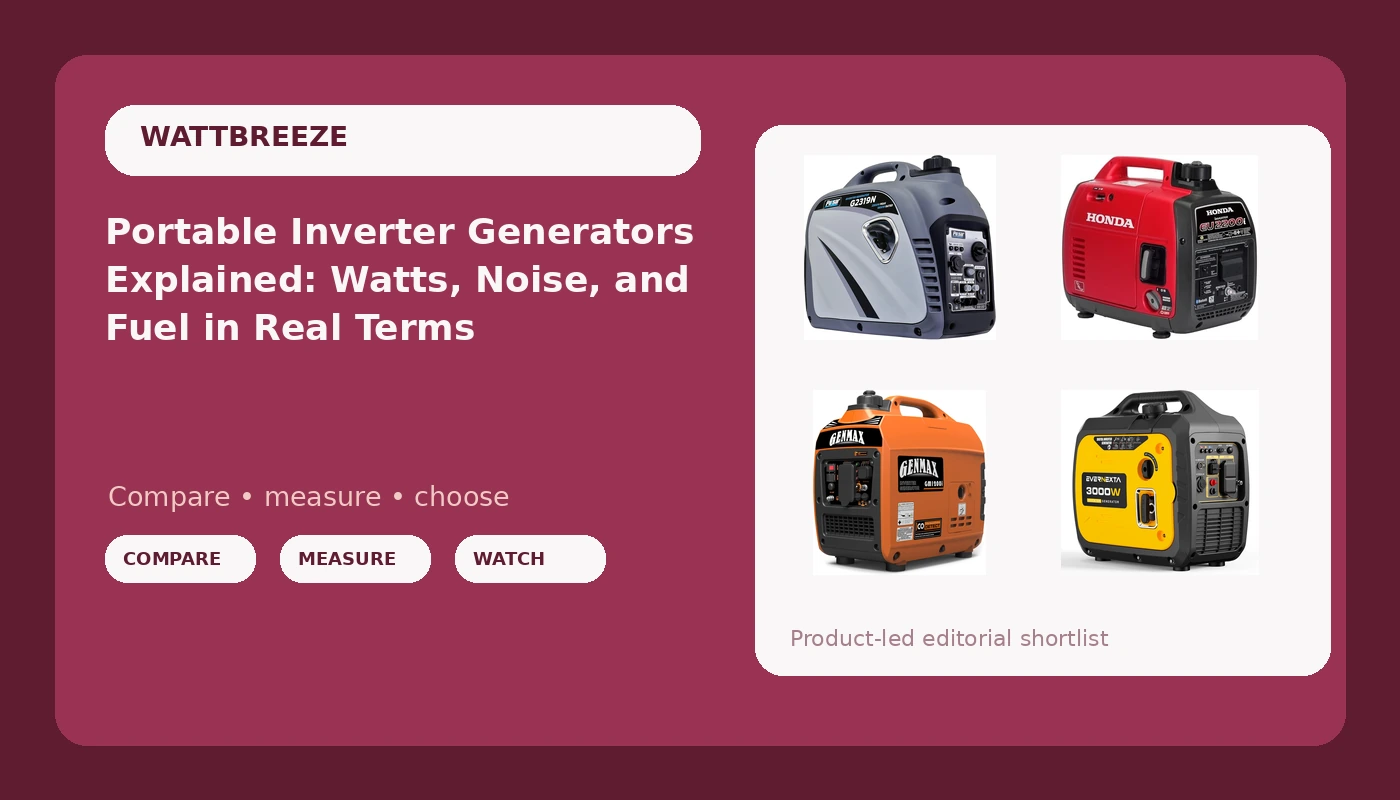
Portable inverter generators are sold on a promise the sticker cannot keep: quiet power, clean power, and enough of it. The figure that decides whether the promise holds up is not the peak watt number printed in 72-point type on the front of the box. It is the running watts, the surge watts, the total harmonic distortion, and the noise level measured at a distance where a neighbor can actually hear it. This explainer unpacks those terms and lines up four current inverter models against the jobs people actually buy them for: campgrounds, tailgates, RV dry camping, and keeping a refrigerator and a sump pump alive through a multi-day outage.
Related: How to Size a Generator for a Fridge, a Sump Pump, and a Few Lights →
Quick answer
An inverter generator earns its price premium when the power runs near people or near electronics. Inverter units produce a cleaner sine wave, and total harmonic distortion under 5 percent is the working threshold for laptops, televisions, and phone chargers. They also throttle engine speed to match the load instead of holding a fixed 3,600 rpm, which cuts both fuel burn and noise. Conventional generators cost less per watt and make sense on a job site where nobody is sleeping.
Sizing comes before brand. Add the running watts of everything you need at once, then find the single largest motor surge and stack that spike on top. A refrigerator might run on a few hundred watts and demand two to three times that for a second or two when the compressor starts. A generator that covers the running load but not the surge will trip its breaker every time the fridge cycles.
Among the four models here, the differences come down to wattage ceiling, weight, and what the unit is built to carry, not to one being universally better. The smallest unit in the group suits lights, phones, and a laptop. The 3,000-watt unit carries the highest rated output here, which is the range an RV air conditioner or a well pump tends to demand.
Four useful options
| Model | Best fit | What stands out |
|---|---|---|
| GENMAX Portable Generator,1200W Ultra-Quiet Gas Engine, EPA Compliant, Eco-Mode Feature, Ultra Lightweight for Backup Home Use & Camping (GM1200i) | Camping, tailgating, small backup loads | 1,200 watts, eco-mode feature, described in its listing as ultra lightweight |
| Honda EU2200i 2200 Watt Inverter Generator (EU2200ITAN) | Buyers who want a proven inverter platform | 2,200-watt inverter class from the brand that set the category benchmark |
| Pulsar 2,300W Portable Gas-Powered Quiet Inverter Generator With USB Outlet & Parallel Capability, Carb Compliant, G2319N | Parallel expansion and USB charging | 2,300 watts, USB outlet, parallel capability, CARB compliant |
| 3000W Inverter Generator, Ultra Quiet Portable Gas Generator RV | RV air conditioning and heavier backup loads | Highest rated output in this group at 3,000 watts |
Lightest option: GENMAX Portable Generator,1200W Ultra-Quiet Gas Engine, EPA Compliant, Eco-Mode Feature, Ultra Lightweight for Backup Home Use & Camping (GM1200i)
The trade-off here is arithmetic, not quality. A 1,200-watt ceiling is a small ceiling. It handles a phone, a laptop, a few LED lights, a small fan, and a television without strain. It will not run a space heater and a microwave at the same time, and a full-size refrigerator with a locked-rotor compressor surge is a gamble on paper, not a guarantee. Where this class earns its keep is weight and convenience: a unit you can lift into a truck bed by yourself is a unit you will actually bring. Eco mode saves fuel and noise under light loads, but it is worth knowing that on some units the throttle response cannot react fast enough to catch a hard motor surge, so heavy starting loads may want eco mode switched off.
Benchmark pick: Honda EU2200i 2200 Watt Inverter Generator (EU2200ITAN)
The honest way to frame the Honda is this: the premium buys consistency, not miracles. What buyers are paying for is a machine that starts on the first pull after sitting, holds a stable output for electronics, and has parts and service behind it years down the road. What it does not buy is unlimited wattage. At 2,200 watts, it runs a fridge, a furnace blower, a modem, and a few lights, and it can handle a sump pump if you are disciplined about what else is on. Add a window air conditioner and you are in parallel or upgrade territory. If this is your only backup for a real outage and you want to hand it to a family member who has never started a generator, that consistency is the whole point.
Parallel-ready mid-size: Pulsar 2,300W Portable Gas-Powered Quiet Inverter Generator With USB Outlet & Parallel Capability, Carb Compliant, G2319N
Parallel capability is the feature people underrate until they need it. It means the ceiling is not permanent: buy one now for tailgating and small backup loads, add a second later and you have a meaningfully larger power plant for the price of a cable and a second unit rather than a whole new generator. The USB outlet is a small convenience that removes one wall adapter from the pile. The catch is that parallel kits and matching units cost money, and pairing two small generators gives you more total watts but not the surge headroom of a single larger machine. If your plan is a 3,000-watt-class load on day one, buy that class on day one.
Highest output: 3000W Inverter Generator, Ultra Quiet Portable Gas Generator RV
This is the unit that changes what is possible rather than how convenient it is. Three thousand watts opens the door to a 13,500 BTU RV air conditioner with a soft-start kit, a well pump, a space heater, or a microwave plus a fridge on the same circuit. That capability comes with weight and fuel appetite: more watts means more engine, more pounds, and more gallons per hour at load. If you are carrying the generator up a ramp or into a truck bed by yourself every weekend, that math matters as much as the wattage. If it lives in an RV bay or a shed and gets wheeled out when needed, the extra capacity is the better trade.
Prices and availability may change. Product images, names, and retailer links are matched to verified listings. No current price, rating, stock status, or measured result is stated here without current evidence.
Running watts, surge watts, and the number the box hides
Running watts are the continuous load a generator can carry hour after hour. That is the number that matters during a nine-day outage, because nothing about a nine-day outage is a sprint. Surge watts are the startup spike a motor needs, usually two to three times its running watts, and they last a second or two. The confusion starts because packaging tends to feature peak watts in large type and running watts in the fine print, and those two numbers are not close.
Do the math on a real house. A refrigerator might draw a few hundred running watts and spike well above that when the compressor kicks in. A sump pump adds another motor surge. A furnace blower adds another. A window air conditioner adds the biggest one. You do not need all of them at once, and that is the point: load management is a skill, and a generator that seems undersized on paper often runs a whole house fine when the homeowner stops treating every circuit as mandatory simultaneously.
Two habits protect the generator. First, stagger the big motors: let the fridge cycle, then run the pump, then the heater. Second, respect the breaker. A tripped breaker is the machine telling you the truth about the load, and resetting it repeatedly to make a point is how you cook a winding.
What THD and eco mode actually do
Total harmonic distortion describes how clean the alternating current waveform is. Under 5 percent is the working threshold, and it is the reason inverter generators exist. A cheap conventional unit can push a dirty waveform that makes electronics buzz, run hot, or fail early. An inverter rectifies the engine's output and rebuilds a clean sine wave, which is why laptops, televisions, and phone chargers are happy on one.
Eco mode is the second piece of the puzzle. Instead of holding engine speed at a fixed 3,600 rpm no matter the load, eco mode drops rpm when demand falls, cutting noise and fuel burn. The limitation is response time. A fridge compressor kicking on is an instant, violent change in load, and on some units the throttle cannot climb fast enough to catch it, which can stall the engine or trip the breaker. The practical answer is to run eco mode for light, steady loads and switch it off when a big motor is about to start.
A short method for picking wattage:
- List every load you need running at the same time, using running watts, not peak.
- Find the single largest motor surge in that list and add it to the total.
- Add roughly 20 to 30 percent headroom so the generator is not working at its ceiling.
- Decide where the unit will sit relative to neighbors and sleeping people, because that decides inverter versus conventional.
- Plan fuel around real consumption: spec run time is usually quoted at 25 percent load, so cut it by about a third at half load and by half at full load.
Practical notes before you buy
- Ask for a dB(A) reading at 25 feet at quarter load. A "whisper quiet" claim with no decibel number anywhere on the box is marketing, not a measurement.
- Run ethanol-free fuel, or treat every tank with stabilizer and drain the carburetor before storage. Ethanol left sitting turns to varnish and a service bill.
- Treat a CO sensor as non-negotiable on anything that runs near a house, and never run a generator in a garage, a breezeway, or against a wall.
- Match your extension cord gauge to the run length. A long, thin cord wastes watts as heat and can starve a motor at startup.
- Weigh the machine full of fuel before you commit. A generator that is awkward at 80 pounds becomes a genuine problem when it is wet and you are tired.
Which option should you choose?
Choose the GENMAX Portable Generator,1200W Ultra-Quiet Gas Engine, EPA Compliant, Eco-Mode Feature, Ultra Lightweight for Backup Home Use & Camping (GM1200i) when your loads are small, your back is the limiting factor, and you want a unit that goes camping as easily as it backs up a few circuits. Choose the Honda EU2200i 2200 Watt Inverter Generator (EU2200ITAN) when you want the proven 2,200-watt inverter platform and the consistency that comes with it, and the premium fits your budget. Choose the Pulsar 2,300W Portable Gas-Powered Quiet Inverter Generator With USB Outlet & Parallel Capability, Carb Compliant, G2319N when you want parallel capability and a USB outlet now with a path to more power later. Choose the 3000W Inverter Generator, Ultra Quiet Portable Gas Generator RV when you need the highest output in this group for an RV air conditioner or a heavier backup load and can handle the weight.
One caveat applies to all four: the specifications here come from manufacturer listings, not from a bench test. Rated wattage, noise descriptions, and run time should be verified against the owner's manual and your own load math before an outage forces the question.
The bottom line
Portable inverter generators are bought twice by most people: once when they guess at wattage, and again when the guess turns out wrong. Avoid the second purchase by sizing on running watts, adding the largest surge, leaving headroom, and choosing the quiet, clean-output design that fits where the machine will actually sit. The smallest unit here covers lights and electronics with the least weight. The 2,200-watt and 2,300-watt models cover a fridge and a few essential circuits, one with a long service reputation and one with parallel expansion built in. The 3,000-watt unit covers the loads that need the most muscle, at the cost of weight and fuel. Whichever you pick, buy ethanol-free fuel, keep the carburetor clean, and confirm the CO shutoff works before storm season, not during it.