Most people buy a generator the way they buy a fire extinguisher: fast, under pressure, and without reading the label. Then the power goes out, the fridge warms up, and the unit they dragged home turns out to be louder than the storm and weaker than the sticker promised. An inverter generator backup setup is really three decisions stacked on top of each other. What runs the big loads. What keeps the small loads alive overnight. What keeps the whole thing electrically sane when you plug into an RV or a transfer setup. Get those three right and a nine day outage is an inconvenience. Get them wrong and it is two neighbors shouting over a fifty foot extension cord.
Related: Sizing a Portable Generator Load Before You Buy →
Quick answer
A dual fuel inverter in the 4,000 watt class with electric start and a carbon monoxide shutoff covers a fridge, a freezer, a router, lights, and phone charging for most households. A 296Wh pure sine wave power station covers indoor charging and short outages without burning any fuel at all. If you plan to feed an RV or a house transfer setup, put a neutral ground bonding plug in the kit before you need it, not after. Wattage numbers are not comparable across brands unless you find the running watt figure, so size your loads first and shop second.
None of the four items below is crowned the quietest, the safest, or the best. Those labels require a decibel meter at 25 feet and the same load on every unit, and the listings here do not provide that evidence.
4 useful options
| Model | Best fit | What stands out |
|---|---|---|
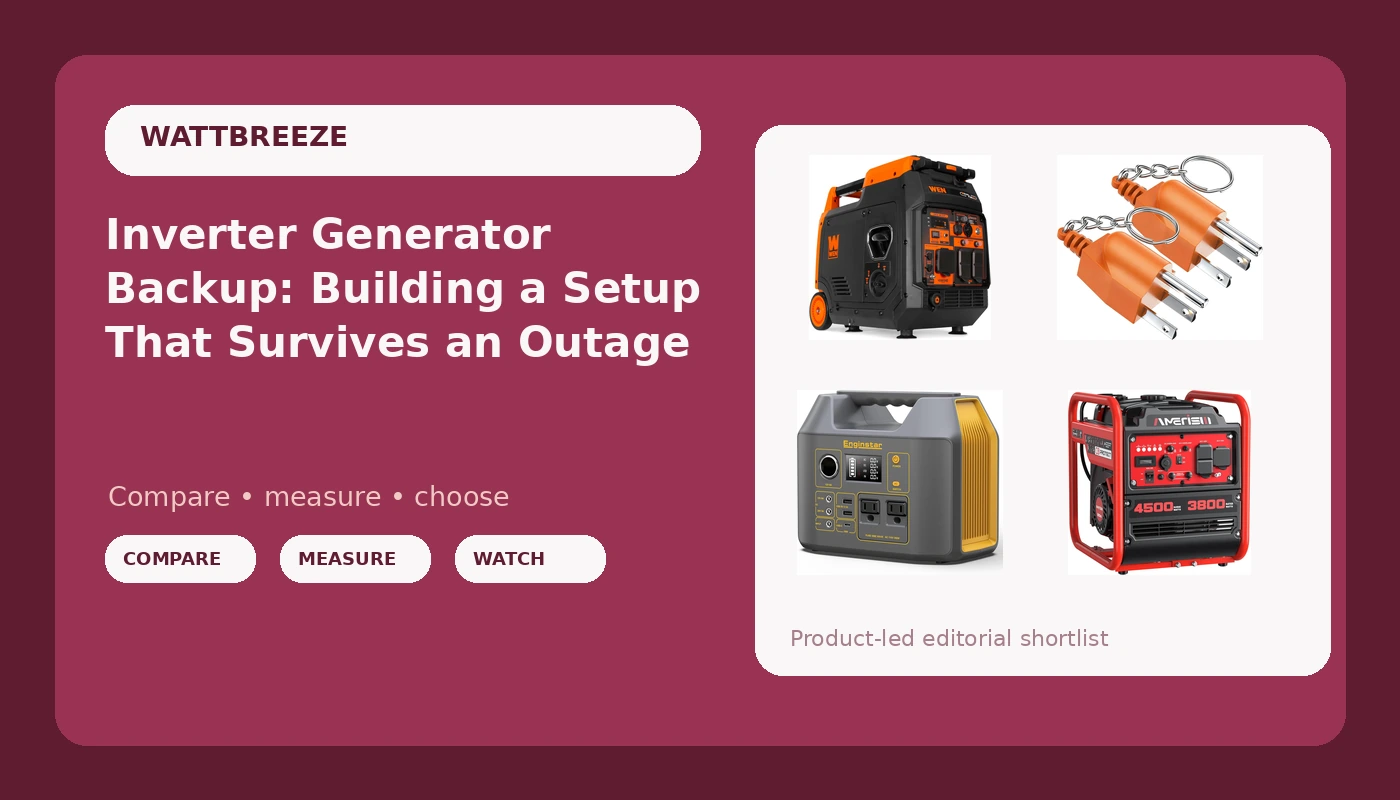
| WEN Quiet and Lightweight 4800-Watt Dual Fuel RV-Ready Electric Start Portable Inverter Generator with Fuel Shut Off and CO Watchdog (DF480iX) | Whole-home backup and RV use | Dual fuel operation, electric start, and a CO shutoff in a 4,800 watt inverter package |
| Generator Grounding Plug with Keychain, Portable Neutral Ground Bonding Adapter (NEMA 5-15P to 5-15R/TT-30R), 2Pack | RV and transfer setups | Bonds neutral to ground so surge protectors and RV power management devices see a normal outlet |
| EnginStar 296Wh Portable Solar Generator, Pure Sine Wave Power Station | Indoor and overnight small loads | 296Wh of pure sine wave power with no exhaust and no fuel |
| AMERISUN 4500W Open Frame Gas Inverter Generator, CO Alarm, Parallel Ready | Budget whole-home power and future expansion | Open frame inverter design with a CO alarm and parallel capability |
The dual fuel anchor: WEN Quiet and Lightweight 4800-Watt Dual Fuel RV-Ready Electric Start Portable Inverter Generator with Fuel Shut Off and CO Watchdog (DF480iX)
The trade off with any dual fuel inverter in this class is weight and price against the convenience. Propane delivers fewer running watts than gasoline on most dual fuel units, which is normal physics, not a defect. Plan your heaviest loads around the gasoline number and treat propane as your long term storage fuel. Electric start is the feature that actually earns its keep at 2 a.m. in freezing rain, because nobody wants to be yanking a cord in the dark with cold hands.
The bonding detail: Generator Grounding Plug with Keychain, Portable Neutral Ground Bonding Adapter (NEMA 5-15P to 5-15R/TT-30R), 2Pack
This is the item people discover they need at the worst possible moment, usually because an RV surge protector keeps refusing to pass power. The failure looks like a dead generator. It is almost never a dead generator. The trade off is that a bonding plug is only correct in specific setups, and using one where the neutral is already bonded elsewhere can create a second bond path. Know which situation you are in before you plug it in. The keychain and the two pack are genuinely useful because these adapters vanish into truck beds faster than any other small part in the kit.
The indoor power station: EnginStar 296Wh Portable Solar Generator, Pure Sine Wave Power Station
The honest limitation here is capacity. 296Wh is a night of small loads, not a fridge. Do the math before you expect more: a 296Wh battery running a 50 watt load is roughly five hours at ideal efficiency, and real world numbers come in below that. The trade off is that a power station cannot be refueled in ten minutes the way a generator can, so it belongs alongside a generator, not instead of one.
The open frame value: AMERISUN 4500W Open Frame Gas Inverter Generator, CO Alarm, Parallel Ready
Open frame means exactly what it sounds like. There is no sound attenuating shell around the engine, so this class of unit is louder than an enclosed inverter at the same load. The trade off is price per watt and easier access for maintenance, which matters if you plan to do your own oil changes and carb work. Parallel ready is the underrated part, because it lets you start with one unit and scale up rather than guessing at your final load today.
Prices and availability may change. Product images, names, and retailer links are matched to verified listings. No current price, rating, stock status, or measured result is stated here without current evidence.
Running watts, surge watts, and the fridge problem
Every motor in your house has two numbers. Running watts are what it draws once it is spinning. Surge watts are the startup spike, usually two to three times running watts, and they last a fraction of a second. A generator has to survive that spike or the motor simply will not start.
This is why the fridge is the load that exposes weak generators. The compressor kicks on, demands its surge, and a marginal unit either stalls, trips its breaker, or drops voltage far enough that the compressor overheats. Add a sump pump or a window air conditioner and you are stacking surges that can overlap.
The practical approach is to add up running watts for everything you want on at once, find the single largest surge in the group, and size around running watts plus that one surge. Then start loads in sequence rather than all at once. Eco mode is worth understanding here too, because it drops engine speed to match load and saves fuel and noise, but on some units it cannot react fast enough to catch a compressor surge. If a fridge refuses to start on eco mode, that is usually why, not a broken generator.
What a bonding plug does, and why the small parts matter
Portable inverter generators typically ship with a floating neutral, meaning neutral is not tied to the frame ground. That is normal and safe for a standalone tool or a lamp. It becomes a problem when you connect the generator to an RV, a trailer, or a transfer setup that includes surge protection or an electrical management system, because those devices test for a neutral to ground bond and refuse to pass power when they do not find one.
A bonding plug creates that bond at the outlet. Install it and the surge protector behaves. Skip it and you get a confusing no power situation that sends people shopping for a generator they do not need.
There is a real caveat. Bonding should exist in exactly one place in a system. If your transfer equipment already bonds neutral and ground, adding a second bond path at the generator outlet is wrong. Understand your specific setup before you install anything.
Here is the order I would work through it for any household:
- Write down every load you actually want during an outage, with running watts for each.
- Find the largest surge in that list and add it once to your running total.
- Decide whether the big loads run on gasoline or propane, since dual fuel output differs between the two.
- Check whether your connection point needs a neutral ground bond, and plan the adapter accordingly.
- Add a battery power station for indoor loads so the generator only runs when it has to.
Practical guidance before the storm
- Store ethanol free fuel if you can get it, and treat anything that will sit for more than a month with stabilizer. Varnish in a carburetor costs more than the fuel you saved.
- Run the generator under a real load for twenty minutes every month or two. Exercising it with no load does not prove much.
- Check oil before every run. Many units ship without oil, and the sticker that says see manual is not a suggestion.
- Keep the bonding adapter, the funnel, the oil, and the extension cords in one tote so nothing goes missing at 2 a.m.
- Never run a generator in a garage, a breezeway, or against the house, even with a CO shutoff. Carbon monoxide kills people who thought they were being careful.
Which option should you choose?
Choose the WEN Quiet and Lightweight 4800-Watt Dual Fuel RV-Ready Electric Start Portable Inverter Generator with Fuel Shut Off and CO Watchdog (DF480iX) when you want one unit that covers a fridge, an RV hookup, and a multi day outage, and you would rather push a button than pull a cord. Choose the Generator Grounding Plug with Keychain, Portable Neutral Ground Bonding Adapter (NEMA 5-15P to 5-15R/TT-30R), 2Pack when anything in your setup runs through an RV surge protector or an electrical management system and keeps refusing to pass power. Choose the EnginStar 296Wh Portable Solar Generator, Pure Sine Wave Power Station when your real problem is phones, laptops, and a CPAP overnight, not refrigeration. Choose the AMERISUN 4500W Open Frame Gas Inverter Generator, CO Alarm, Parallel Ready when budget per watt leads and you want the option to add a second matching unit later instead of buying bigger up front.
One caveat on all four. The wattage figures in a product name do not tell you whether they are running watts or peak watts, and the split matters more than the headline number. Verify the running watt rating against your load list before you buy, and do not assume two units with similar numbers perform the same way.
The bottom line
A workable outage setup is not one purchase. It is a dual fuel inverter for the heavy loads, a battery power station for the quiet indoor hours, and a bonding adapter for the connection details that decide whether any of it works when you plug in. The generator gets all the attention, but the small parts and the load math are what keep the fridge cold and the neighbors speaking to you. Size the load first, read the running watt figure, and keep the fuel fresh. That is the whole game.