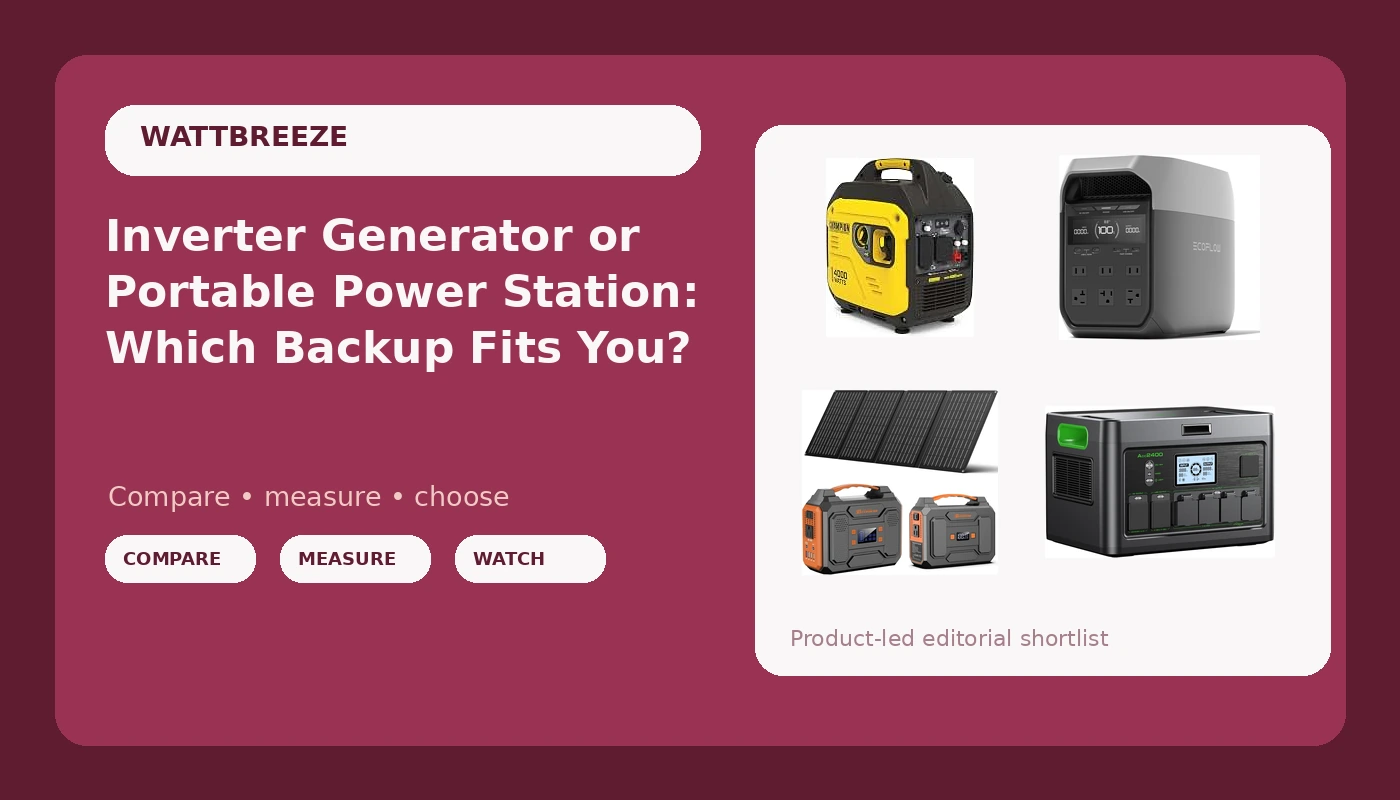
Most people shopping for backup power start with a watt number and end up with the wrong box in the garage. The portable power station vs inverter generator question is not really about which one is better. It is about where the power comes from, how long you need it, and whether the thing can sit ten feet from where you sleep. A battery unit and a fuel-burning inverter can carry the same refrigerator, but they get there in completely different ways, and the one that fits your outage is usually decided by hours and by placement, not by peak watts in big print.
Related: How to Size a Generator for a Fridge and Sump Pump →
Quick answer
There is no single winner. A fuel-burning inverter generator in the 4,000-watt class is the choice when you need to run loads for days and can store fuel safely outdoors. A battery-based portable power station is the choice when the load is modest, the run time is measured in hours rather than days, and the unit has to run indoors or in a tent with no exhaust. Match running watts and surge watts to your actual appliances first, then pick the power source that can feed them for the number of hours you realistically need.
Four useful options
| Model | Best fit | What stands out |
|---|---|---|
| Champion 4000-Watt RV Ready Portable Inverter Generator | Multi-day outages and RV trips with fuel on hand | Fuel-burning inverter in the 4,000-watt class with RV-ready connections |
| EF ECOFLOW Delta 3 Portable Power Station, 1024Wh 1800W | Indoor backup and shorter outages without fumes | 1024Wh of stored energy with 1800W output in a portable body |
| Portable Power Station 2400W, 1843.2Wh Solar Generator Home Use Outages | Longer battery runtime during home outages | 2400W output paired with 1843.2Wh of capacity |
| Portable Solar Generator with Panel, 300W Portable Power Station with Foldable Solar Panel 40W, 110V AC Outlet 100W Camping Solar Power Bank Lithium Battery Pack for Home Use RV Outdoor Power Outage | Camping, small electronics, and solar top-up | 300W-class station bundled with a 40W foldable solar panel |
The fuel-burning option: Champion 4000-Watt RV Ready Portable Inverter Generator
The trade-off here is simple: fuel. A 4,000-watt class inverter will carry a fridge, a few lights, a router, and a sump pump without much drama, and it will still be running on hour twelve because you refilled the tank. What it will not do is run in a garage or a living room, because it produces exhaust and carbon monoxide. It also asks more of you: oil checks, fuel that has not been sitting since last spring, and a start procedure you should know cold before the weather turns. If your outage math runs into days instead of hours, this is the category that gets you there.
The mid-size battery option: EF ECOFLOW Delta 3 Portable Power Station, 1024Wh 1800W
Battery capacity is a tank you cannot refill in five minutes. Divide watt-hours by the load you are actually pulling and you get a rough ceiling in hours, then subtract for inverter losses and for the fact that you rarely draw a perfectly steady load. A 1024Wh station running a few hundred watts of essentials is an evening and part of a night, not a week. Where this category wins is placement and simplicity: no fumes, no pull cord, no stabilizer, and nothing to winterize. Recharging happens from a wall outlet, a car, or solar panels, which means an outage longer than your battery is an outage you spend recharging rather than running.
The high-capacity battery option: Portable Power Station 2400W, 1843.2Wh Solar Generator Home Use Outages
The step up in capacity is also a step up in weight and in recharge time. More watt-hours means longer before the battery is empty, and it also means longer before it is full again unless you have serious solar or a wall circuit to plug into. Read the output rating and the capacity rating as two separate promises: the 2400W figure tells you what the unit can push at once, and the 1843.2Wh figure tells you how long it can keep pushing. Neither number alone tells you whether it will start your furnace blower or your well pump, so check surge requirements before you commit.
The small solar bundle: Portable Solar Generator with Panel, 300W Portable Power Station with Foldable Solar Panel 40W, 110V AC Outlet 100W Camping Solar Power Bank Lithium Battery Pack for Home Use RV Outdoor Power Outage
Be honest about what a 40W panel can do. It is a maintenance trickle, not a fast refill; a panel that size puts back a small number of watt-hours per sunny hour, and clouds, shade, and panel angle cut that further. This kit makes sense when the goal is keeping phones, headlamps, a fan, and a small screen alive on a camping trip, or running a few essentials for a few hours at home. It is not a substitute for a whole-house backup plan, and it should not be judged against a fuel-burning unit on run time.
Prices and availability may change. Product images, names, and retailer links are matched to verified listings. No current price, rating, stock status, or measured result is stated here without current evidence.
Where fuel-burning inverters and battery stations actually differ
Both categories feed standard AC outlets, and both can be called a generator. The difference is the energy source, and that single fact drives everything else.
A fuel-burning inverter generator makes electricity as long as fuel and oil hold out. Output is limited by engine size, not by stored energy, which is why a 4,000-watt class unit can carry a load for days. The costs are noise, exhaust, maintenance, and the logistics of storing fuel safely. Inverter models produce a cleaner sine wave than conventional generators, which is the reason laptops and modern electronics do not object to them. Any generator that burns fuel also needs to run outdoors, well away from windows, doors, and vents, and a carbon monoxide shutoff is a feature worth insisting on.
A battery-based power station stores a fixed amount of energy in watt-hours and converts it to AC. It is silent, produces no exhaust, and can sit on a kitchen counter. Its limit is arithmetic: watt-hours divided by load watts gives a rough ceiling, and inverter losses take a bite out of that. Recharging takes wall time, sun time, or both, so a long outage becomes a cycle of use and recharge rather than a steady supply.
Sizing your load before you buy anything
- List what actually has to run: fridge, freezer, sump pump, furnace blower, router, phone chargers, a few lights. Leave the space heater off the list unless you have decided it is the priority.
- Find the running watts for each item on the label or in the manual. Add them up. That total is the load your unit has to carry hour after hour.
- Note the surge watts for anything with a motor or compressor. Startup spikes commonly run two to three times the running figure, and that spike decides whether the unit trips the moment the fridge kicks on.
- Decide how many hours you need, then convert: watt-hours for a battery station, gallons of fuel for a generator. At half load, real run time is well short of the number measured at a quarter load.
- Check the placement rules before you buy. Fuel-burning units go outside. Battery stations can go anywhere, which is often the deciding factor in an apartment, a tent, or a bedroom.
Practical guidance for outages, camping, and RV use
- Run the unit under a real load before storm season, not during it. A test with the fridge plugged in tells you more than any spec sheet.
- Store fuel with stabilizer or use ethanol-free fuel, and drain the carburetor before long storage. Old fuel is the most common reason a generator will not start when you need it.
- Keep a carbon monoxide alarm in the house even when the generator is outside, and never run a fuel-burning unit in a garage, even with the door open.
- Match extension cord gauge to distance and load. A long, thin cord turns usable watts into heat and voltage drop.
- Treat solar recharge as a supplement. A small foldable panel keeps a battery topped up; it does not refill a large bank quickly.
- Recharge battery stations fully the day before a storm watch, and keep them out of freezing storage if the manufacturer calls for it.
Which option should you choose?
Choose the Champion 4000-Watt RV Ready Portable Inverter Generator when you need multi-day run time, have safe outdoor space for fuel and exhaust, and want one unit that can also serve an RV hookup. Choose the EF ECOFLOW Delta 3 Portable Power Station, 1024Wh 1800W when the load is modest, the need is hours rather than days, and the unit has to run indoors or in a tent. Choose the Portable Power Station 2400W, 1843.2Wh Solar Generator Home Use Outages when you want more stored energy and higher output for a home outage without fuel. Choose the Portable Solar Generator with Panel, 300W Portable Power Station with Foldable Solar Panel 40W, 110V AC Outlet 100W Camping Solar Power Bank Lithium Battery Pack for Home Use RV Outdoor Power Outage when the job is camping, travel, and keeping small devices charged, with solar as a slow top-up.
A caveat worth repeating: the numbers on any box describe conditions, not your house. Running watts, surge watts, and run time all shift with temperature, altitude, load type, and how well the unit has been maintained. The only figures that matter are the ones you measure at your own wall with your own appliances.
The bottom line
Fuel buys hours; batteries buy silence and placement. A 4,000-watt class inverter generator is the answer when an outage stretches into days and you can run it outdoors. A battery station, whether the 1024Wh Delta 3 or the higher-capacity 1843.2Wh unit, is the answer when the load is smaller, the window is shorter, and the power has to sit inside the house. The small 300W solar bundle covers camping and small-device duty. Size your load, count your hours, and pick the source that matches both.