Spec watts are measured at sea level with a gentle breeze. Real watts are what a fridge surge demands, and the gap between those two numbers is where most portable inverter generator shopping goes wrong. The box shouts peak watts. The fine print whispers running watts. Your compressor says surge, and it says it for about two seconds every time it kicks on. Miss that spike and the fridge hums, clicks, and quits.
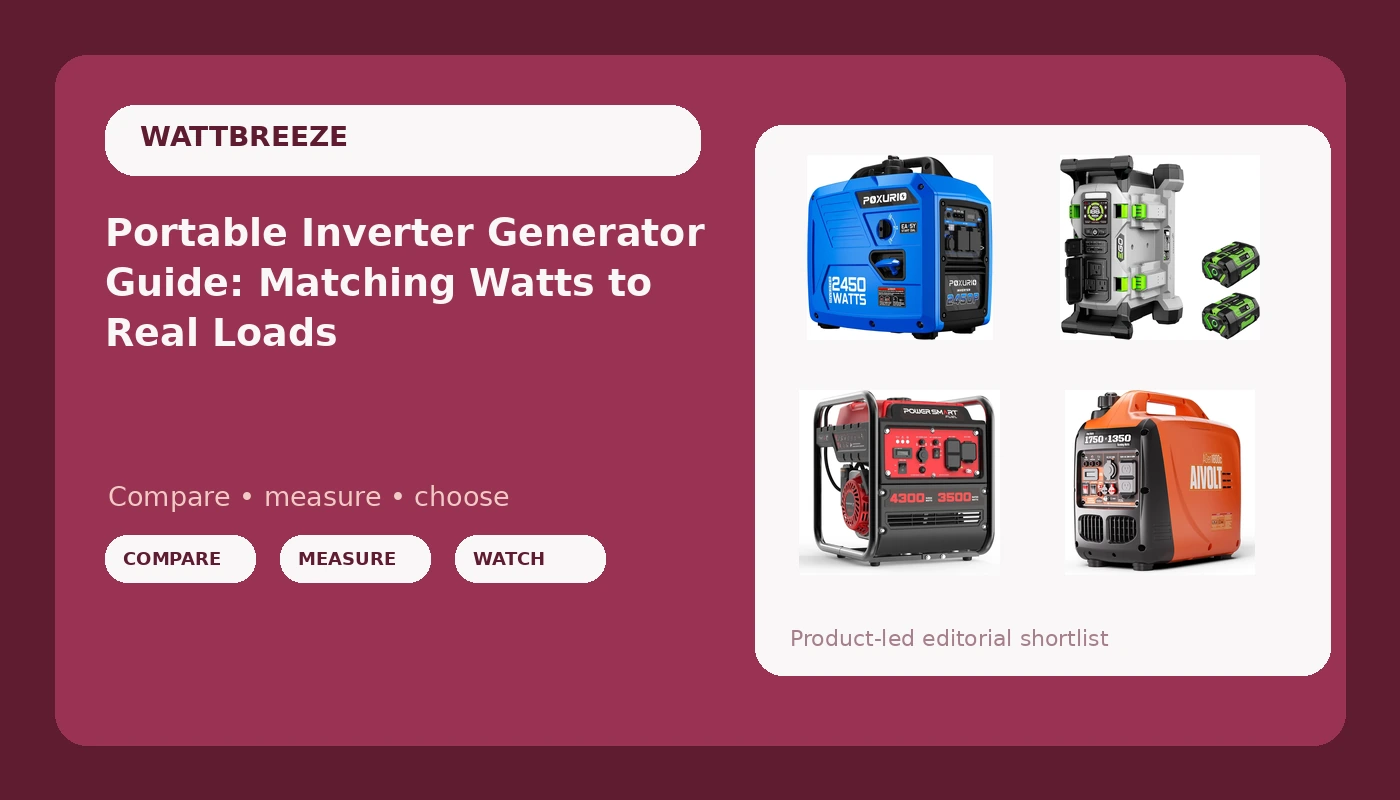
This is an explainer, not a scoreboard. Four current listings do four different jobs: a 2,450 watt gas inverter with a 1.6 gallon tank, a 4,300 watt inverter aimed at household loads, a 1,750 watt gas inverter built for camping and light backup, and a 1,400 watt battery power station that ships with two 56V 6.0Ah batteries and a charger. None of them is a standby generator, and none of them fits everybody. The work is figuring out which one fits you before the storm, not during it.
Related: Inverter Generator Run Time: What the Box Number Really Means →
Quick answer
Match running watts first, surge watts second, fuel type third. For a fridge, a few lights, a router, and phone chargers, a 2,000 to 2,500 watt class gas inverter covers the job. Add a sump pump, a furnace blower, or a window air conditioner and you are shopping in the 4,000 watt and up class. If you want no exhaust, no fuel can, and no pull cord, a battery power station is the honest answer, as long as you accept that stored energy runs out and recharges slowly. Peak watts are marketing. Running watts are what you live with.
4 useful options
Here is the field, sorted by what each unit is built to carry.
| Model | Best fit | What stands out |
|---|---|---|
| 2450-Watt Portable Inverter Generator for Home Use, Super Quiet Small 120V Gas Generator for Camping, 1.6 Gallon Gas Tank for 8.3 Hours Use, EPA Compliant | Fridge and essentials on a budget | 2,450 watt class output, 1.6 gallon tank, stated 8.3 hour run time |
| PowerSmart 4300 Watt Inverter Portable Generator for Home Use | Larger household loads | 4,300 watt class output on an inverter platform |
| AIVOLT 1750W Inverter Generator Portable Gas Generator for Camping Home | Camping and light backup | 1,750 watt class gas inverter in a compact package |
| EGO POWER+ Portable Power Station, 1400W, Battery Powered, Inverter Generator for Home and Outdoor, Includes (2) 56V 6.0Ah Batteries and Charger - PST1405-2 | Fuel-free, exhaust-free power | Battery powered, includes two 56V 6.0Ah batteries and a charger |
The budget home-backup pick: 2450-Watt Portable Inverter Generator for Home Use, Super Quiet Small 120V Gas Generator for Camping, 1.6 Gallon Gas Tank for 8.3 Hours Use, EPA Compliant
Here is the math that matters. A household fridge draws a few hundred running watts but can demand two to three times that for a second or two on startup, and a 2,450 watt class inverter has room for that spike as long as nothing else big is running. Add a sump pump cycling at the same moment and you are at the edge of the envelope. The watt meter does not care what the box says, so measure your own loads and leave margin. This is the budget home-backup answer for a genuinely small outage list.
The high-output pick: PowerSmart 4300 Watt Inverter Portable Generator for Home Use
Watts scale with fuel burn and noise. A 4,300 watt class inverter is not a campsite companion; it is a machine that drinks fuel under real load and makes itself heard across a yard. In exchange, it is the one here that can start a furnace blower or a window air conditioner without you holding your breath. If your outage plan is about keeping the house livable rather than keeping phones charged, this is the class you are shopping in.
The camping pick: AIVOLT 1750W Inverter Generator Portable Gas Generator for Camping Home
The 1,750 watt class is where a lot of people start and where a lot of people get surprised. It runs small loads well and quietly enough for a campsite. It will not start a well pump, it will not carry a space heater and a fridge together, and it will not carry a family of four through a nine-day outage unless you are disciplined about what gets plugged in. Buy it for camping, tailgating, and device backup and you will be happy. Buy it as your whole hurricane plan and you will be running extension cords and apologies.
The fuel-free pick: EGO POWER+ Portable Power Station, 1400W, Battery Powered, Inverter Generator for Home and Outdoor, Includes (2) 56V 6.0Ah Batteries and Charger - PST1405-2
Stored energy is finite and honest about it. Two 56V 6.0Ah batteries hold a fixed amount of work, and when it is spent the station needs a wall outlet and time. A gas tank refills in two minutes from a can. That is the trade: the battery unit is cleaner, simpler, and quieter, while the gas units are refuelable. For short outages, tailgates, and campsites where a running engine is unwelcome, the battery station is the better citizen. For a nine-day grid failure it is a supplement, not a plan, unless you can recharge it during the day.
Prices and availability may change. Product images, names, and retailer links are matched to verified listings. No current price, rating, stock status, or measured result is stated here without current evidence.
Running watts, surge watts, and the number nobody prints
Every motor in a house has two numbers. Running watts are what it draws hour after hour. Surge watts are the startup spike, usually two to three times the running figure. A refrigerator compressor might run at a few hundred watts and demand two to three times that for a second or two when it kicks on. A sump pump, a furnace blower, a well pump, and a window air conditioner all do the same thing, and the bigger the motor, the bigger the spike.
The reason this matters is sequencing. A 2,450 watt class inverter absorbs one fridge startup comfortably. It does not absorb a fridge startup, a sump pump startup, and a microwave at the same moment. So add up the running watts of everything you want on at once, add the single largest surge on top, and compare that total to the generator's surge rating. If the math is close, it is not close enough.
Inverter output matters for a second reason: total harmonic distortion, or THD. Inverter generators condition their power, which keeps laptops, televisions, and appliance control boards happy. Conventional generators cost less per watt but deliver rougher power, which is fine for a circular saw and less fine for a modern furnace board.
Fuel, batteries, and where the hours actually go
Run time is the most optimistic number on any generator box. Stated figures are measured at roughly a quarter load, which almost nobody runs. At half load, take the number and cut it by about a third. At full load, cut it in half. A 1.6 gallon tank with a stated 8.3 hours is a real tank and a real figure, at a load you probably will not be pulling.
Plan fuel around the real number. Estimate your half-load hours, multiply by the days you expect to be dark, and buy that much fuel plus stabilizer. Rotate it, store it safely, and use ethanol-free fuel when you can get it. Ethanol left in a carburetor over the off season is a time bomb, and a carburetor rebuild costs more than a year of stabilizer.
Battery stations invert the problem. There is no tank to refill, so the hours come out of a fixed pool of stored energy, and recharge time is measured in hours, not minutes.
Eco mode is worth understanding on either type. On a gas inverter it drops engine speed to match the load, saving fuel and noise, but on some units the throttle cannot react fast enough to catch a fridge surge.
Work through it in this order:
- Write down every load you want running at once, with its running watts: fridge, freezer, router, furnace blower, lights.
- Add the single largest surge on top of that total. That is your real requirement, not the sticker number.
- Decide fuel or battery. A tank refills in minutes and burns fuel; a battery recharges from a wall outlet and takes hours.
- Decide where it sits. Twenty feet from the house, exhaust pointed away, with a working carbon monoxide alarm inside.
- Plan the boring part: stabilized or ethanol-free fuel, oil changes, a monthly start under load, and a written log of what your unit actually does.
Practical guidance for the week before the storm
- Buy a plug-in watt meter and measure your fridge, freezer, and any pump. Guessing is how people end up with the wrong generator.
- Write the running watts of each load on a card and tape it inside the generator's lid. At 2 a.m. in the rain you will not want to do arithmetic.
- Store fuel with stabilizer, rotate it every few months, and never leave ethanol fuel sitting in a carburetor over the off season.
- Use a heavy enough extension cord. A long, thin cord turns clean inverter output into voltage drop and a warm cord.
- Run the unit once a month under a real load, not just idling. A generator that will not start in July will not start in a storm.
- Keep a carbon monoxide alarm on every floor, and never run a gas generator in a garage, breezeway, or screened porch.
Which option should you choose?
Choose the 2450-Watt Portable Inverter Generator when your outage list is genuinely small: a fridge, lights, a router, and chargers, with nothing else big running at once. Choose the PowerSmart 4300 Watt Inverter Portable Generator when you need to carry larger household loads like a furnace blower or a window air conditioner and you are willing to feed a bigger engine. Choose the AIVOLT 1750W Inverter Generator when the real job is camping and tailgating, with light home backup as a bonus. Choose the EGO POWER+ Portable Power Station when you want fuel-free, exhaust-free power for short outages and anywhere a running gas engine would be unwelcome, and you accept the recharge time.
One caveat covers all four: what is published here is listing-level specification, not measured performance. Watts, tank size, and run time come from the product listings, and run time in particular is a light-load figure. Your numbers will differ, which is exactly why the watt meter and the logbook matter more than any spec sheet.
The bottom line
The category stops being complicated once you strip the marketing off it: running watts, surge watts, fuel or battery, and a real plan for where the machine sits. A 2,450 watt inverter covers a small, disciplined outage list. A 4,300 watt inverter covers a bigger one. A 1,750 watt gas inverter is a camping tool that doubles as light backup. A 1,400 watt battery station is the clean option for short outages and places where a gas engine does not belong. Pick the one that matches your load list, not the one with the biggest number on the box, and do it before the weather report gives you a reason to hurry.